Advanced Geometry for GED® Math
A complete 12-week self-study GED® Advanced Geometry course with course-level syllabus and outcomes, 24 SVG-supported lessons, 240 lesson MCQs, detailed explanations, and a 40-question final GED®-style geometry exam.
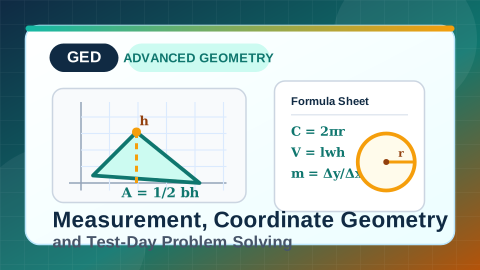
📚 Course Curriculum
Week 1, Session 1: GED® Geometry Orientation, Formula Sheet, Units, and Calculator Readiness. Self-study purpose. This session builds the foundation for self-study. On the GED®, …
🔒 Enroll to unlock this session.
Week 1, Session 2: Perimeter of Polygons and Real-World Boundary Problems. Self-study purpose. Perimeter is the total distance around a flat figure. GED® questions use …
🔒 Enroll to unlock this session.
Week 2, Session 1: Area of Rectangles, Triangles, and Parallelograms. Self-study purpose. Area tells how much flat surface is covered. GED® area problems often involve …
🔒 Enroll to unlock this session.
Week 2, Session 2: Polygons, Trapezoids, and Missing Dimensions. Self-study purpose. This session strengthens GED® polygon work. You will combine formulas, decompose shapes, and work …
🔒 Enroll to unlock this session.
Week 3, Session 1: Circles—Radius, Diameter, Circumference, and Area. Self-study purpose. Circle problems are common because they connect vocabulary, formulas, calculator use, and real-life measurements …
🔒 Enroll to unlock this session.
Week 3, Session 2: Composite 2-D Figures and Shaded Regions. Self-study purpose. A composite figure is made from simpler shapes. GED® questions often ask for …
🔒 Enroll to unlock this session.
Week 4, Session 1: Unit Conversions, Scale Drawings, Maps, and Blueprints. Self-study purpose. Scale problems appear in GED® contexts such as maps, floor plans, models, …
🔒 Enroll to unlock this session.
Week 4, Session 2: Similar Figures and Proportional Geometry. Self-study purpose. Similar figures have the same shape but not necessarily the same size. GED® problems …
Open trial session →Week 5, Session 1: Pythagorean Theorem Foundations. Self-study purpose. The Pythagorean theorem is a GED® essential for right triangles. It finds missing side lengths when …
🔒 Enroll to unlock this session.
Week 5, Session 2: Pythagorean Applications and Distance on a Grid. Self-study purpose. GED® right-triangle problems appear as ladders, ramps, diagonal screens, rectangular fields, coordinate …
🔒 Enroll to unlock this session.
Week 6, Session 1: Volume of Rectangular Prisms and Triangular Prisms. Self-study purpose. Volume measures the amount of space inside a 3-D object. GED® volume …
🔒 Enroll to unlock this session.
Week 6, Session 2: Volume of Cylinders, Cones, Pyramids, and Spheres. Self-study purpose. This session extends volume to round and pointed solids. GED® problems may …
🔒 Enroll to unlock this session.
Week 7, Session 1: Surface Area of Prisms and Cylinders. Self-study purpose. Surface area measures how much material covers the outside of a 3-D object. …
🔒 Enroll to unlock this session.
Week 7, Session 2: Surface Area of Pyramids, Cones, Spheres, and Nets. Self-study purpose. This session focuses on curved and slanted surfaces. GED® surface area …
🔒 Enroll to unlock this session.
Week 8, Session 1: Composite 3-D Solids and Real-World Design Problems. Self-study purpose. Composite 3-D problems combine solids. You may need to add volumes, subtract …
🔒 Enroll to unlock this session.
Week 8, Session 2: Coordinate Plane Foundations—Points, Quadrants, and Distances. Self-study purpose. Coordinate geometry connects graphs to measurement. GED® questions may ask you to read …
🔒 Enroll to unlock this session.
Week 9, Session 1: Slope from Graphs, Points, Tables, and Contexts. Self-study purpose. Slope measures steepness and rate of change. On GED® questions, slope can …
Open trial session →Week 9, Session 2: Parallel and Perpendicular Lines. Self-study purpose. Parallel and perpendicular lines connect slope to geometry. GED® questions may ask whether lines are …
🔒 Enroll to unlock this session.
Week 10, Session 1: Linear Equations and Graphing in Geometry Contexts. Self-study purpose. GED® coordinate geometry often uses linear equations. You should be able to …
🔒 Enroll to unlock this session.
Week 10, Session 2: Coordinate Geometry—Area, Perimeter, and Diagonal Distance on the Grid. Self-study purpose. This session combines geometry formulas with coordinates. On GED®-style tasks, …
Open trial session →Week 11, Session 1: Working Backward with Geometry Formulas. Self-study purpose. GED® problems often give the area, volume, circumference, or surface area and ask for …
🔒 Enroll to unlock this session.
Week 11, Session 2: Multi-Step GED® Geometry Word Problems and Formula Selection. Self-study purpose. Multi-step GED® problems test whether you can choose the right formula, …
🔒 Enroll to unlock this session.
Week 12, Session 1: Timed Mixed GED® Geometry Practice and Error Analysis. Self-study purpose. This session teaches test behavior: how to choose quickly, how to …
🔒 Enroll to unlock this session.
Week 12, Session 2: Final GED® Geometry Review and Test-Day Strategy. Self-study purpose. The final review pulls together every major GED® geometry skill: formulas, diagrams, …
🔒 Enroll to unlock this session.
Course Syllabus
GED® Advanced Geometry Syllabus
Course Overview
GED® Advanced Geometry is a self-study Mathematical Reasoning course designed for adult learners who want to master the geometry, measurement, and coordinate-plane skills that appear on GED®-style math questions. The course is practical rather than proof-based: every session teaches students how to recognize the shape or graph, choose the correct formula, substitute accurately, use units, and answer test questions efficiently.
Course Information
- Program: GED®
- Subject: Mathematical Reasoning / Geometry
- Course length: 12 weeks
- Schedule: 2 sessions per week
- Total sessions: 24
- Lesson practice: 10 multiple-choice questions per session
- Final exam: 40 mixed GED®-style geometry questions
- Recommended study time: 60–90 minutes per session, plus correction time
- Instructor voice: Professional GED® teacher, self-study guided format
GED® Test Alignment
This course supports the Mathematical Reasoning test topics of Basic Math, Geometry, Basic Algebra, and Graphs and Functions. It emphasizes geometry and measurement, including perimeter, area, circumference, composite figures, scale drawings, the Pythagorean theorem, 3-D volume, surface area, coordinate plane, slope, parallel lines, perpendicular lines, and linear graphs.
The official GED® Mathematical Reasoning test uses a formula sheet, calculator reference sheet, and multiple question types. This course uses MCQs for consistent self-study practice, but the explanations train the same reasoning needed for fill-in-the-blank, drag-and-drop, select-area, and drop-down items.
Course Description
Students begin with formula-sheet readiness and unit sense, then move through 2-D measurement, circles, composite figures, scale, similarity, right triangles, 3-D volume and surface area, coordinate geometry, slope, graphing, mixed word problems, and final test strategy. Each lesson contains direct teaching, a geometry SVG diagram, LaTeX/MathTex formulas, a worked example, common mistakes, a mastery check, and 10 lesson-specific MCQs with explanations.
Learning Objectives
By the end of the course, students will be able to:
- Use the GED® formula sheet strategically instead of guessing formulas.
- Compute perimeter, area, circumference, volume, and surface area.
- Solve for missing dimensions from geometry formulas.
- Analyze composite 2-D and 3-D figures by adding or subtracting simpler parts.
- Apply scale factors to maps, blueprints, drawings, and similar figures.
- Use the Pythagorean theorem for missing sides, diagonals, ramps, ladders, and coordinate distances.
- Plot points, read quadrants, calculate slope, and identify parallel and perpendicular lines.
- Interpret linear equations in coordinate-geometry and real-world contexts.
- Solve multi-step GED®-style geometry word problems under timed conditions.
- Review errors using a correction routine that improves future test performance.
Required Materials
- Notebook or digital notes
- Pencil and scratch paper
- Graph paper or printed coordinate grids
- Ruler or straightedge
- Scientific calculator, preferably TI-30XS MultiView or the GED® onscreen calculator
- GED® formula sheet
- This self-study course and its lesson questions
Self-Study Method
For each session:
- Read the lesson overview and formula bank.
- Study the SVG diagram and connect each label to the formula.
- Work through the example without skipping steps.
- Complete the 10 MCQs without notes.
- Review every explanation, including questions answered correctly by guessing.
- Redo missed questions in the format: given information → formula → substitution → answer with units.
- Move on only when you can score at least 8 out of 10.
Course Outline
| Week | Session | Topic | Main GED® Skill |
|---|---|---|---|
| 1 | 1 | Geometry orientation, formula sheet, units, calculator readiness | Formula and unit sense |
| 1 | 2 | Perimeter of polygons and boundary problems | Linear measurement |
| 2 | 3 | Area of rectangles, triangles, and parallelograms | Surface coverage |
| 2 | 4 | Polygons, trapezoids, and missing dimensions | Formula algebra |
| 3 | 5 | Circles: radius, diameter, circumference, area | Circle formulas |
| 3 | 6 | Composite 2-D figures and shaded regions | Add/subtract areas |
| 4 | 7 | Unit conversions, scale drawings, maps, blueprints | Proportional reasoning |
| 4 | 8 | Similar figures and proportional geometry | Scale factor and similarity |
| 5 | 9 | Pythagorean theorem foundations | Right-triangle structure |
| 5 | 10 | Pythagorean applications and grid distance | Diagonal and distance problems |
| 6 | 11 | Volume of rectangular and triangular prisms | 3-D capacity |
| 6 | 12 | Volume of cylinders, cones, pyramids, spheres | Round and pointed solids |
| 7 | 13 | Surface area of prisms and cylinders | Outside covering |
| 7 | 14 | Surface area of pyramids, cones, spheres, nets | Slant height and curved surfaces |
| 8 | 15 | Composite 3-D solids and design problems | Add/subtract solids |
| 8 | 16 | Coordinate plane foundations | Points, quadrants, grid distances |
| 9 | 17 | Slope from graphs, points, tables, contexts | Rate of change |
| 9 | 18 | Parallel and perpendicular lines | Slope relationships |
| 10 | 19 | Linear equations and graphing | \(y=mx+b\) interpretation |
| 10 | 20 | Coordinate geometry area, perimeter, and distance | Geometry on the grid |
| 11 | 21 | Working backward with geometry formulas | Missing dimensions |
| 11 | 22 | Multi-step GED® word problems | Formula selection and units |
| 12 | 23 | Timed mixed practice and error analysis | Test behavior |
| 12 | 24 | Final review and test-day strategy | Mixed readiness |
Assessments
- Session MCQs: 240 total lesson questions, 10 per session
- Final Course Exam: 40 mixed GED®-style questions
- Recommended mastery target: At least 80% on each session before moving forward
- Final readiness target: At least 32 out of 40 on the final exam
Suggested Scoring Guide
| Score | Readiness Level | Recommendation |
|---|---|---|
| 36–40 | Excellent GED® Geometry Readiness | Schedule or proceed to full GED® Math review |
| 32–35 | Strong Readiness | Review only missed categories |
| 28–31 | Developing Readiness | Repeat weak sessions before testing |
| 24–27 | Needs Targeted Review | Re-study formulas, units, and multi-step problems |
| Below 24 | Needs Intensive Support | Restart the course with guided tutoring or extra practice |
Course Policies for Self-Study
- Do not skip explanations. The explanation is where test-day reasoning is built.
- Do not rely on memorization alone. Learn what each formula measures.
- Keep a mistake log with columns for topic, error type, corrected setup, and new habit.
- Use a calculator, but write the formula first.
- Review mixed questions weekly so skills stay active.
Completion Standard
A student completes the course when all 24 sessions are finished, all missed questions are corrected, and the final exam score is at least 80%. Students below 80% should repeat the sessions linked to their missed questions before taking the official GED® Mathematical Reasoning test.
Course Outcomes
GED® Advanced Geometry Course Outcomes
By the end of this course, students will be able to:
Geometry and Measurement Fluency
- Select and apply perimeter, area, circumference, volume, and surface-area formulas from GED®-style prompts.
- Convert units, interpret scale drawings, and keep measurements consistent in multi-step problems.
- Break composite 2-D and 3-D figures into simpler shapes, then combine the results accurately.
Coordinate Geometry and Graphing
- Plot and interpret points, quadrants, distances, slopes, and linear equations on the coordinate plane.
- Use slope, parallel and perpendicular relationships, and \(y=mx+b\) to answer graph-based questions.
- Connect grid-based diagrams to area, perimeter, distance, and rate-of-change reasoning.
Formula Reasoning and Problem Solving
- Rearrange geometry formulas to solve for missing dimensions before substituting numbers.
- Translate GED® word problems into a clear plan: requested measurement, known values, formula, units, and final answer.
- Use calculator support responsibly while showing the formula and setup first.
GED® Test Readiness Habits
- Read diagrams, labels, units, and answer choices carefully before calculating.
- Estimate whether an answer is reasonable and recognize common geometry distractor traps.
- Maintain a mistake log and use missed questions to target review before the final exam.
Completion Benchmark
Students are ready to move on when they can score at least 80% on session practice and at least 32 out of 40 on the final mixed geometry exam.
📝 Practice Questions
280 interactive questions with instant feedback and explanations.
Enroll for free to unlock the full practice bank after the trial sessions.