GED® Math: Algebra In Depth
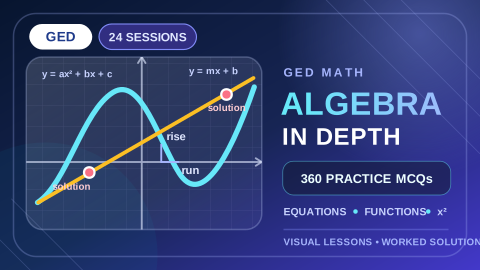
A complete 24-session, step-by-step algebra course for the GED®. Learners build from variables and expressions through equations, inequalities, proportional reasoning, graphing, systems, formulas, exponents, radicals, polynomials, factoring, quadratics, functions, and real-world modeling. Every idea is explained in plain language with responsive SVG diagrams, explicit visual explanations, at least three fully worked examples per session, interactive self-checks, 15 explained MCQs per session, cumulative review, and answer-checking strategies.
📚 Course Curriculum
Algebra is just arithmetic with a placeholder. A variable (usually a letter like \(x\)) is a box that holds a number we don't know yet. …
🔒 Enroll to unlock this session.
Before solving anything, you often need to tidy an expression. Two tools do almost all the work. Combining like terms. 'Like terms' have the exact …
🔒 Enroll to unlock this session.
Solving an equation means finding the value of the variable that makes it true. The golden rule: keep the equation balanced — whatever you do …
🔒 Enroll to unlock this session.
An inequality compares two sides that are *not* necessarily equal, using \(<\) (less than), \(>\) (greater than), \(\le\) (at most), or \(\ge\) (at least). Instead …
Open trial session →The coordinate plane is two number lines crossing at the origin \((0,0)\): a horizontal x-axis and a vertical y-axis. Every point has an address \((x, …
🔒 Enroll to unlock this session.
A system is two equations with the same two unknowns. The solution is the single \((x, y)\) pair that satisfies both — graphically, the point …
🔒 Enroll to unlock this session.
An exponent is repeated multiplication: \(2^4 = 2 \times 2 \times 2 \times 2 = 16\). The laws of exponents let you simplify quickly:. Example: …
Open trial session →Factoring is multiplication in reverse: rewriting a polynomial as a product. It's the key to solving quadratic equations of the form \(ax^2 + bx + …
🔒 Enroll to unlock this session.
A function is a rule that takes an input and gives exactly one output — like a machine: put a number in, get a number …
🔒 Enroll to unlock this session.
A ratio compares quantities by division. A rate compares quantities with different units, and a unit rate has a denominator of 1. If a car …
🔒 Enroll to unlock this session.
A literal equation contains more than one variable. Rearranging a formula means isolating the variable named in the question while treating every other letter like …
🔒 Enroll to unlock this session.
Absolute value measures distance from zero, so it is never negative. Both \(5\) and \(-5\) are 5 units from zero:. If \( x =7\), there …
🔒 Enroll to unlock this session.
A compound inequality combines two conditions. The word and means both conditions must be true, so the solution is their overlap. The word or means …
🔒 Enroll to unlock this session.
A relationship is linear when equal changes in the input produce equal changes in the output. In a table with evenly spaced \(x\)-values, a constant …
🔒 Enroll to unlock this session.
GED® questions may describe a line with a graph, table, two points, a slope and one point, or a real-world story. Your goal is to …
🔒 Enroll to unlock this session.
Slope determines how lines relate. Distinct parallel lines never meet and have the same slope. Perpendicular lines meet at a right angle and have slopes …
🔒 Enroll to unlock this session.
Systems are especially useful when two plans, prices, or conditions must be true at the same time. Begin by defining variables and writing one equation …
🔒 Enroll to unlock this session.
A square root reverses squaring. The principal square root is nonnegative:. But the equation \(x^2=49\) has two solutions, \(x=7\) and \(x=-7\). Simplify radicals by finding …
🔒 Enroll to unlock this session.
A polynomial is written in standard form with powers descending. In \(4x^3-2x^2+7x-5\), the degree is 3 and the leading coefficient is 4. Add polynomials by …
Open trial session →Factoring reverses polynomial multiplication. Use a consistent decision process: first remove a greatest common factor, then count terms and look for a recognizable pattern. Greatest …
🔒 Enroll to unlock this session.
A quadratic function has the form \(y=ax^2+bx+c\), and its graph is a parabola. If \(a>0\), it opens upward and has a minimum. If \(a<0\), it …
🔒 Enroll to unlock this session.
Choose a quadratic-solving method based on the equation's structure. First write it in standard form \(ax^2+bx+c=0\). Square-root property. If \((x-3)^2=16\), then \(x-3=\pm4\), so \(x=7\) or …
🔒 Enroll to unlock this session.
The domain is the set of allowed inputs; the range is the set of possible outputs. Context may restrict both even when an algebraic rule …
🔒 Enroll to unlock this session.
Strong GED® algebra performance comes from a repeatable process rather than memorizing isolated tricks. 1. Understand. Identify the unknown, label units, and translate phrases carefully. …
🔒 Enroll to unlock this session.
Course Syllabus
Course structure
This 24-session course is organized into six cumulative units. Each session combines plain-language instruction, a responsive SVG explanation, at least three fully worked GED®-style examples, a repeatable problem-solving method, error analysis, an interactive independent check, and 15 explained MCQs balanced across easy, medium, and hard difficulty.
Unit 1: Algebra foundations (Sessions 1-4)
- Session 1: variables, expressions, equations, and translating verbal phrases
- Session 2: like terms, the distributive property, and simplifying expressions
- Session 3: one-step, multi-step, and variables-on-both-sides equations
- Session 4: inequalities and number-line graphs
Unit 2: Linear relationships (Sessions 5-8)
- Session 5: the coordinate plane, slope, intercepts, and graphing lines
- Session 6: systems solved by substitution and elimination
- Session 7: exponent rules and an introduction to polynomial operations
- Session 8: factoring and the zero-product property
Unit 3: Functions and applied algebra (Sessions 9-12)
- Session 9: function notation, inputs, outputs, and evaluation
- Session 10: ratios, unit rates, proportions, percent, and scale models
- Session 11: rearranging formulas and literal equations
- Session 12: absolute value equations and distance from zero
Unit 4: Deeper linear reasoning (Sessions 13-16)
- Session 13: compound inequalities, intersections, unions, and interval reasoning
- Session 14: recognizing linear relationships in tables and data
- Session 15: writing equations from points, slopes, tables, graphs, and contexts
- Session 16: parallel and perpendicular lines
Unit 5: Algebraic models and advanced operations (Sessions 17-20)
- Session 17: systems as real-world models, including break-even and mixture problems
- Session 18: radicals, rational exponents, and scientific notation
- Session 19: adding, subtracting, and multiplying polynomials
- Session 20: GCF, trinomial, difference-of-squares, and grouping strategies
Unit 6: Quadratics, functions, and GED® synthesis (Sessions 21-24)
- Session 21: quadratic graphs, vertex, axis of symmetry, intercepts, and transformations
- Session 22: solving quadratics by square roots, completing the square, and the quadratic formula
- Session 23: domain, range, sequences, and choosing linear versus nonlinear models
- Session 24: cumulative GED® algebra modeling, multi-step review, and answer verification
Course Outcomes
By the end of this course, learners will be able to:
- translate verbal statements and real-world conditions into algebraic expressions, equations, inequalities, and functions;
- evaluate expressions and functions accurately using substitution and the order of operations;
- simplify expressions using like terms, distribution, exponent rules, radicals, and polynomial operations;
- solve and check linear, literal, absolute value, compound inequality, system, and quadratic problems;
- interpret slope, intercepts, rate of change, and initial value in graphs, tables, equations, and contexts;
- write equations of lines from points, slopes, tables, graphs, and verbal descriptions;
- distinguish proportional from nonproportional relationships and solve ratio, percent, scale, and unit-rate problems;
- model real situations with formulas, systems, sequences, linear functions, and quadratic functions;
- factor polynomials using a greatest common factor, trinomial patterns, grouping, and the difference of squares;
- interpret the key features of quadratic graphs, including the vertex, axis of symmetry, roots, and maximum or minimum;
- select an efficient solution method, use a calculator strategically, estimate reasonableness, and verify answers by substitution or graphical evidence; and
- explain solutions with correct notation, units, domain restrictions, and conclusions appropriate to GED® Mathematical Reasoning questions.
📝 Practice Questions
376 interactive questions with instant feedback and explanations.
Enroll for free to unlock the full practice bank after the trial sessions.