GED® Geometry: Coordinate Geometry & Distance
A comprehensive course on coordinate geometry for the GED®. Students learn the coordinate plane, how to plot points, calculate slope, apply the distance formula, find midpoints, determine if lines are parallel or perpendicular, and solve geometric problems on grids. Includes many worked examples, real-world applications like navigation and construction, and step-by-step practice questions.
📚 Course Curriculum
The coordinate plane is formed by two perpendicular number lines: the horizontal x-axis and the vertical y-axis. They intersect at the origin \((0, 0)\). Every …
🔒 Enroll to unlock this session.
Before using the distance formula, check whether the segment is horizontal or vertical. These cases need only one subtraction. Same y-coordinate: the segment is horizontal, …
🔒 Enroll to unlock this session.
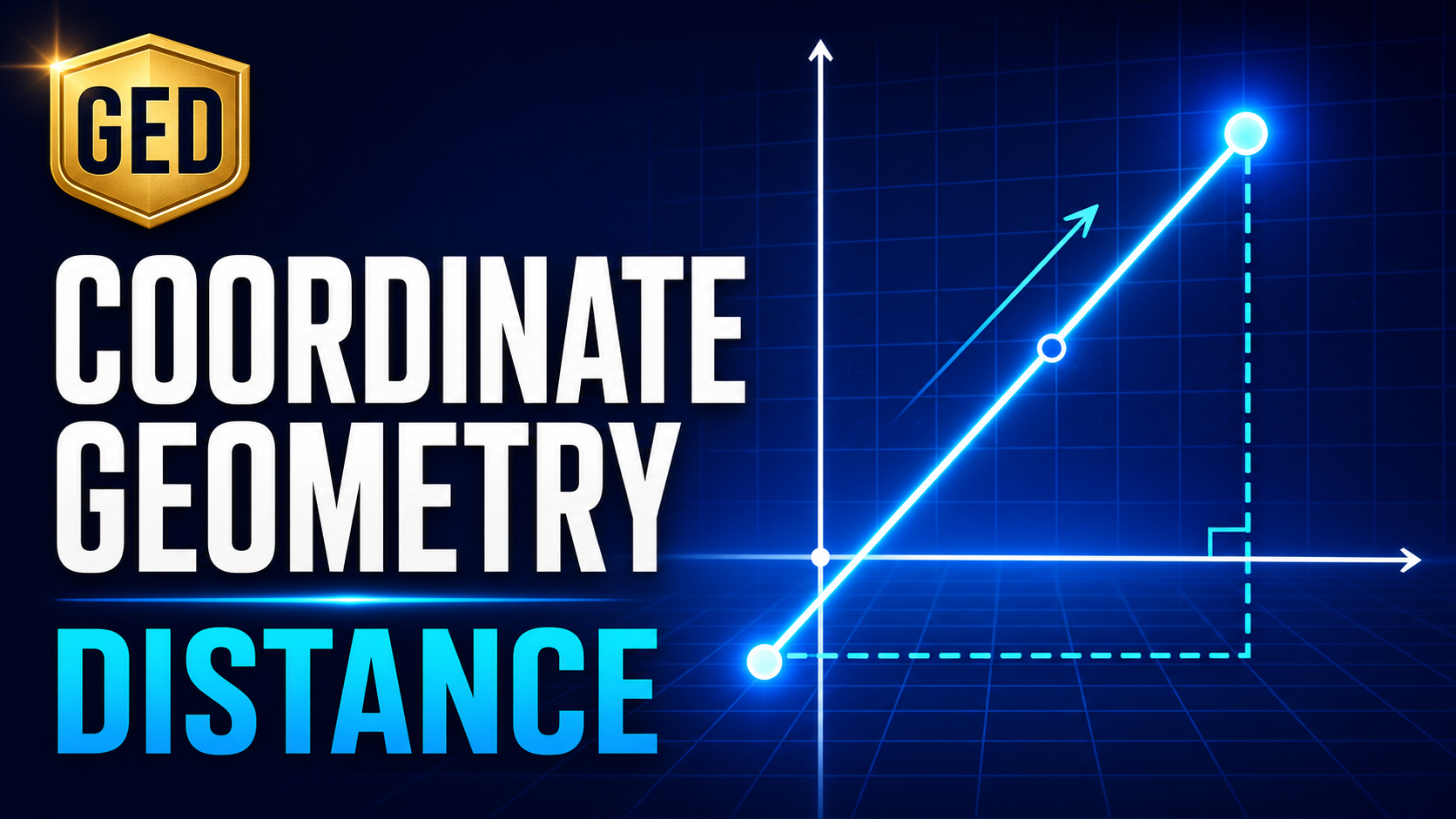
The distance between two points measures the straight-line length connecting them. Use the distance formula:. This formula comes from the Pythagorean theorem: the two points …
Open trial session →Slope measures the steepness and direction of a line. It is the ratio of rise (vertical change) to run (horizontal change):. Interpreting slope:. Positive slope: …
🔒 Enroll to unlock this session.
The slope-intercept form of a line is:. where:. \(m\) is the slope. \(b\) is the y-intercept (the y-value when \(x = 0\)). Graphing from slope-intercept …
🔒 Enroll to unlock this session.
The midpoint between two points is the point exactly halfway between them. Use the midpoint formula:. Simply average the x-coordinates and average the y-coordinates. Worked …
Open trial session →Slope lets you classify how two lines relate. Parallel nonvertical lines have equal slopes: \(m_1=m_2\). Perpendicular nonvertical lines have negative-reciprocal slopes: \(m_1m_2=-1\). Distinct vertical lines …
🔒 Enroll to unlock this session.
The coordinate plane is perfect for analyzing shapes: triangles, rectangles, circles, and more. Use distance and slope formulas to verify properties. Determining if a triangle …
🔒 Enroll to unlock this session.
Coordinates can provide every measurement needed for perimeter and area. For an axis-aligned figure, find horizontal and vertical side lengths by subtracting coordinates. For a …
🔒 Enroll to unlock this session.
Transformations move or flip figures on the coordinate plane without changing their size or shape. Translation (Slide):. A translation shifts every point the same distance …
🔒 Enroll to unlock this session.
Coordinate geometry models locations and change on maps, site plans, screens, and scaled drawings. A strong model defines the origin, axis directions, scale, and units …
🔒 Enroll to unlock this session.
Coordinate geometry questions often feature grids and require calculation. Master these strategies:. Strategy 1 - Always label clearly. Mark given points, identify what you're solving …
Open trial session →Course Syllabus
GED® Geometry: Coordinate Geometry & Distance Syllabus
Course Overview
This 12-session GED® Mathematical Reasoning course builds coordinate-geometry fluency from reading a grid to solving multi-step geometry and real-world problems. Students connect visual movement on the coordinate plane to numerical differences, formulas, graphs, and geometric properties. Each session follows a consistent routine: sketch, label, choose a relationship, substitute, calculate, and verify.
Course Information
- Program: GED®
- Subject: Mathematical Reasoning / Geometry
- Course length: 12 sessions
- Recommended pace: 2-3 sessions per week
- Recommended study time: 45-60 minutes per session, plus correction time
- Learning design: Visual model, explicit instruction, worked example, guided practice, self-check, and GED®-style questions
- Recommended mastery target: At least \(80\%\)
GED® Skill Alignment
The course develops the quantitative and algebraic reasoning used when GED® questions combine graphs, ordered pairs, distance, slope, linear equations, and plane figures. Students interpret diagrams that may not be drawn to scale, use the calculator strategically, and explain how a coordinate calculation represents a geometric measurement.
Central relationships include
\[
\begin{aligned}
\text{horizontal distance}&=|x_2-x_1|, &
\text{vertical distance}&=|y_2-y_1|,\\
d&=\sqrt{(x_2-x_1)^2+(y_2-y_1)^2}, &
m&=\frac{y_2-y_1}{x_2-x_1},\\
M&=\left(\frac{x_1+x_2}{2},\frac{y_1+y_2}{2}\right), &
y&=mx+b.
\end{aligned}
\]
Learning Approach
Use this routine throughout the course:
- Sketch and label. Plot or identify the points and axes; do not rely on appearance alone.
- Name the target. Decide whether the question asks for a coordinate, distance, slope, midpoint, equation, area, perimeter, or transformation.
- Choose the relationship. Write the needed rule or formula before inserting values.
- Substitute consistently. Keep the same point order in paired subtractions and protect negative signs with parentheses.
- Calculate with units. Simplify exactly when possible and round only as directed.
- Verify visually and numerically. Check quadrant, direction, magnitude, slope sign, and units.
- Correct the error. Record the wrong turn and a specific prevention habit.
Course Outline
| Session | Topic | Essential skill |
|---|---|---|
| 1 | Coordinate Plane Foundations | Read, plot, and interpret ordered pairs, axes, and quadrants |
| 2 | Horizontal and Vertical Distance | Use absolute coordinate differences for axis-aligned segments |
| 3 | Diagonal Distance | Derive and apply the distance formula |
| 4 | Slope and Rate of Change | Calculate and interpret positive, negative, zero, and undefined slope |
| 5 | Linear Equations and Graphs | Connect slope, intercept, points, and \(y=mx+b\) |
| 6 | Midpoint and Segment Reasoning | Find midpoints and reason backward from a midpoint |
| 7 | Parallel and Perpendicular Lines | Classify line relationships using slopes and grid structure |
| 8 | Figures on the Coordinate Grid | Verify figures using side lengths, slopes, and diagonals |
| 9 | Perimeter and Area on the Grid | Measure coordinate figures and apply geometry formulas |
| 10 | Transformations | Apply translations, reflections, and rotations to points and figures |
| 11 | Real-World Coordinate Modeling | Model maps, routes, design, and scale-based situations |
| 12 | Mixed Review and GED® Strategy | Select methods efficiently and solve mixed exam-style problems |
Required Materials
- Notebook or digital notes
- Pencil, scratch paper, and graph paper
- Scientific calculator or GED® onscreen-calculator practice
- Access to the GED® mathematics formula sheet
- Lesson diagrams and practice questions
Mastery and Correction Routine
Classify each missed item as a coordinate-order error, sign error, formula-choice error, substitution error, calculation error, graph-reading error, unit error, or context error. Rework it using
\[
\text{target}\rightarrow\text{sketch}\rightarrow\text{relationship}
\rightarrow\text{substitution}\rightarrow\text{calculation}\rightarrow\text{verification}.
\]
Completion Standard
A student completes the course after studying all 12 sessions, completing the available practice, correcting every missed item, and demonstrating at least \(80\%\) mastery. Students below the target should repeat the sessions connected to their error categories before moving to broader GED® geometry review.
Course Outcomes
GED® Geometry: Coordinate Geometry & Distance Course Outcomes
By the end of this course, students will be able to demonstrate the following skills.
Coordinate and Visual Literacy
- Identify the x-axis, y-axis, origin, and four quadrants.
- Read, plot, and describe ordered pairs without reversing coordinate order.
- Interpret positive, negative, and zero coordinates in diagrams and contexts.
- Create a useful sketch from coordinates even when no graph is supplied.
Distance, Midpoint, and Slope
- Find horizontal and vertical distances using absolute coordinate differences.
- Explain the distance formula as an application of the Pythagorean theorem.
- Calculate exact and approximate distances between points, including points in different quadrants.
- Find the midpoint of a segment and determine a missing endpoint from a midpoint and one endpoint.
- Calculate slope from a graph or two points and interpret it as rise per unit of run.
- Distinguish positive, negative, zero, and undefined slopes.
Lines and Equations
- Identify slope and y-intercept in \(y=mx+b\).
- Graph a line from its equation and write an equation from a slope and point or graph.
- Determine whether lines are parallel, perpendicular, or neither using slopes.
- Explain special cases involving horizontal and vertical lines.
Coordinate Geometry and Transformations
- Use lengths, slopes, and diagonals to identify and verify triangles and quadrilaterals on a coordinate grid.
- Calculate perimeter and area of axis-aligned and non-axis-aligned coordinate figures.
- Apply translations, reflections, and rotations and state the coordinates of image points.
- Verify which measurements and angle relationships remain unchanged after a rigid transformation.
Application and GED® Readiness
- Translate map, navigation, construction, design, and scale situations into coordinate models.
- Select efficiently among coordinate differences, distance, slope, midpoint, line equations, and geometric formulas.
- Use estimation, quadrant checks, slope direction, and units to reject unreasonable answers.
- Explain a solution using the sequence
\[ \text{sketch}\rightarrow\text{label}\rightarrow\text{choose} \rightarrow\text{solve}\rightarrow\text{verify}. \] - Solve mixed coordinate-geometry problems with at least \(80\%\) accuracy and independently correct missed items.
Mastery Benchmark
Students demonstrate readiness when they can choose the correct relationship before calculating, preserve signs and units through multi-step work, connect numerical results to the graph, and justify why an answer is reasonable.
📝 Practice Questions
211 interactive questions with instant feedback and explanations.
Enroll for free to unlock the full practice bank after the trial sessions.