GED® Math: Mastering Fractions, Decimals & Percents
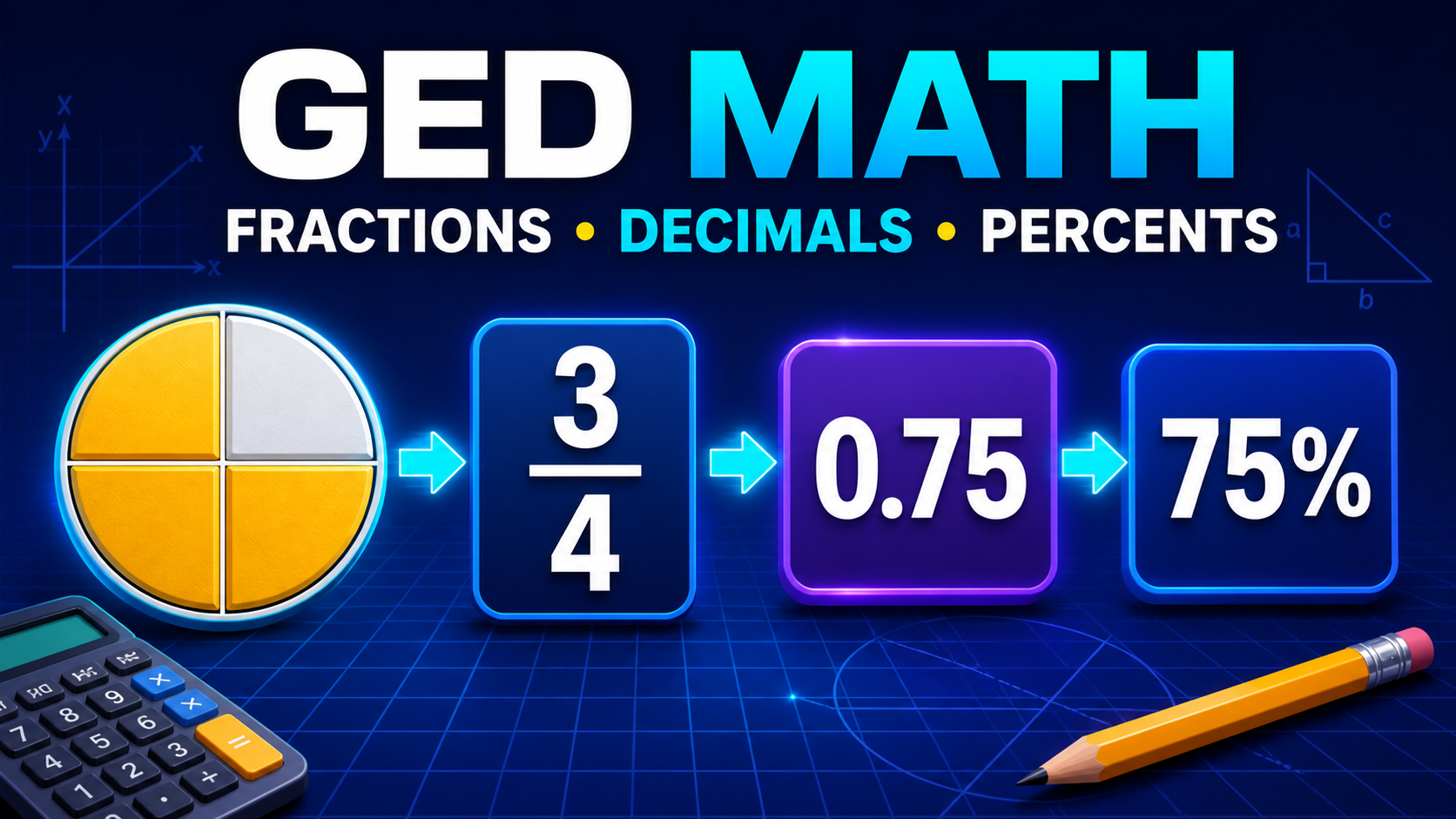
Fractions, decimals, and percents are three ways of saying the same thing: a part of a whole. This course builds deep intuition for all three, shows how to switch between them effortlessly, and connects every idea to real life (money, recipes, discounts). By the end, parts-of-a-whole problems will feel obvious.
📚 Course Curriculum
A fraction names part of a whole. The most important word is equal: the whole must be cut into equal-size pieces. In \(\frac{3}{8}\):. The denominator …
🔒 Enroll to unlock this session.
Equivalent fractions are different names for the same amount. If a rectangle is half shaded, it can be labeled \(\frac{1}{2}\), \(\frac{2}{4}\), or \(\frac{4}{8}\). The amount …
🔒 Enroll to unlock this session.
To compare fractions, ask: are the pieces the same size? If denominators match, compare numerators:. Five ninths is more pieces than two ninths. If denominators …
🔒 Enroll to unlock this session.
A proper fraction is less than 1, like \(\frac{3}{5}\). An improper fraction is 1 or more, like \(\frac{9}{4}\). A mixed number combines a whole number …
🔒 Enroll to unlock this session.
Addition and subtraction require same-size pieces. This is the one rule that explains almost everything. Same denominator:. The denominator stays 7 because the piece size …
🔒 Enroll to unlock this session.
Mixed-number subtraction can require borrowing, just like whole-number subtraction. Example:. First use a common denominator:. You cannot subtract \(5/6\) from \(2/6\), so borrow 1 whole …
🔒 Enroll to unlock this session.
Multiplication answers "of" questions. One half of one third means:. Multiply straight across:. You can simplify before multiplying:. Cancel 4 with 8 to get 1 …
🔒 Enroll to unlock this session.
Division asks how many groups fit. If you have \(\frac{3}{4}\) cup of rice and each serving uses \(\frac{1}{8}\) cup, then:. Rewrite \(\frac{3}{4}\) as \(\frac{6}{8}\). Six …
🔒 Enroll to unlock this session.
Fractions become real when they measure things. Case study 1 - recipe scaling. A recipe uses \(\frac{2}{3}\) cup of milk for one batch. You need …
🔒 Enroll to unlock this session.
Decimals extend the base-ten place-value system to amounts smaller than one. Every move one place to the right divides a place value by 10:. Place …
🔒 Enroll to unlock this session.
Compare decimals from left to right by place value. Add trailing zeros when useful so the places line up:. Both have 0 ones. At the …
🔒 Enroll to unlock this session.
Decimal addition and subtraction are place-value operations. Align decimal points, not the right edges of the numbers. Add trailing zeros to make the columns clear. …
🔒 Enroll to unlock this session.
Decimal multiplication combines whole-number multiplication with place-value reasoning. To calculate \(2.4\times0.35\):. 1. Multiply \(24\times35=840\). 2. Count three decimal places in the factors altogether: one in …
🔒 Enroll to unlock this session.
Division answers either "how many groups?" or "how much in each group?" Decimal division keeps those meanings. When the divisor is a decimal, multiply both …
🔒 Enroll to unlock this session.
Every fraction represents division:. This is the universal fraction-to-decimal method. A calculator can perform the division, but you still need to interpret and round the …
🔒 Enroll to unlock this session.
Percent means per hundred. The symbol \(\%\) is a shortcut for "out of 100.". [[figure:percent_grid A 100-grid makes percent literal: 37 shaded squares out of …
🔒 Enroll to unlock this session.
Percents, decimals, and fractions are three names for the same amount. [[figure:percent_conversion The same value can be written as percent, fraction, simplified fraction, or decimal.]]. …
🔒 Enroll to unlock this session.
The core percent equation is:. [[figure:percent_equation_triangle Cover the unknown: part = percent times whole.]]. Example: Find 30% of 150. So 30% of 150 is 45. …
🔒 Enroll to unlock this session.
Sometimes the question gives the part and whole, and asks for the percent. Use:. Example: 18 is what percent of 72?. Another example: A student …
Open trial session →Reverse percent problems give the final amount and ask for the original. These feel harder because the original is hidden. Use this idea:. If a …
🔒 Enroll to unlock this session.
A discount lowers the original price. If an item is 25% off, the store removes 25% and you pay the remaining 75%. [[figure:percent_discount_bar A 25% …
🔒 Enroll to unlock this session.
Percent change compares the change to the original amount. [[figure:percent_change_arrow The change is compared to the old value, not the new value.]]. Increase example: A …
Open trial session →Percent questions become easier when you identify the base: what is the percent being taken of?. Case study 1 - shopping with discount and tax. …
Open trial session →Fractions, decimals, and percents are not separate topics. They are three representations of rational numbers, and the best representation depends on the job. Use this …
🔒 Enroll to unlock this session.
Course Syllabus
Complete 24-session outline
Fraction foundations and operations
Sessions 1-9 develop fraction meaning, equivalence, comparison, mixed numbers, all four operations, and applied problem solving.
Decimal fluency and fraction-decimal conversion
Sessions 10-15 develop decimal place value, comparison, rounding, all four operations, and exact or rounded conversions between fractions and decimals.
Percent reasoning and applications
Sessions 16-23 connect percent to fractions and decimals, solve for part/rate/whole, and apply percent reasoning to discounts, tax, tips, commission, reverse percent, and percent change.
Cumulative GED® synthesis
Session 24 combines all three forms in multi-step GED®-style contexts with estimation, calculator discipline, and error analysis.
Course Outcomes
By the end of this course, students can:
- interpret, simplify, compare, and calculate with fractions and mixed numbers;
- read, compare, round, add, subtract, multiply, and divide decimals accurately;
- convert among fractions, terminating or repeating decimals, and percents;
- identify the part, rate, whole, original value, and final value in percent situations;
- solve consumer and workplace applications involving discounts, tax, tips, commission, markup, and percent change;
- choose an efficient representation, estimate before calculating, use a calculator deliberately, and verify whether a result is reasonable.
📝 Practice Questions
406 interactive questions with instant feedback and explanations.
Enroll for free to unlock the full practice bank after the trial sessions.
1 written response prompt with model rubric.