GED® Geometry: Area Practice
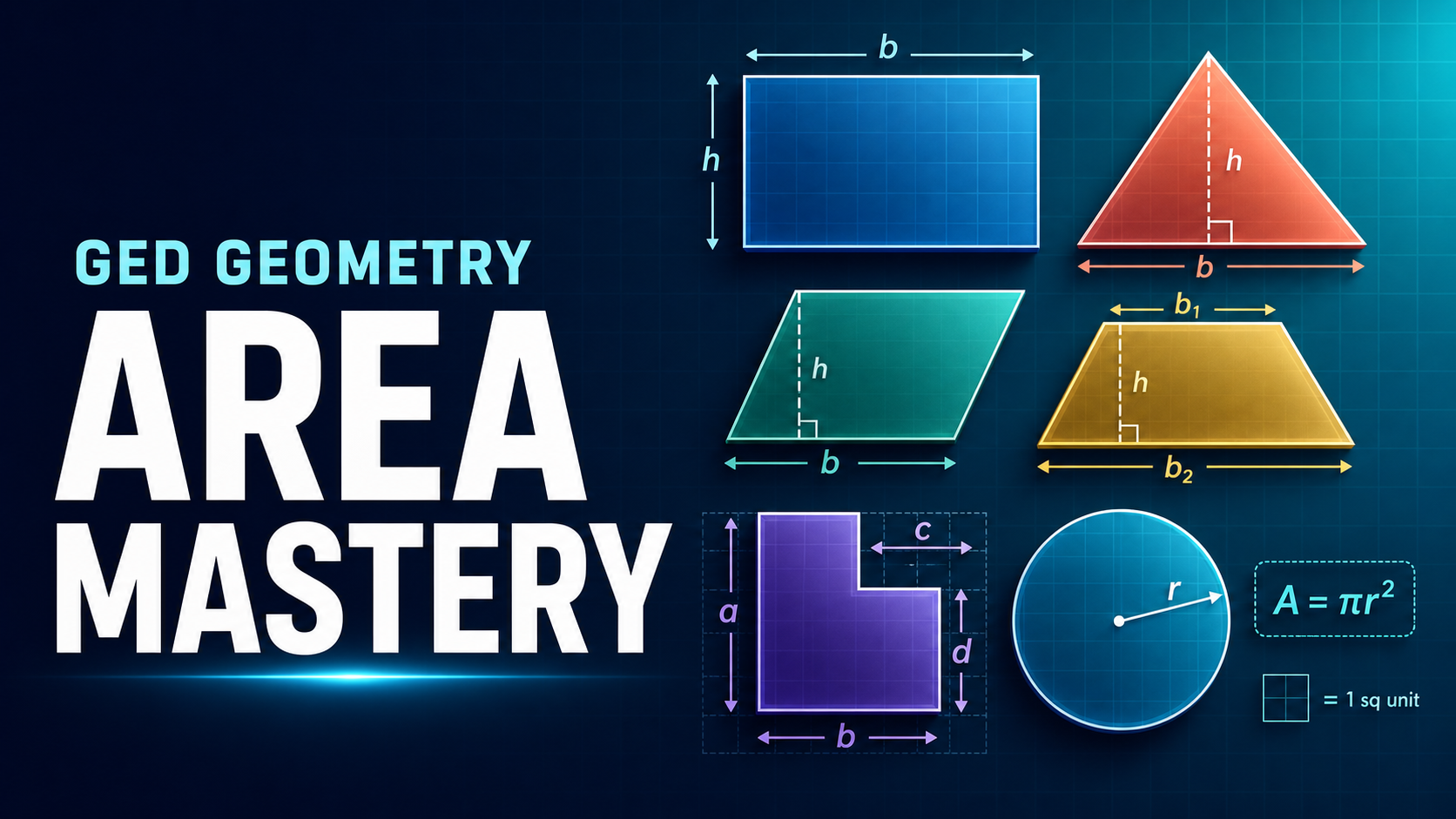
A deep GED® Geometry course built around a single high-value skill: finding AREA. Students learn what area really means, master the formulas for rectangles, squares, triangles, parallelograms, trapezoids, and circles, then combine them to handle composite figures, coordinate grids, missing sides, unit conversions, and real-world problems from flooring, painting, gardening, and tiling. Every shape has a labeled diagram, every lesson has an interactive self-check, and every practice answer explains the method and adds a Pro tip.
📚 Course Curriculum
Session 1 Learning Plan. Learning objective: Interpret area as coverage by unit squares. Key vocabulary: area, unit square, square unit, perimeter. Success criterion: Model a …
🔒 Enroll to unlock this session.
Session 2 Learning Plan. Learning objective: Calculate and compare rectangle and square areas. Key vocabulary: length, width, side, rectangle, square. Success criterion: Select \(A=lw\) or …
🔒 Enroll to unlock this session.
Session 3 Learning Plan. Learning objective: Calculate triangle area from a base and perpendicular height. Key vocabulary: base, height, perpendicular, triangle. Success criterion: Identify a …
Open trial session →Session 4 Learning Plan. Learning objective: Calculate parallelogram area using perpendicular height. Key vocabulary: parallelogram, base, perpendicular height, slanted side. Success criterion: Use \(A=bh\) without …
🔒 Enroll to unlock this session.
Session 5 Learning Plan. Learning objective: Calculate trapezoid area from two parallel bases and height. Key vocabulary: trapezoid, parallel bases, height, average. Success criterion: Apply …
Open trial session →Session 6 Learning Plan. Learning objective: Calculate circle area from a radius or diameter. Key vocabulary: circle, center, radius, diameter, pi. Success criterion: Convert diameter …
🔒 Enroll to unlock this session.
Session 7 Learning Plan. Learning objective: Find the area of composite and cutout figures. Key vocabulary: composite figure, decompose, component, cutout. Success criterion: Choose an …
🔒 Enroll to unlock this session.
Session 8 Learning Plan. Learning objective: Derive dimensions and area from coordinate points. Key vocabulary: coordinate plane, horizontal distance, vertical distance, vertex. Success criterion: Subtract …
🔒 Enroll to unlock this session.
Session 9 Learning Plan. Learning objective: Use area formulas backward to find missing dimensions. Key vocabulary: inverse operation, rearrange, unknown dimension, square root. Success criterion: …
🔒 Enroll to unlock this session.
Session 10 Learning Plan. Learning objective: Convert compatible lengths and square-unit measures. Key vocabulary: conversion factor, square unit, customary unit, metric unit. Success criterion: Square …
🔒 Enroll to unlock this session.
Session 11 Learning Plan. Learning objective: Solve multi-step area, coverage, quantity, and cost problems. Key vocabulary: coverage rate, unit price, waste allowance, whole-unit rounding. Success …
🔒 Enroll to unlock this session.
Session 12 Learning Plan. Learning objective: Select and combine area strategies under GED®-style conditions. Key vocabulary: formula selection, estimation, error analysis, verification. Success criterion: Solve …
Open trial session →Course Syllabus
GED® Geometry: Area Mastery Syllabus
Course Overview
This focused GED® Mathematical Reasoning course develops area fluency from visual meaning through multi-step application. Students begin by interpreting square units, then master the area formulas for common two-dimensional figures. Later sessions combine shapes, coordinates, algebra, conversions, and real-world constraints. Every session uses a repeatable GED® routine: identify the figure, label the needed dimensions, select a formula, substitute with units, calculate, and verify.
Course Information
- Program: GED®
- Subject: Mathematical Reasoning / Geometry
- Course length: 12 sessions
- Recommended pace: 2-3 sessions per week
- Recommended study time: 45-60 minutes per session, plus correction time
- Learning design: Visual model, explicit formula, worked examples, error analysis, self-check, and GED®-style practice
- Recommended mastery target: At least \(80\%\)
GED® Skill Alignment
The course supports the quantitative and algebraic reasoning used in GED® geometry and measurement questions. Students interpret diagrams that may not be drawn to scale, select relevant measurements, use the GED® formula sheet efficiently, convert compatible units, and solve contextual problems involving materials, cost, and coverage.
The central formulas are
\[
\begin{aligned}
A_{\text{rectangle}}&=lw, & A_{\text{square}}&=s^2,\\
A_{\text{triangle}}&=\tfrac12 bh, & A_{\text{parallelogram}}&=bh,\\
A_{\text{trapezoid}}&=\tfrac12(b_1+b_2)h, & A_{\text{circle}}&=\pi r^2.
\end{aligned}
\]
Learning Approach
Use the same routine in every session:
- Name the target. Confirm that the question asks for area rather than perimeter, circumference, surface area, or volume.
- Read and mark the figure. Identify the shape, dimensions, perpendicular height, radius, openings, and units.
- Choose the formula. Write the formula before inserting numbers.
- Substitute with units. Convert incompatible measurements before calculating.
- Calculate carefully. Use estimation and the calculator when appropriate.
- Label and verify. Report square units and check that the result is reasonable.
- Correct errors. Record the wrong turn, the correct relationship, and a prevention habit.
Course Outline
| Session | Topic | Essential skill |
|---|---|---|
| 1 | What Area Really Means | Model area with unit squares and distinguish area from perimeter |
| 2 | Rectangles and Squares | Apply \(A=lw\) and \(A=s^2\) |
| 3 | Triangles | Use a base and its perpendicular height in \(A=\tfrac12bh\) |
| 4 | Parallelograms | Distinguish perpendicular height from a slanted side |
| 5 | Trapezoids | Average the parallel bases and multiply by height |
| 6 | Circles | Find radius when needed and apply \(A=\pi r^2\) |
| 7 | Composite Figures | Decompose, add regions, and subtract cutouts |
| 8 | Coordinate-Grid Area | Derive horizontal and vertical lengths from coordinates |
| 9 | Missing Dimensions | Rearrange area formulas and solve backward |
| 10 | Square-Unit Conversions | Convert lengths or square-unit measures correctly |
| 11 | Real-World Applications | Connect area to coverage, quantity, waste, and cost |
| 12 | GED® Area Strategy | Select and combine formulas in mixed timed problems |
Required Materials
- Notebook or digital notes
- Pencil and scratch paper
- Scientific calculator or GED® onscreen-calculator practice
- Access to the GED® mathematics formula sheet
- Lesson diagrams and practice questions
Mastery and Correction Routine
Classify each missed question as a target error, diagram error, formula error, measurement error, calculation error, unit error, or context error. Then rewrite it using
\[
\text{target}\rightarrow\text{shape}\rightarrow\text{formula}\rightarrow
\text{substitution}\rightarrow\text{calculation}\rightarrow\text{unit check}.
\]
Completion Standard
A student completes the course after studying all 12 sessions, completing the available practice, correcting every missed item, and demonstrating at least \(80\%\) mastery. Students below the target should repeat the sessions connected to their error categories before moving to mixed GED® geometry review.
Course Outcomes
GED® Geometry: Area Mastery Course Outcomes
By the end of this course, students will be able to demonstrate the following skills.
Area Concepts and Diagram Literacy
- Explain area as the number of unit squares covering a two-dimensional region.
- Distinguish area from perimeter, circumference, surface area, and volume by target and unit.
- Interpret labels, right-angle marks, radii, diameters, coordinate points, and missing dimensions without assuming a diagram is drawn to scale.
- Identify the base and corresponding perpendicular height of a triangle, parallelogram, or trapezoid.
Formula Fluency
- Calculate areas of rectangles, squares, triangles, parallelograms, trapezoids, and circles.
- Convert a diameter to a radius before applying \(A=\pi r^2\).
- Explain the roles of the factor \(\tfrac12\) in triangle and trapezoid formulas.
- Use the GED® formula sheet as a confirmation tool while explaining what every variable represents.
Composite, Coordinate, and Algebraic Reasoning
- Decompose a composite figure into non-overlapping familiar shapes.
- Add component areas or subtract holes and excluded regions without double-counting.
- Find horizontal and vertical dimensions by subtracting coordinate values.
- Rearrange area formulas to determine a missing length, width, base, height, side, or radius.
- Use square roots to recover the side length of a square from its area.
Units and Real-World Application
- Report every area answer with an appropriate squared unit.
- Convert between square inches, square feet, square yards, and metric square units using squared conversion factors.
- Ensure all linear dimensions use compatible units before applying a formula.
- Solve GED®-style problems involving flooring, paint, tile, landscaping, fabric, coverage rates, material quantities, waste allowances, and total cost.
- Round only when the context requires a whole purchasable unit or specified precision.
Verification and GED® Readiness
- Estimate area and reject answers with unreasonable magnitude or incorrect units.
- Identify common distractors produced by adding instead of multiplying, using diameter as radius, omitting \(\tfrac12\), using a slanted side as height, or applying a linear conversion to square units.
- Solve mixed area problems using
\[ \text{identify}\rightarrow\text{mark}\rightarrow\text{formula} \rightarrow\text{solve}\rightarrow\text{verify}. \] - Explain the selected strategy clearly enough that another student can reproduce it.
Mastery Benchmark
Students demonstrate readiness when they select the correct formula before calculating, preserve units through multi-step work, solve mixed problems with at least \(80\%\) accuracy, and independently correct missed items.
📝 Practice Questions
180 interactive questions with instant feedback and explanations.
Enroll for free to unlock the full practice bank after the trial sessions.