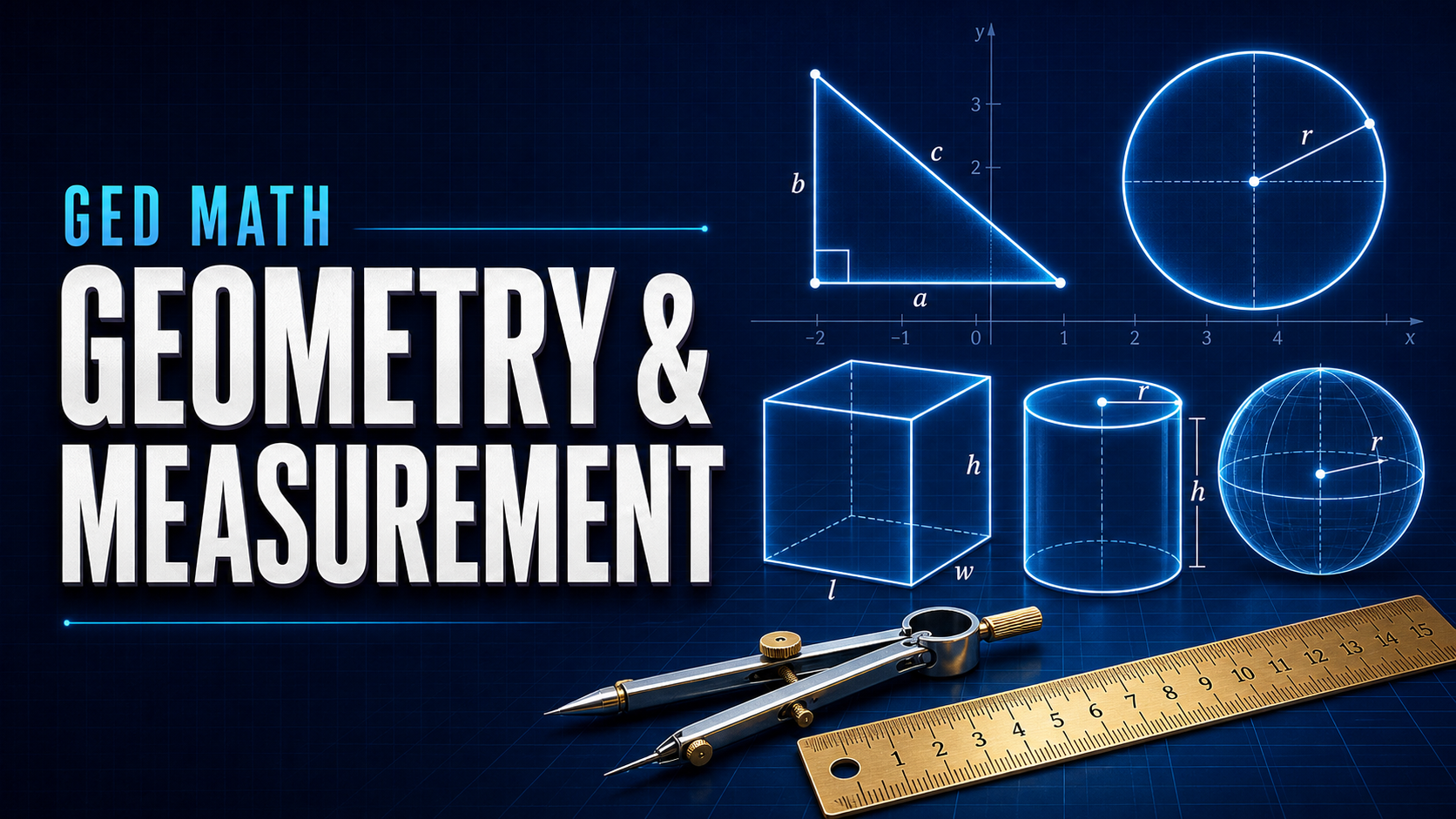
GED® Math: Geometry & Measurement
A complete 24-session GED® Geometry & Measurement course that turns formulas into reliable problem-solving tools. Learners progress from units and formula selection through area, perimeter, circles, volume, surface area, right triangles, coordinate geometry, angles, and mixed applications. Every session includes visual models, a repeatable solving routine, fully worked GED®-style examples, common-error analysis, an independent check, fifteen explained practice questions, and a 46-question cumulative final exam.
📚 Course Curriculum
GED® geometry questions usually ask for one of five things: distance around, surface inside, space filled, a missing length, or a missing angle. Use this …
🔒 Enroll to unlock this session.
Units are one of the fastest ways to catch mistakes. Length and perimeter use plain units: cm, ft, m. Area and surface area use square …
🔒 Enroll to unlock this session.
Area tells how much flat surface is covered. [[figure:area_rectangle A rectangle's area is length times width.]]. Formulas:. Rectangle: \(A = l \times w\). Square: \(A …
Open trial session →Triangle area is half of a matching rectangle or parallelogram. [[figure:area_triangle Triangle area uses base and perpendicular height.]]. Formula: \(A = \tfrac{1}{2}bh\). The height must …
🔒 Enroll to unlock this session.
Parallelograms and trapezoids both depend on a perpendicular height. [[figure:area_parallelogram A parallelogram's height is straight up and down from the base.]]. Formulas:. Parallelogram: \(A = …
🔒 Enroll to unlock this session.
Circle area measures the surface inside the circle. [[figure:area_circle Area uses the radius squared.]]. Formula: \(A=\pi r^2\). On GED®-style practice, use \(\pi \approx 3.14\) unless …
🔒 Enroll to unlock this session.
Composite figures are made from simpler shapes. Split the figure into rectangles, triangles, circles, or other known pieces. [[figure:composite_area Break a composite shape into easier …
🔒 Enroll to unlock this session.
Perimeter means distance around the outside edge. [[figure:perimeter_polygon Perimeter is the sum of all outside side lengths.]]. Rules:. Rectangle: \(P=2(l+w)\). Square: \(P=4s\). Any polygon: add …
🔒 Enroll to unlock this session.
Circumference is the perimeter of a circle. [[figure:circle_circumference Circumference goes around the circle.]]. Formulas:. \(C=\pi d\). \(C=2\pi r\). Use the formula that matches the information …
🔒 Enroll to unlock this session.
Volume tells how much a solid holds or fills. [[figure:volume_box A box's volume is length times width times height.]]. Formulas:. Rectangular prism: \(V=lwh\). Cube: \(V=s^3\). …
Open trial session →A prism keeps the same cross-section from one end to the other. A cylinder works the same way with a circular base. [[figure:cylinder_volume A cylinder's …
🔒 Enroll to unlock this session.
Cones and spheres are common formula-sheet problems. [[figure:volume_cone A cone is one-third of the matching cylinder.]]. Formulas:. Cone: \(V=\tfrac{1}{3}\pi r^2h\). Sphere: \(V=\tfrac{4}{3}\pi r^3\). The cone …
🔒 Enroll to unlock this session.
Surface area measures the outside covering of a 3D solid. [[figure:surface_net A net unfolds a solid into flat faces.]]. For a box:. For a cube:. …
🔒 Enroll to unlock this session.
Volume and surface area often appear in real-world wording. Volume words: fill, hold, capacity, water, sand, air, contents. Surface area words: paint, cover, wrap, label, …
🔒 Enroll to unlock this session.
The Pythagorean theorem works only for right triangles. [[figure:pythagorean_triangle The hypotenuse is across from the right angle.]]. Formula:. When finding the hypotenuse, square the legs, …
🔒 Enroll to unlock this session.
If the hypotenuse and one leg are known, subtract the squares. [[figure:right_triangle_345 Common triples can save time.]]. Missing leg:. Example: hypotenuse \(13\), one leg \(5\). …
🔒 Enroll to unlock this session.
Coordinate geometry turns points on a grid into lengths and relationships. [[figure:coordinate_quadrants Coordinates are written as \((x,y)\).]]. Key ideas:. The \(x\)-coordinate moves left or right. …
🔒 Enroll to unlock this session.
Three coordinate tools show up often. [[figure:distance_on_grid Distance on a grid is a right-triangle problem.]]. Distance:. Midpoint:. Slope:. Common mistake: using midpoint when the question …
🔒 Enroll to unlock this session.
Angle vocabulary makes problems faster. [[figure:angle_types Acute, right, obtuse, and straight angles.]]. Useful sums:. Right angle: \(90^\circ\). Straight line: \(180^\circ\). Full turn around a point: …
Open trial session →When two lines cross, the angle relationships are predictable. [[figure:vertical_angles Opposite angles are equal; neighboring angles form a straight line.]]. Rules:. Vertical angles are equal. …
🔒 Enroll to unlock this session.
Parallel lines cut by another line create repeated angle patterns. [[figure:parallel_transversal Parallel-line angles repeat or add to 180 degrees.]]. Rules to know:. Corresponding angles are …
🔒 Enroll to unlock this session.
Triangle angle questions usually use one of two rules. [[figure:triangle_angle_sum A triangle's interior angles total 180 degrees.]]. Rules:. Interior angles of a triangle add to …
🔒 Enroll to unlock this session.
Some triangles give extra information. [[figure:triangle_types_sides Triangle side patterns often imply angle patterns.]]. Rules:. Isosceles triangle: two equal sides and two equal base angles. Equilateral …
🔒 Enroll to unlock this session.
On a mixed GED® geometry set, slow down for the first 5 seconds and classify the problem. Use this routine:. Name the shape or situation. …
🔒 Enroll to unlock this session.
Course Syllabus
GED® Math: Geometry & Measurement Syllabus
Course overview
This 24-session course develops the geometry and measurement skills tested on
GED® Mathematical Reasoning. It begins with the decisions that come before a
calculation—identifying the requested measurement, reading a diagram, and
choosing the correct unit—then builds through two-dimensional measurement,
three-dimensional measurement, right triangles, coordinate geometry, angle
relationships, and mixed applications.
Every session follows a repeatable classify–sketch–plan–solve–check routine.
Learners study visual models, work through fully explained examples, identify
common mistakes, complete an independent check, and answer fifteen GED®-style
multiple-choice questions with explanations.
Course information
- Program: GED®
- Subject: Mathematical Reasoning / Geometry and Measurement
- Total sessions: 24
- Suggested schedule: 3 sessions per week for 8 weeks
- Suggested study time: 60–90 minutes per session
- Lesson practice: 15 explained MCQs per session (360 total)
- Cumulative final exam: 46 mixed, explained MCQs across all course strands
- Recommended materials: notebook, pencil, ruler, graph paper, calculator,
and the official GED® formula sheet
Problem-solving routine
- Classify: Decide whether the problem asks for length, perimeter,
circumference, area, surface area, volume, coordinate information, or an
angle measure. - Sketch and label: Draw or mark the figure, dimensions, right angles,
parallel lines, coordinates, and units. - Plan: Select a formula or geometry rule and estimate the answer's unit
and approximate size. - Solve: Substitute carefully, calculate in a logical order, and round
only when the question requires it. - Check: Re-read the question and verify the unit, magnitude, diagram
evidence, and calculator entry.
Complete 24-session outline
| Unit | Session | Topic | Main skill |
|---|---|---|---|
| 1 | 1 | Geometry Test Map: What Is Being Asked? | Classify the target measurement |
| 1 | 2 | Units: Plain, Square, Cubic, and Degrees | Match quantities to units |
| 1 | 3 | Rectangle and Square Area | Use area models and find missing dimensions |
| 1 | 4 | Triangle Area | Identify a base and perpendicular height |
| 2 | 5 | Parallelograms and Trapezoids | Apply height and average-base reasoning |
| 2 | 6 | Circle Area | Distinguish radius from diameter and use pi |
| 2 | 7 | Composite Area | Decompose figures and subtract cutouts |
| 2 | 8 | Perimeter of Polygons | Trace and total exterior edges |
| 3 | 9 | Circumference | Select and apply a circle-perimeter formula |
| 3 | 10 | Volume of Boxes and Cubes | Model volume with unit-cube layers |
| 3 | 11 | Prism and Cylinder Volume | Use base area times height |
| 3 | 12 | Cones and Spheres | Substitute accurately into formula-sheet formulas |
| 4 | 13 | Surface Area and Nets | Count exposed faces and curved surfaces |
| 4 | 14 | Volume vs. Surface Area in Context | Distinguish capacity from outside covering |
| 4 | 15 | Pythagorean Theorem: Hypotenuse | Identify legs and find a missing hypotenuse |
| 4 | 16 | Missing Legs and Diagonals | Subtract squares and model real diagonals |
| 5 | 17 | Coordinate Plane Basics | Plot points and read axes and quadrants |
| 5 | 18 | Distance, Midpoint, and Slope | Choose the correct coordinate tool |
| 5 | 19 | Angle Types and Special Sums | Use 90°, 180°, and 360° relationships |
| 5 | 20 | Vertical Angles and Linear Pairs | Solve equal and supplementary angle pairs |
| 6 | 21 | Parallel Lines and Transversals | Apply corresponding and interior-angle rules |
| 6 | 22 | Triangle and Exterior Angles | Use triangle sums and exterior-angle reasoning |
| 6 | 23 | Special Triangles and Mixed Reasoning | Apply justified triangle properties |
| 6 | 24 | Full Mixed Geometry Review | Select methods, manage time, and analyze errors |
Study and assessment plan
- Complete sessions in order because later work combines earlier measurement
and algebra skills. - Draw and label a diagram even when the question supplies one; do not assume a
picture is drawn to scale. - Write the formula or rule before entering numbers into a calculator.
- Aim for at least 12 correct answers out of 15 on each session practice set.
- Review every explanation, including answers that were correct by guessing.
- Record each missed problem as a classification, formula, diagram, arithmetic,
calculator, or unit error, then retry it after 24–48 hours. - Use Session 24 and the 46-question cumulative final exam as a final mixed check.
Completion standard
A learner completes the course by studying all 24 sessions, attempting each
session practice set, correcting missed questions with written reasoning, and
completing the mixed review. Strong mastery means the learner can select and
justify a method—not merely recall a formula—and can report a reasonable answer
with the correct unit.
Course Outcomes
GED® Math: Geometry & Measurement Outcomes
By the end of this course, learners will be able to:
Measurement and model selection
- classify a problem as length, perimeter, circumference, area, surface area,
volume, coordinate distance, slope, midpoint, or angle measure before
calculating; - interpret words, diagrams, tables, and formula-sheet information as parts of
one mathematical model; - predict and use plain, square, cubic, and degree units correctly;
- convert compatible measurements to a common unit before applying a formula;
- estimate magnitude and use units to reject unreasonable answers;
Two-dimensional measurement
- calculate perimeter for regular and irregular polygons, including problems
with missing exterior lengths; - calculate the area of rectangles, squares, triangles, parallelograms,
trapezoids, and circles; - identify perpendicular height even when a shape is tilted or the height lies
outside the figure; - distinguish radius from diameter and select efficiently between circle area
and circumference formulas; - decompose composite figures into simpler regions and add or subtract areas;
- solve reverse-measurement problems in which an area or perimeter is known and
a dimension is missing;
Three-dimensional measurement
- model prism and cylinder volume as the area of a base multiplied by height;
- calculate the volume of boxes, cubes, prisms, cylinders, cones, and spheres;
- interpret nets and calculate surface area for prisms, boxes, cubes, and
cylinders; - adjust surface-area calculations for open, attached, missing, or unexposed
faces; - distinguish inside capacity from outside covering in real-world applications;
- combine geometry with rates, cost, waste allowance, and unit conversions in
multi-step measurement problems;
Right triangles and coordinate geometry
- identify the hypotenuse and apply the Pythagorean theorem to find a missing
side of a right triangle; - find a missing leg by subtracting squares and use common Pythagorean triples
as reasonableness checks; - model ladders, ramps, rectangle diagonals, and coordinate distances as
right-triangle problems; - plot and interpret ordered pairs, axes, quadrants, and horizontal and vertical
distances; - calculate and interpret distance, midpoint, and slope from coordinates;
- distinguish positive, negative, zero, and undefined slopes from graphs and
coordinate evidence;
Angles, lines, and triangles
- classify acute, right, obtuse, straight, reflex, complementary, and
supplementary angles; - solve vertical-angle and linear-pair problems, including those containing
algebraic expressions; - apply corresponding, alternate interior, and same-side interior relationships
formed by parallel lines and a transversal; - use triangle interior-angle and exterior-angle relationships;
- apply isosceles, equilateral, and right-triangle properties only when stated
information or diagram markings justify them; - check side-angle consistency, including that the longest side lies opposite
the largest angle;
GED® problem solving
- follow a classify–sketch–plan–solve–check process on unfamiliar questions;
- use the GED® formula sheet and calculator strategically without replacing
mathematical setup and estimation; - identify distractors caused by wrong formulas, missing factors, unsupported
diagram assumptions, radius/diameter confusion, and unit errors; - explain a solution with correct notation, units, and a conclusion that answers
the original question; and - complete mixed geometry practice with at least 80% accuracy and use an error
log to select targeted review sessions.
📝 Practice Questions
406 interactive questions with instant feedback and explanations.
Enroll for free to unlock the full practice bank after the trial sessions.
1 written response prompt with model rubric.