GED® Geometry: Perimeter and Circumference
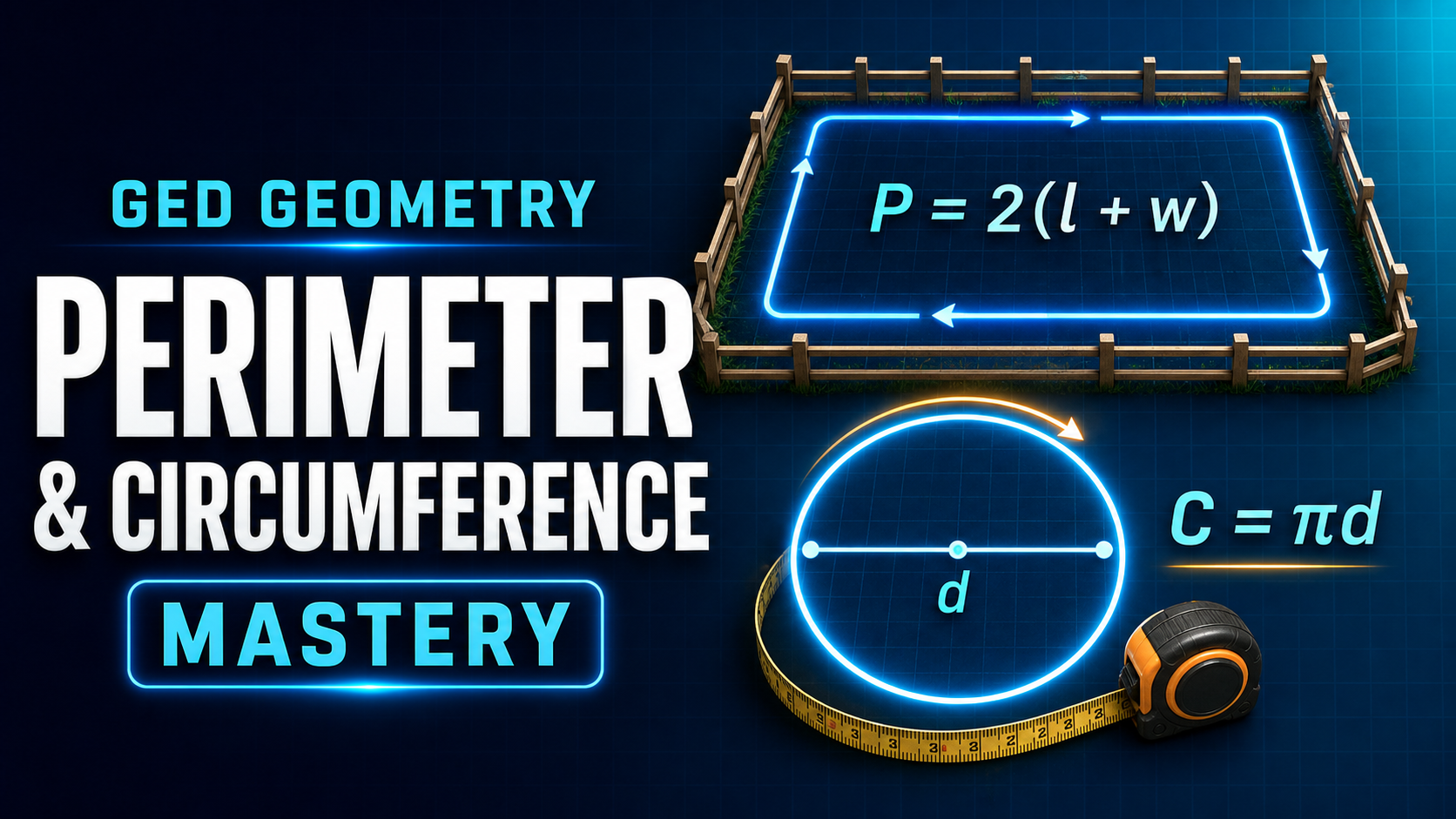
A deep GED® Geometry course built around the distance AROUND a shape. Students master perimeter for rectangles, squares, triangles, regular polygons, and composite figures, then move to circles -- radius, diameter, pi, and circumference. The course also covers working backward from a known perimeter, telling perimeter apart from area, and real-world problems like fencing, framing, and trim. Every shape has a labeled diagram, every lesson has an interactive self-check, downloadable teacher notes, two curated resources, and practice answers that explain the method and add a Pro tip.
📚 Course Curriculum
Session 1 Learning Plan. Learning objective: Interpret perimeter as the total length of a complete exterior boundary. Key vocabulary: perimeter, boundary, exterior, closed path, linear …
🔒 Enroll to unlock this session.
Session 2 Learning Plan. Learning objective: Calculate and explain the perimeter of rectangles and squares. Key vocabulary: length, width, side, opposite sides, rectangle, square. Success …
Open trial session →Session 3 Learning Plan. Learning objective: Calculate polygon perimeter by inventorying every exterior side. Key vocabulary: polygon, vertex, congruent, side inventory, compatible units. Success criterion: …
🔒 Enroll to unlock this session.
Session 4 Learning Plan. Learning objective: Use repeated structure to calculate or reverse regular-polygon perimeter. Key vocabulary: regular polygon, number of sides, side length, congruent. …
🔒 Enroll to unlock this session.
Session 5 Learning Plan. Learning objective: Determine the perimeter of composite and irregular rectilinear figures. Key vocabulary: composite figure, shared edge, notch, exterior, missing length. …
🔒 Enroll to unlock this session.
Session 6 Learning Plan. Learning objective: Distinguish radius, diameter, circumference, and pi. Key vocabulary: circle, center, radius, diameter, chord, circumference, pi. Success criterion: Identify circle …
🔒 Enroll to unlock this session.
Session 7 Learning Plan. Learning objective: Calculate circumference from a given diameter or radius. Key vocabulary: circumference, exact value, approximation, pi, rounding. Success criterion: Select …
🔒 Enroll to unlock this session.
Session 8 Learning Plan. Learning objective: Choose correctly between radius and diameter in circle contexts. Key vocabulary: across, through the center, radius, diameter, wheel rotation. …
🔒 Enroll to unlock this session.
Session 9 Learning Plan. Learning objective: Reverse perimeter and circumference relationships to find unknown dimensions. Key vocabulary: inverse operation, rearrange, missing side, unknown radius, verification. …
🔒 Enroll to unlock this session.
Session 10 Learning Plan. Learning objective: Distinguish perimeter and circumference from area. Key vocabulary: boundary, interior, linear unit, square unit, formula selection. Success criterion: Choose …
🔒 Enroll to unlock this session.
Session 11 Learning Plan. Learning objective: Solve multi-step boundary, material, opening, packaging, and cost problems. Key vocabulary: gate, opening, unit price, fixed-length piece, repeated object, …
Open trial session →Session 12 Learning Plan. Learning objective: Select and combine perimeter strategies under GED®-style conditions. Key vocabulary: formula selection, estimation, error analysis, multi-step verification. Success criterion: …
Open trial session →Course Syllabus
GED® Geometry: Perimeter & Circumference Mastery Syllabus
Course Overview
This focused GED® Mathematical Reasoning course develops fluency with distance around two-dimensional figures. Students begin by interpreting perimeter as a complete boundary, then calculate perimeters of rectangles, squares, triangles, regular polygons, and composite figures. The course builds circle vocabulary before applying circumference formulas, reverses formulas to recover missing dimensions, distinguishes boundary from area, and finishes with multi-step applications involving fencing, framing, trim, travel, materials, and cost.
Every session follows a consistent learning cycle: connect the idea to a visual boundary, study an explicit relationship, reproduce worked examples, analyze common errors, complete a self-check, answer aligned practice questions, and correct missed work.
Course Information
- Program: GED®
- Subject: Mathematical Reasoning / Geometry
- Course length: 12 sessions
- Recommended pace: 2-3 sessions per week
- Recommended study time: 45-60 minutes per session, plus correction time
- Learning design: Visual model, concept explanation, formula reasoning, worked examples, error analysis, self-check, and GED®-style practice
- Assessment bank: 240 multiple-choice questions, 20 aligned to each session
- Recommended mastery target: At least \(80\%\)
GED® Skill Alignment
The course supports quantitative and algebraic reasoning used in GED® geometry and measurement questions. Students interpret diagrams that may not be drawn to scale, distinguish relevant boundary measurements from extra information, use formulas from meaning rather than memory alone, convert compatible linear units, estimate for reasonableness, and complete contextual cost or purchasing steps.
The central relationships are
\[
\begin{aligned}
P_{\text{polygon}}&=\text{sum of all exterior sides},\\
P_{\text{rectangle}}&=2(l+w), & P_{\text{square}}&=4s,\\
P_{\text{regular polygon}}&=ns,\\
C_{\text{circle}}&=\pi d=2\pi r.
\end{aligned}
\]
Learning Approach
Use the same routine in every session:
- Name the target. Decide whether the problem asks for perimeter, circumference, area, a missing dimension, material, cost, or repeated distance.
- Trace the boundary. Mark every exterior segment or identify the circular rim.
- Label the measurements. Record side lengths, equal-side marks, radius, diameter, openings, and units.
- Choose a relationship. Add sides or select the formula that matches the figure and given information.
- Solve in stages. Complete geometry first, then cost, packaging, comparison, or repetition.
- Label and verify. Use a linear unit, estimate, and reconstruct the boundary when possible.
- Correct errors. Name the wrong decision, write the correct relationship, and record a prevention habit.
Course Outline
| Session | Topic | Essential skill |
|---|---|---|
| 1 | What Perimeter Means | Interpret perimeter as a complete closed boundary and report linear units |
| 2 | Rectangles and Squares | Apply and explain \(P=2(l+w)\) and \(P=4s\) |
| 3 | Triangles and Other Polygons | Inventory and add every exterior side exactly once |
| 4 | Regular Polygons | Apply \(P=ns\) only when all sides are equal |
| 5 | Composite and Irregular Figures | Trace an outside boundary and derive missing horizontal or vertical lengths |
| 6 | Radius, Diameter, and Pi | Identify circle measurements and explain \(d=2r\) and \(C/d=\pi\) |
| 7 | Circumference of a Circle | Calculate with \(C=\pi d\) or \(C=2\pi r\) and round appropriately |
| 8 | Radius vs. Diameter | Select the correct circle formula from diagrams and real-world language |
| 9 | Working Backward | Reverse perimeter and circumference formulas to recover missing dimensions |
| 10 | Perimeter vs. Area | Distinguish boundary length from interior coverage by context, operation, and unit |
| 11 | Real-World Applications | Solve fencing, framing, trim, edging, cost, opening, and packaging problems |
| 12 | GED® Perimeter Strategy | Select, combine, estimate, and verify boundary strategies in mixed problems |
Required Materials
- Notebook or digital notes
- Pencil and scratch paper
- Scientific calculator or GED® onscreen-calculator practice
- Access to the GED® mathematics formula sheet
- Lesson diagrams and session practice questions
Teacher Notes and Additional Resources
Each session includes a downloadable two-page teacher-note packet with an opening diagnostic,
high-value teaching sequence, guided example, misconception checks, coaching questions, an error
log, differentiation ideas, and a mastery conference. Each session also links to two curated
follow-up resources (text/video practice, an interactive graphing investigation, or official GED®
information) so a tutor or independent learner can extend the exact skill being studied.
Mastery and Correction Routine
Classify every missed question as a target error, boundary error, formula error, radius/diameter error, unit error, calculation error, or context-step error. Rewrite the solution using
\[
\text{target}\rightarrow\text{boundary}\rightarrow\text{relationship}
\rightarrow\text{calculation}\rightarrow\text{unit}\rightarrow\text{context check}.
\]
Completion Standard
A student completes the course after studying all 12 sessions, completing the aligned practice, correcting every missed item, and demonstrating at least \(80\%\) mastery. Students below the target should repeat the sessions connected to their error categories before moving to mixed GED® geometry review.
Course Outcomes
GED® Geometry: Perimeter & Circumference Mastery Outcomes
By the end of this course, students will be able to demonstrate the following skills.
Boundary Concepts and Diagram Literacy
- Explain perimeter as the total length of a complete exterior boundary.
- Distinguish exterior sides from interior divisions, shared edges, heights, and other irrelevant measurements.
- Trace straight-sided, regular, irregular, composite, circular, and partially open boundaries without skipping or double-counting segments.
- Interpret congruence marks, right angles, center points, radii, diameters, chords, and diagram labels without assuming the figure is drawn to scale.
- Report perimeter and circumference with appropriate linear units.
Polygon Formula Fluency
- Calculate the perimeter of any polygon by adding all exterior side lengths.
- Derive and apply \(P=2(l+w)\) for rectangles and \(P=4s\) for squares.
- Apply \(P=ns\) to regular polygons after verifying that all sides are equal.
- Use congruence information to infer repeated side lengths.
- Find missing segments in rectilinear composite figures by balancing total horizontal and vertical distances.
- Exclude shared interior edges and include exposed notch boundaries correctly.
Circle and Circumference Reasoning
- Distinguish radius, diameter, chord, and circumference from diagrams and contextual wording.
- Use \(d=2r\) and \(r=d/2\) to move accurately between radius and diameter.
- Explain \(\pi\) as the constant ratio \(C/d\) and estimate circumference as a little more than three diameters.
- Calculate circumference using \(C=\pi d\) or \(C=2\pi r\).
- Express answers exactly in terms of \(\pi\) or approximately as decimals according to directions.
- Distinguish a semicircular arc from the full perimeter of a semicircle.
Algebraic and Inverse Reasoning
- Reverse \(P=4s\), \(P=ns\), and \(P=2(l+w)\) to determine missing dimensions.
- Reverse \(C=\pi d\) or \(C=2\pi r\) to determine an unknown diameter or radius.
- Form and solve one-variable equations from algebraic side expressions.
- Substitute a recovered value into the original relationship to verify the result.
- Distinguish the value of a variable from the requested side length or measurement expression.
Perimeter, Area, and Units
- Distinguish boundary questions from interior-coverage questions using context, formula structure, and units.
- Explain why perimeter uses linear units while area uses square units.
- Convert compatible linear measurements before adding sides or applying a formula.
- Compare figures that have the same perimeter but different areas, or the same area but different perimeters.
- Identify distractors produced by multiplying dimensions, adding only half a boundary, squaring a radius, or using radius as diameter.
Real-World Application and GED® Readiness
- Model fencing, framing, trim, baseboard, border, edging, wheel rotation, track, and repeated-lap situations.
- Adjust a full perimeter for gates, doors, shared walls, open sides, or other excluded segments.
- Use a boundary length to calculate total material cost or the number of fixed-length pieces required.
- Round up when whole purchasable units are required and round decimal measurements only at an appropriate final step.
- Estimate expected magnitude and reject answers with unreasonable size, incompatible units, or an incomplete context step.
- Solve mixed boundary problems using
\[ \text{identify}\rightarrow\text{trace}\rightarrow\text{formula} \rightarrow\text{solve}\rightarrow\text{verify}. \] - Explain the selected strategy clearly enough that another student can reproduce it.
Mastery Benchmark
Students demonstrate readiness when they can identify the complete boundary before calculating, select the correct relationship from unfamiliar wording or diagrams, preserve linear units through multi-step work, solve mixed problems with at least \(80\%\) accuracy, and independently correct missed items.
📝 Practice Questions
240 interactive questions with instant feedback and explanations.
Enroll for free to unlock the full practice bank after the trial sessions.