GED® Geometry: Volume and Surface Area
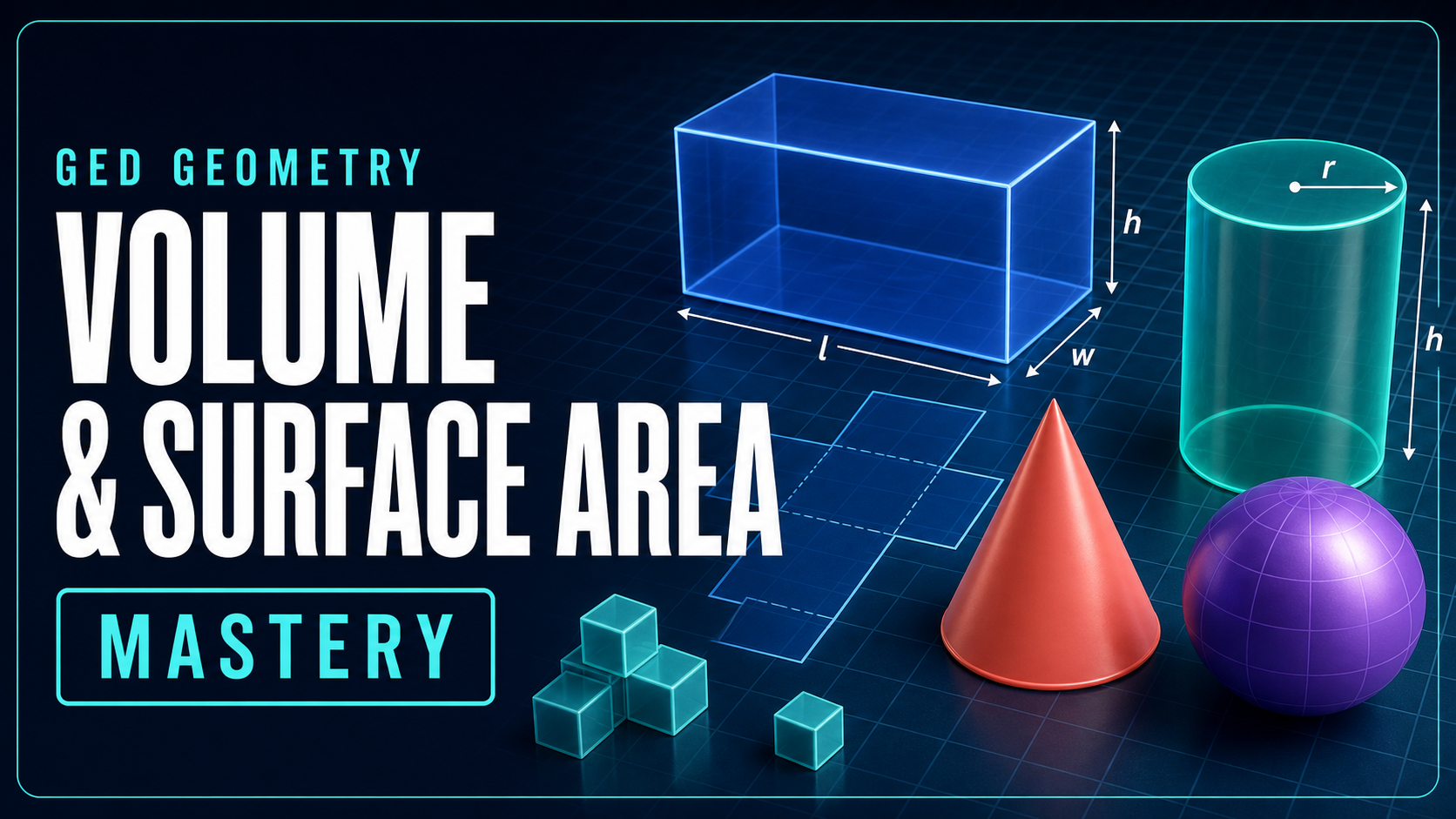
A deep GED® Geometry course on three-dimensional solids. Students learn what volume and surface area mean, then master the formulas for boxes, cubes, cylinders, cones, and spheres, plus surface area from nets. The course stresses the big idea that prism volume is base area times height, tells volume apart from surface area, and applies both to real-world filling, capacity, and wrapping problems. Every solid has a labeled diagram, every lesson has an interactive self-check and 20 practice MCQs, and a separate 46-question final exam withholds answers and explanations until results. The GED® provides a formula sheet, so the focus is on choosing and using the right formula.
📚 Course Curriculum
Session 1 Learning Plan. Learning objective: Interpret volume as a count of unit cubes and distinguish one-, two-, and three-dimensional units. Key vocabulary: volume, unit …
🔒 Enroll to unlock this session.
Session 2 Learning Plan. Learning objective: Calculate and reverse the volume formula for rectangular prisms. Key vocabulary: rectangular prism, length, width, height, base layer. Success …
🔒 Enroll to unlock this session.
Session 3 Learning Plan. Learning objective: Calculate cube volume and reason about cubic scale. Key vocabulary: cube, side length, exponent, cube, cube root. Success criterion: …
🔒 Enroll to unlock this session.
Session 4 Learning Plan. Learning objective: Use base area times perpendicular height for prisms and cylinders. Key vocabulary: base area, cross-section, prism, perpendicular height. Success …
🔒 Enroll to unlock this session.
Session 5 Learning Plan. Learning objective: Calculate cylinder volume from radius or diameter. Key vocabulary: cylinder, circular base, radius, diameter, pi. Success criterion: Convert diameter …
🔒 Enroll to unlock this session.
Session 6 Learning Plan. Learning objective: Calculate cone volume and explain the one-third relationship. Key vocabulary: cone, apex, perpendicular height, matching cylinder, one-third. Success criterion: …
Open trial session →Session 7 Learning Plan. Learning objective: Calculate sphere volume and analyze radius scale. Key vocabulary: sphere, center, radius, diameter, cubic scale. Success criterion: Apply \(V=\tfrac43\pi …
🔒 Enroll to unlock this session.
Session 8 Learning Plan. Learning objective: Interpret surface area by unfolding solids into nets. Key vocabulary: surface area, net, face, exposed surface, square unit. Success …
🔒 Enroll to unlock this session.
Session 9 Learning Plan. Learning objective: Calculate full and partial surface area of boxes and cubes. Key vocabulary: face pair, rectangular prism, cube, open top, …
🔒 Enroll to unlock this session.
Session 10 Learning Plan. Learning objective: Calculate full and partial surface area of cylinders. Key vocabulary: circular base, curved surface, circumference, lateral area. Success criterion: …
Open trial session →Session 11 Learning Plan. Learning objective: Choose between volume and surface area in real-world problems. Key vocabulary: capacity, coverage, fill, wrap, rate, conversion. Success criterion: …
🔒 Enroll to unlock this session.
Session 12 Learning Plan. Learning objective: Select, combine, estimate, and verify volume and surface-area strategies under GED®-style conditions. Key vocabulary: formula sheet, composite solid, internal …
Open trial session →Course Syllabus
GED® Geometry: Volume & Surface Area Mastery Syllabus
Course Overview
This focused GED® Mathematical Reasoning course develops three-dimensional
measurement from visual meaning through multi-step application. Students learn
to see volume as a count of unit cubes and surface area as a total of exposed
faces. They then build formula fluency for rectangular prisms, cubes, general
prisms, cylinders, cones, and spheres. Later sessions distinguish interior
capacity from exterior coverage and combine solids in GED®-style contexts.
Every session follows a consistent learning cycle: connect the concept to an
explanatory diagram, study the formula from its meaning, reproduce worked
examples, analyze common errors, complete an interactive self-check, answer
practice questions, and correct missed work.
Course Information
- Program: GED®
- Subject: Mathematical Reasoning / Geometry
- Course length: 12 sessions
- Recommended pace: 2-3 sessions per week
- Recommended study time: 45-60 minutes per session plus correction time
- Learning design: Visual model, concept explanation, formula reasoning,
worked examples, error analysis, self-check, and GED®-style practice - Recommended mastery target: At least \(80\%\)
Core Relationships
\[ \begin{aligned} V_{\text{rectangular prism}}&=lwh, & V_{\text{prism}}&=Bh,\\ V_{\text{cylinder}}&=\pi r^2h, & V_{\text{cone}}&=\tfrac13\pi r^2h,\\ V_{\text{sphere}}&=\tfrac43\pi r^3, & SA_{\text{box}}&=2(lw+lh+wh),\\ SA_{\text{cube}}&=6s^2, & SA_{\text{cylinder}}&=2\pi r^2+2\pi rh. \end{aligned} \]
The formulas are not treated as disconnected facts. Rectangular prisms,
cylinders, and all other prisms share the structure \(V=Bh\): find the area of
one base and extend it through a perpendicular height. A cone is one-third of a
matching cylinder. Surface-area formulas are face inventories rather than
single multiplication rules. Understanding these connections reduces memory
load and makes unfamiliar GED® diagrams easier to interpret.
Course Outline
| Session | Topic | Essential skill |
|---|---|---|
| 1 | What Volume Means | Interpret volume as unit cubes and use cubic units |
| 2 | Rectangular Prisms | Apply and reverse \(V=lwh\) |
| 3 | Cubes | Interpret \(s^3\), cube roots, and volume scale |
| 4 | Base Area Times Height | Generalize \(V=Bh\) to prisms and cylinders |
| 5 | Cylinders | Use radius, circular base area, height, and \(\pi\) |
| 6 | Cones | Apply the one-third relationship to a matching cylinder |
| 7 | Spheres | Use radius, \(r^3\), and the four-thirds factor |
| 8 | Surface Area and Nets | Inventory exposed faces and square units |
| 9 | Boxes and Cubes | Calculate full and partial surface area |
| 10 | Cylinders | Combine two circular bases and a rectangular wrap |
| 11 | Volume vs. Surface Area | Translate capacity and coverage contexts |
| 12 | GED® Strategy | Select formulas, combine solids, estimate, and verify |
Who This Course Is For
This course is designed for GED® learners who know basic multiplication,
division, decimals, fractions, exponents, and two-dimensional area but need a
structured route into three-dimensional geometry. It also supports learners who
remember formulas but are unsure when to use them, confuse radius with
diameter, mix square and cubic units, or lose accuracy in multi-step word
problems.
Before starting, students should be able to:
- multiply whole numbers and decimals;
- evaluate a square such as \(5^2\) and a cube such as \(4^3\);
- find rectangle, triangle, and circle area from labeled dimensions;
- solve a one-step equation using an inverse operation;
- use a scientific calculator for multiplication, division, exponents, and
\(\pi\); and - convert a length when the conversion factor is provided.
Students who need review can still begin the course. Each session restates the
needed area relationship and models calculator entry in visible stages.
Essential Questions
The following questions organize the course:
- What physical quantity does the problem ask us to measure: boundary, flat
coverage, interior space, or exterior covering? - How do unit cubes and repeated cross-sections explain a volume formula?
- Which measurement is the perpendicular height, and which labeled values are
irrelevant? - When does a circular measurement represent a radius rather than a diameter?
- Why does a cone use one-third, and why does a sphere use a cubed radius?
- Which faces are exposed, hidden, open, or joined when surface area is
requested? - How can units, estimation, and comparison with a familiar solid expose an
incorrect answer? - How should geometry connect to a later capacity, coverage, rate, material,
or cost step?
Session Learning Cycle
Each session uses a repeatable structure so students can focus on the
mathematics rather than guessing how to study.
- Orient. Read the learning objective, vocabulary, and success criterion.
- Observe. Study the explanatory SVG diagram and describe what each label,
face, layer, or arrow represents. - Connect. Link the visual model to a formula and its measurement unit.
- Follow. Reproduce the worked example line by line, including units.
- Analyze. Identify why a common wrong answer is tempting and which
decision created it. - Check. Complete the interactive self-check without looking back.
- Practice. Answer the aligned multiple-choice questions and show work for
every item, including correct guesses. - Correct. Classify each miss and redo it from the first incorrect step.
- Reflect. Complete the exit prompt from memory and record a next action.
Suggested Four-Week Study Plan
| Week | Sessions | Main focus | End-of-week evidence |
|---|---|---|---|
| 1 | 1-3 | Unit cubes, boxes, and cubes | Explain cubic units and solve direct or inverse box problems |
| 2 | 4-6 | \(Bh\), cylinders, and cones | Select a base, use radius correctly, and apply the one-third factor |
| 3 | 7-9 | Spheres, nets, boxes, and cubes | Use \(r^3\) and inventory exposed rectangular faces |
| 4 | 10-12 | Cylinder surfaces, applications, and mixed strategy | Distinguish fill from cover and solve composite GED®-style problems |
Learners using a slower schedule may complete two sessions each week. A student
should not rush forward after a low practice score. Repeat the worked examples,
correct the error log, and attempt a fresh set after a break. Spacing practice
across several days produces stronger recall than completing all sessions in
one sitting.
Assessment and Mastery Plan
Assessment is formative throughout the course. Every session includes an
interactive self-check, worked-example reproduction, error analysis, exit
reflection, and 20 aligned MCQs. After all 12 sessions, a separate 46-question
final exam samples the full course without hints or answer feedback during the
attempt. The question banks deliberately include
distractors based on adding dimensions, omitting an exponent, using diameter as
radius, forgetting a fraction, selecting surface area for capacity, or using
the wrong unit.
Use the following decision rules:
- 80-100% with clear work: proceed and include one mixed review item at the
next study session. - 60-79%: correct every miss, reread the related diagram, and retry before
continuing. - Below 60%: return to the concept model and worked examples; seek tutor,
teacher, or peer support before adding a new formula. - Correct answer without a reproducible method: treat it as not yet secure.
Write the formula, substitution, and verification so the result can be
repeated.
Mastery means more than recognizing a formula. A proficient learner can explain
why the formula fits, identify the required measurements, calculate accurately,
label the result, estimate its size, and diagnose a plausible wrong answer.
Teacher Notes and Additional Resources
Every session includes a downloadable two-page teacher-note packet with an
opening diagnostic, high-value teaching sequence, guided example,
misconception corrections, coaching questions, a student error-log table,
differentiation ideas, mastery evidence, and an exit conference. These packets
support classroom instruction, tutoring, intervention, family study, and
independent correction.
Each session also includes two curated links from official GED®, OpenStax, or
Khan Academy resources. The links are selected for the exact session skill,
such as unit-cube volume, prism layers, cone comparison, sphere volume, nets,
cylinder surfaces, or formula-sheet fluency. Learners can open a resource,
complete the relevant explanation or practice, and mark it complete in the
course interface.
Materials and Calculator Expectations
Students should have a notebook or digital workspace, pencil, scratch paper,
access to the GED® mathematics formula sheet, and a scientific calculator or GED®
onscreen-calculator practice tool. Keep one page for formulas built from
meaning, one page for vocabulary and diagrams, and one page for the error log.
The calculator supports arithmetic; it does not select a target or formula.
Write the symbolic formula first, substitute values second, and enter the
expression third. Use the calculator's \(\pi\) key unless the question specifies
\(3.14\). Preserve full precision through intermediate steps and round only the
final result according to directions.
Inclusive Learning and Independent Study
The course supports visual, verbal, and procedural learning. Every session pairs
written explanation with a labeled, responsive SVG that remains sharp when
zoomed. Formulas are explained in words and symbols. Worked examples separate
the decision, substitution, calculation, and verification stages. Learners may
read one section at a time, enlarge diagrams, pause between stages, and explain
the visual aloud before calculating.
For independent study, use the success criterion as a self-conference. Ask:
“Can I do this without copying the example, and can I explain why?” For guided
instruction, a teacher or tutor can use the common-error section as a quick
diagnostic and the exit reflection as the next session's opening prompt.
Learning and Correction Routine
For every problem, name the target, identify the solid, mark relevant
measurements, write the formula, substitute with compatible units, calculate in
stages, and verify the result by meaning, estimate, and unit. Classify each
missed item as a target, shape, formula, radius/diameter, exponent, unit,
calculation, or rounding error. Rewrite the solution from the first incorrect
decision and record one prevention habit.
Use this written chain:
\[
\text{target}\rightarrow\text{solid}\rightarrow\text{measurements}
\rightarrow\text{formula}\rightarrow\text{substitution}
\rightarrow\text{calculation}\rightarrow\text{unit}\rightarrow\text{check}.
\]
The correction is complete only when the student can state what went wrong,
show the corrected decision, and name a habit that will prevent the same error.
Examples include “I used diameter as radius; next time I will write \(r=d/2\)
beside the diagram,” and “I found capacity when the problem asked for wrapping;
next time I will label the target inside or outside before choosing.”
Completion Standard
Students complete the course after studying all 12 sessions, completing the
aligned practice, correcting every missed item, and demonstrating at least
\(80\%\) mastery on mixed volume and surface-area problems. Completion also
requires a final error log with corrections, correct use of square and cubic
units, and an explanation of at least one composite-solid problem that another
learner could follow.
Course Outcomes
GED® Geometry: Volume & Surface Area Mastery Outcomes
By the end of this course, students will be able to demonstrate the following
skills independently in diagrams, calculations, explanations, and GED®-style
applications. An outcome is considered secure when the student can select and
justify a method without copying a worked example, calculate accurately, and
verify the result by meaning, estimate, and unit.
Measurement Meaning and Diagram Literacy
- Explain volume as interior three-dimensional space and as a count of unit
cubes arranged in layers. - Explain surface area as the sum of the areas of all required exposed faces or
curved surfaces. - Distinguish length, perimeter, area, surface area, and volume using both
physical meaning and unit type. - Interpret a solid from a perspective drawing, labeled diagram, word
description, cross-section, or net without assuming the picture is drawn to
scale. - Identify length, width, side length, base area, perpendicular height, radius,
diameter, center, circular base, curved surface, apex, and slant height. - Distinguish relevant measurements from extra labels and identify hidden,
shared, open, omitted, or unpainted faces. - Sketch and label a simple solid or net when a word problem does not provide a
diagram.
Units, Conversions, and Dimensional Reasoning
- Report length in linear units, area and surface area in square units, and
volume in cubic units. - Explain why multiplying two compatible lengths produces square units and
multiplying three produces cubic units. - Convert incompatible dimensions to a common unit before substituting them
into a geometric formula. - Apply supplied relationships between cubic units and capacity units only
after calculating the geometric volume. - Use unit structure to detect a formula mismatch, incomplete conversion, or
answer that solves the wrong target. - Distinguish the unit of a recovered edge or radius from the square or cubic
unit of the quantity used to find it.
Rectangular-Prism and Cube Fluency
- Derive \(V=lwh\) from the number of unit cubes in one \(l\times w\) layer and
the number of layers \(h\). - Calculate rectangular-prism volume from whole-number, fraction, or decimal
dimensions. - Reverse \(V=lwh\) to recover a missing length, width, or height and verify it
by rebuilding the original volume. - Apply \(V=s^3\) to cubes and interpret the exponent as three equal factors
rather than multiplication by three. - Use a cube root or known perfect cube to recover a cube's side length from its
volume. - Explain why multiplying every edge by a scale factor \(k\) multiplies volume
by \(k^3\).
Base-Area and Cylinder Reasoning
- Explain \(V=Bh\) as equal cross-sectional layers extended through a
perpendicular height. - Identify \(B\) as a square-unit base area, not merely a base length.
- Apply \(V=Bh\) to rectangular, triangular, and other prisms when the base area
is given or can be calculated. - Use the perpendicular distance between congruent bases rather than a slanted
lateral edge. - Connect \(B=\pi r^2\) to \(V=\pi r^2h\) for a cylinder.
- Convert diameter to radius before substitution and distinguish radius errors
from exponent errors. - Compare cylinders efficiently when only radius, height, or both change.
Cone and Sphere Fluency
- Explain a cone's volume as one-third of a cylinder with the same base and
perpendicular height. - Calculate cone volume with \(V=\tfrac13\pi r^2h\), including diameter-to-radius
conversion and appropriate rounding. - Distinguish perpendicular height from slant height in a cone diagram.
- Use the matching-cylinder comparison to detect a missing one-third factor.
- Calculate sphere volume with \(V=\tfrac43\pi r^3\).
- Explain why a sphere uses \(r^3\) and how doubling a sphere's radius multiplies
its volume by eight. - Use containment or scale comparisons to reject an impossible sphere volume.
Surface Area and Nets
- Unfold a solid conceptually and match each section of a net to one face or
curved surface. - Build \(SA=2(lw+lh+wh)\) from the three congruent face pairs of a rectangular
prism. - Apply \(SA=6s^2\) to a cube and distinguish one-face area from total surface
area. - Calculate partial box surface area when a top, bottom, opening, shared face,
or other region is excluded. - Explain why a cylinder's curved side becomes a rectangle with width \(2\pi r\)
and height \(h\). - Calculate full cylinder surface area with
\(SA=2\pi r^2+2\pi rh\). - Select only \(2\pi rh\) for a label, one circular base plus the curved side
for an open container, or the full formula for a sealed cylinder. - Count each exposed region once and exclude faces hidden where solids join.
Algebraic, Scaling, and Composite Reasoning
- Substitute values into formulas while preserving parentheses, exponents,
fractions, and units. - Rearrange a volume relationship to isolate a missing dimension.
- Explain how linear scale \(k\), surface-area scale \(k^2\), and volume scale
\(k^3\) differ. - Decompose a composite solid into familiar, non-overlapping prisms, cylinders,
cones, or other supplied components. - Add component volumes to obtain total capacity or subtract a cavity when
appropriate. - Treat a shared face as internal for exterior surface area while recognizing
that joining non-overlapping volumes still requires addition. - Decide whether a single \(Bh\) model fits the situation or whether changing
cross-sections require decomposition.
Real-World Modeling
- Translate fill, capacity, wrapping, painting, coating, labeling, and material
contexts into the correct geometric target. - Model boxes, tanks, aquariums, pools, cans, labels, packages, silos, storage
containers, coatings, and material requirements with appropriate solids. - Separate the geometry stage from a later capacity, flow-rate, coverage,
quantity, packaging, or cost calculation. - Adjust a full-surface calculation for an open top, unpainted base, doorway,
overlap, joined face, or other contextual exclusion. - Round up when a context requires whole purchasable containers or pieces and
round decimal measurements only when the problem directs. - Complete the statement “My answer represents ___ and is measured in ___” to
confirm that the result answers the original question.
Calculator, Precision, and Estimation
- Enter expressions in a reliable order: evaluate exponents, preserve grouped
factors, then multiply or divide. - Use the calculator's \(\pi\) key unless the question specifies another
approximation. - Preserve intermediate precision and round only the final answer to the
requested place. - Estimate with friendly dimensions before exact calculation and identify a
reasonable answer range. - Compare a cone with a matching cylinder, a sphere with a containing cube, or
a composite solid with its component bounds to test plausibility. - Reject answers with unreasonable magnitude, incompatible units, a missing
fraction, an incorrect radius, or an incomplete context step.
GED® Formula-Sheet and Test Strategy
- Use the formula sheet as a reference after naming the target and solid, not as
a list from which to guess. - Follow the sequence
\[ \text{target}\rightarrow\text{solid}\rightarrow\text{measurements} \rightarrow\text{formula}\rightarrow\text{solve} \rightarrow\text{unit}\rightarrow\text{verify}. \] - Mark radius and diameter explicitly, write one-third or four-thirds before
entering a cone or sphere formula, and inventory exposed surfaces before
calculating surface area. - Use answer choices diagnostically by identifying which common error could
produce each distractor. - Decide when to calculate exactly, estimate, work backward from choices, or
postpone a difficult item for a second pass. - Solve mixed volume and surface-area questions with at least \(80\%\) accuracy
while showing enough work to reproduce the method.
Communication and Independent Learning
- Explain a solution using the target, labeled measurements, formula,
substitution, arithmetic, unit, and reasonableness check. - Describe the difference between a correct computation and a correct answer to
the problem's actual question. - Ask and answer clarifying questions about an ambiguous diagram or contextual
exclusion. - Maintain an error log that classifies target, shape, formula,
radius/diameter, exponent, unit, calculation, and rounding errors. - Rewrite a missed solution from the first incorrect decision and state a
specific prevention habit. - Use a diagram, formula map, worked example, and self-check to study
independently without relying on answer memorization.
Session-by-Session Evidence of Learning
| Session | Students can demonstrate |
|---|---|
| 1 | Build and explain a volume using unit-cube layers and cubic units |
| 2 | Solve direct and inverse rectangular-prism problems |
| 3 | Use \(s^3\), cube roots, and cubic scale accurately |
| 4 | Identify base area and perpendicular height in a prism |
| 5 | Calculate cylinder volume from radius or diameter |
| 6 | Compare a cone with a matching cylinder and apply one-third |
| 7 | Calculate sphere volume and reason with \(r^3\) |
| 8 | Use a net to count exposed faces exactly once |
| 9 | Calculate full or partial box and cube surface area |
| 10 | Select the correct pieces of a cylinder surface |
| 11 | Translate fill-versus-cover language in multi-step contexts |
| 12 | Select, combine, estimate, and verify strategies in mixed problems |
Proficiency Indicators
| Level | Observable performance |
|---|---|
| Beginning | Identifies some solids but needs support choosing targets, formulas, or units |
| Developing | Solves direct familiar problems but makes inconsistent radius, exponent, face-count, or context errors |
| Proficient | Independently solves familiar and mixed problems, uses correct units, and verifies results |
| Mastery | Explains formula meaning, transfers methods to unfamiliar contexts, diagnoses distractors, and corrects errors independently |
Mastery Benchmark
Students demonstrate course readiness when they can distinguish volume from
surface area before calculating, select the correct relationship from an
unfamiliar diagram or context, preserve compatible units and precision through
multi-step work, solve mixed problems with at least \(80\%\) accuracy, and
independently correct missed items. A mastery response is reproducible: another
learner can follow the diagram labels, formula choice, substitution,
calculation, unit, and final reasonableness check.
📝 Practice Questions
286 interactive questions with instant feedback and explanations.
Enroll for free to unlock the full practice bank after the trial sessions.