GED® Science: Experimental Design & Fair Tests
A practical GED® Science reasoning course on hypotheses, variables, controls, fair tests, replication, sample size, bias, and valid experiment-based conclusions. Includes new visuals and 20 MCQs.
📚 Course Curriculum
Scientific reasoning begins with a question that can be answered with evidence. "Do bean plants grow taller with more light?" is testable. "Are bean plants …
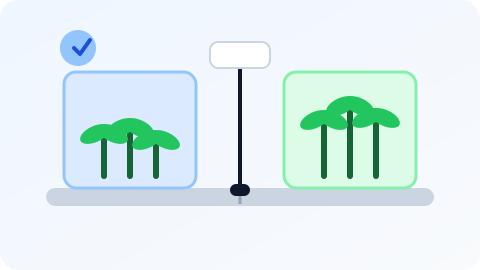
Open trial session →The heart of a fair test is simple: change one thing, measure one thing, and keep the rest the same. [[figure:fair_test_setup A controlled experiment compares …
Open trial session →A control group is not a useless group. It is the baseline that shows what happens without the treatment or under normal conditions. Without it, …
Open trial session →When a GED® question describes an experiment, read it in a steady order. First, find the question being tested. Second, identify what changed. Third, identify …
🔒 Enroll to unlock this session.
Course Syllabus
This self-paced GED® Science course follows a 4-lesson sequence. Work through the modules in order so that each skill supports the next.
Course sequence
Module 1 - Lessons 1-4
- A Good Scientific Question Can Be Tested
- Variables: Change One Thing at a Time
- Controls, Replication, Sample Size, and Bias
- Reading an Experiment Like a GED® Question
Practice and completion
- Use worked examples and lesson practice to check understanding after each module.
- Review incorrect answers, explain the correction, and repeat weak skills.
- Complete the available mixed or final course practice to demonstrate readiness.
Course Outcomes
By the end of this course, learners will be able to:
- Explain the key scientific ideas and vocabulary in A Good Scientific Question Can Be Tested.
- Interpret observations, data, models, or evidence related to Variables: Change One Thing at a Time.
- Apply scientific reasoning to questions involving Controls, Replication, Sample Size, and Bias.
- Evaluate explanations and identify common errors about Reading an Experiment Like a GED® Question.
- Use feedback and answer explanations to diagnose and correct mistakes.
- Complete mixed, exam-style practice with clearer reasoning and greater independence.
📝 Practice Questions
20 interactive questions with instant feedback and explanations.
Enroll for free to unlock the full practice bank after the trial sessions.