GED® Math Practice Test 6: Final Review
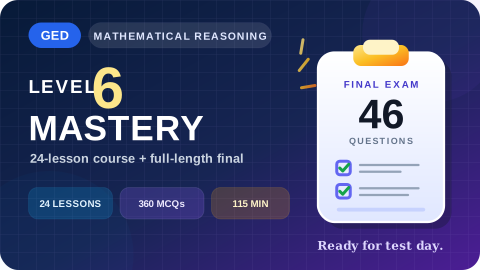
A 24-lesson GED® Mathematical Reasoning mastery course with 15 aligned MCQs per lesson and a sixth full-length, elite-ceiling practice exam for learners who have cleared Levels 1-5. Guided lessons develop no-calculator fluency, ratios and percent applications, algebra and functions, geometry and measurement, statistics and probability, multi-step modeling, calculator strategy, pacing, and error analysis. Its 360 session questions provide worked feedback before the final assessment, which keeps the test-day structure: 46 questions in 115 minutes, with 5 no-calculator questions followed by 41 calculator questions, a provided formula sheet, and detailed worked explanations with pro tips.
📚 Course Curriculum
Mastery Course Orientation and Baseline. Level 6 is a capstone, not a collection of tricks. The target is transfer:. when a problem looks unfamiliar, identify …
🔒 Enroll to unlock this session.
Exam Architecture, Timing, and Scoring. The assessment contains 46 questions in 115 minutes. Questions 1-5 form the. no-calculator section; Questions 6-46 allow the calculator. A …
🔒 Enroll to unlock this session.
Formula Sheet Fluency and Calculator Judgment. The formula sheet is a reference, not a substitute for interpretation. Before. substitution, name every variable and confirm compatible …
🔒 Enroll to unlock this session.
Fractional Exponents, Negative Exponents, and Radicals. Fractional exponents combine roots and powers:. The denominator is the root and the numerator is the power. Choose the …
🔒 Enroll to unlock this session.
Fractions, Complex Fractions, and Exact Arithmetic. Exact fraction work protects the no-calculator section and avoids premature. rounding. Use a common denominator for addition and subtraction, …
🔒 Enroll to unlock this session.
Ratios, Proportions, and Chained Relationships. A ratio compares labeled quantities in a fixed order. For chained ratios such. as \(A:B=2:3\) and \(B:C=4:5\), first make the …
🔒 Enroll to unlock this session.
Percent Change, Markup, Tax, Margin, and Interest. Identify the base before calculating. Percent change divides by the original. amount; markup is based on cost; profit …
🔒 Enroll to unlock this session.
Rates, Work, Mixtures, and Unit Conversion. Rate problems use amount = rate times time. For a multi-leg trip, total. average speed is total distance divided …
🔒 Enroll to unlock this session.
Polynomial and Rational Expression Fluency. Mastery algebra begins with structure. Before expanding, look for a common. factor, difference of squares, or trinomial pattern. Distribute every …
Open trial session →Linear Equations and Systems. Solve linear equations by preserving equality: apply the same valid operation. to both sides, collect variable terms, and isolate the variable. …
🔒 Enroll to unlock this session.
Inequalities and Absolute-Value Constraints. Solve a linear inequality like an equation, except that multiplying or dividing. by a negative reverses the inequality sign. Absolute value …
🔒 Enroll to unlock this session.
Coordinate Geometry: Slope, Distance, and Intersections. Slope is change in \(y\) per change in \(x\):. Parallel nonvertical lines have equal slopes; perpendicular slopes are negative. …
Open trial session →Functions, Notation, and Inverses. A function assigns one output to every allowed input. Function notation. \(f(3)\) means substitute 3 for the input; it does not …
🔒 Enroll to unlock this session.
Quadratics: Factoring, Formula, and Vertex Form. Choose a method by structure: factor when integer factors are visible, use. square roots for \((x-h)^2=k\), use the quadratic …
🔒 Enroll to unlock this session.
Exponential Models and Geometric Sequences. Linear change adds a constant amount; exponential change multiplies by a. constant factor. A model \(A=A_0b^t\) grows when \(b>1\) and …
🔒 Enroll to unlock this session.
Statistics: Center, Spread, Outliers, and Weighted Values. Choose a statistic for the question. The mean uses every value and is sensitive. to outliers; the median …
🔒 Enroll to unlock this session.
Probability, Conditional Reasoning, and Counting. Define the sample space before dividing. For two-way-table problems, add row and. column totals first. Conditional probability changes the denominator:. …
🔒 Enroll to unlock this session.
Triangles, Circles, and Special Geometry. Draw and label the figure before choosing a formula. Mark radii, diameters,. right angles, and corresponding sides. For a right …
🔒 Enroll to unlock this session.
Area, Surface Area, Volume, and Composite Solids. Dimension determines formula and units: length uses units, area uses square. units, and volume uses cubic units. For …
🔒 Enroll to unlock this session.
Similarity, Scale Factors, and Coordinate Distance. Similar figures have equal corresponding angles and proportional lengths. Identify the linear scale factor \(k\) first:. Perimeters scale by …
🔒 Enroll to unlock this session.
Multi-Step Modeling and Answer-Choice Strategy. Hard items combine familiar skills while hiding the target. Use one routine:. 1. List known quantities with units. 2. Circle …
Open trial session →No-Calculator Mastery Sprint. The first five questions demand exact, efficient work. Rehearse these habits:. Rewrite fractional exponents as roots and powers. Convert negative exponents to …
🔒 Enroll to unlock this session.
Calculator-Section Pacing and Verification. Treat the 41 calculator questions as a sequence of decisions. On the first pass,. capture direct setups and mark harder items …
🔒 Enroll to unlock this session.
Full-Length Exam Protocol and Error Analysis. Take the 46-question assessment in one protected 115-minute sitting. Use only. the allowed tools, silence notifications, and reproduce test …
🔒 Enroll to unlock this session.
Course Syllabus
GED® Mathematical Reasoning Level 6 — Mastery Syllabus
Course purpose
This capstone course prepares advanced GED® learners to solve difficult Mathematical
Reasoning items accurately, efficiently, and under time pressure. Twenty-four guided
lessons develop connected reasoning rather than isolated tricks. Each lesson includes
15 aligned MCQs with explanations (360 session questions total), followed by a
46-question full-length assessment.
Recommended schedule
Complete two lessons per week for 12 weeks, or use the course as a four-week
intensive review. Allow 35-50 minutes for Lessons 1-22, 25-35 minutes for Lesson 23,
and a protected 115-minute block for Lesson 24's final exam. Keep an error log and
rework missed skills after one day and again after one week.
Learning sequence
- Phase 1 — Readiness (Lessons 1-3): baseline diagnosis, exam structure,
formula-sheet fluency, calculator judgment, and pacing. - Phase 2 — Quantitative reasoning (Lessons 4-8): exponents, radicals,
fractions, ratios, percent applications, rates, mixtures, work, and conversions. - Phase 3 — Algebra and functions (Lessons 9-15): expressions, equations,
systems, inequalities, coordinate relationships, functions, quadratics,
exponentials, and sequences. - Phase 4 — Data and geometry (Lessons 16-20): statistics, probability,
counting, triangles, circles, area, surface area, volume, similarity, and distance. - Phase 5 — Integration (Lessons 21-24): unfamiliar modeling, no-calculator
fluency, calculator-section pacing, the timed exam, and evidence-based review.
Assessment
Every lesson contains retrieval checks and 15 formative MCQs, staged from foundational
recall to multi-step mastery. The capstone assessment contains 46 additional
multiple-choice questions: Questions 1-5 are no-calculator and Questions 6-46 allow
the calculator. Use 145 as the passing benchmark, but judge mastery by score, correct
setup, efficient tool choice, complete units, and a documented correction for every
error.
Course Outcomes
Learning outcomes
By the end of this course, the learner will be able to:
- Explain the exam structure and allocate 115 minutes across both sections.
- Evaluate fractional and negative exponents, complex fractions, and radicals
without a calculator. - Model multi-step ratio, rate, work, mixture, currency, and conversion problems.
- Distinguish percent change, percentage points, markup, tax, margin, and compound
growth and apply the correct base. - Simplify polynomial and rational expressions while preserving restrictions.
- Solve linear systems, rational and exponential equations, quadratics, quadratic
inequalities, and absolute-value constraints. - Interpret slope, distance, functions, inverses, vertex form, and sequence rules.
- Analyze center, spread, outliers, weighted values, and variance.
- Solve conditional-probability, addition-rule, permutation, and multi-stage
probability problems. - Apply geometry to triangles, circles, composite solids, surface area, volume,
coordinate distance, and similar figures with correct units. - Translate unfamiliar situations into diagrams, tables, equations, or
answer-choice tests and verify the result independently. - Complete 360 lesson MCQs and a timed 46-question mastery exam, using explanations
and error patterns to create specific, scheduled correction actions.
📝 Practice Questions
406 interactive questions with instant feedback and explanations.
Enroll for free to unlock the full practice bank after the trial sessions.