Week 10, Session 2: Exponential and Logarithmic Equations
Grade 11 Math: Advanced Algebra and Precalculus Foundations · preview lesson
Session Focus
Today you will solve exponential and logarithmic equations using common bases, inverse operations, and property-based rewriting. This session is written for independent study, but it should feel like a teacher is sitting beside you and asking the right questions at the right time. Read slowly, keep paper beside you, and do each example before you look at the explanation.
Key Language
exponential equation, logarithmic equation, common base, inverse, check
Teacher Explanation
Some exponential equations can be solved by rewriting both sides with the same base. Others require logarithms. Logarithmic equations often require condensing and always require checking the domain. This is a high-difficulty course, so the goal is not only to get an answer. The goal is to understand why the method works, what restrictions are present, and how the same idea appears in symbolic, graphical, numerical, and verbal forms.
When you study this session, use a three-pass routine. On the first pass, read the explanation and copy the main rule in your own words. On the second pass, redo the worked examples from a blank page. On the third pass, complete the independent practice without checking notes until you have a full attempt.
Visual Study Cue
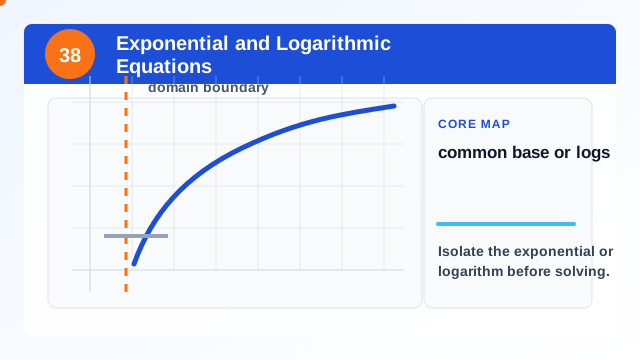
Use the image above as a quick map of the session. Before solving, name the main object in the visual, identify what is changing, and connect the picture to the rule below. This habit helps you move between graphical, symbolic, numerical, and verbal reasoning.
Core Rule
Use common bases when possible; otherwise isolate the exponential expression and apply a logarithm.
Worked Example 1: Solving with logarithms
Solve \(3(2^x) = 45\). Divide by 3 to get \(2^x=15\). Since 15 is not a simple power of 2, take logarithms: \(x=log(15)/log(2)\), which is about 3.907. This answer is reasonable because \(2^4=16\).
Pause after the example and ask yourself what made the solution move forward. Was it a definition, a theorem, a graph feature, an algebraic manipulation, or a domain restriction? Naming the reason matters because it helps you transfer the method to harder problems.
Worked Example 2: A second angle on the same idea
Solve \(\log_{3}(x-1)+\log_{3}(x+1)=2\). Condense the left side: \(\log_{3}((x-1)(x+1))=2\). Convert to exponential form: \((x-1)(x+1)=3^2=9\), so \(x^2-1=9\), and \(x^2=10\). Candidate solutions are \(x=\pmsqrt(10)\). Check the domain: \(x-1>0\) and \(x+1>0\), so \(x>1\). Only \(\sqrt{10}\) is valid.
Notice how the second example uses the same core idea but changes the surface details. That is deliberate. Advanced algebra and precalculus become difficult when a familiar idea is hidden inside a new representation. Your task is to recognize the structure underneath the wording.
Solve \(2^x=32\).
32 is 2^5.
Independent Practice
- Solve \(5^{x-1}=125\).
- Solve \(7e^{2x}=28\) using natural logarithms.
- Solve \(log(x)+log(x-9)=1\) and check domain.
Error-Log Reflection
After you finish, write one sentence beginning with "The step I must watch most carefully is..." Then write one sentence beginning with "The clue that tells me to use this method is..." These two sentences convert practice into self-learning because they make your decision process visible.
References
- Abramson, J. (2021). Algebra and trigonometry 2e. OpenStax. https://openstax.org/books/algebra-and-trigonometry-2e
- College Board. (2023). AP Precalculus course and exam description. https://apcentral.collegeboard.org/media/pdf/ap-precalculus-course-and-exam-description.pdf
- National Governors Association Center for Best Practices & Council of Chief State School Officers. (2010). Common Core State Standards for Mathematics. https://corestandards.org/wp-content/uploads/2023/09/Math_Standards1.pdf
No teacher notes have been added for this session.
No additional resources have been added for this session.
Lesson Discussion
Ask a question about this lesson. A teacher or admin can answer here.
Sign in to ask a question or save this lesson.
No questions yet for this lesson.