Week 10, Session 37: Solutions, Solutes, and Solvents
Grade 11 Chemistry: Term 1 Foundations · preview lesson
Session Focus
Today you will describe solutions using solute, solvent, concentration, and particle models. This course is designed for independent study, so move slowly: read, sketch, calculate, check, and then explain the idea aloud in your own words.
Key Language
solution, solute, solvent, aqueous, concentration, dissociation
Teacher Explanation
A solution is a homogeneous mixture. The solute is dissolved, and the solvent does the dissolving. In aqueous solutions, water is the solvent. At the particle level, dissolving means solute particles become dispersed among solvent particles. Ionic solutes may dissociate into ions.
Throughout the course, use three-level chemistry thinking. The macroscopic level is what can be observed or measured. The particle level is the model of atoms, molecules, and ions. The symbolic level is the language of formulas, equations, units, and calculations. When all three levels agree, your explanation becomes much stronger.
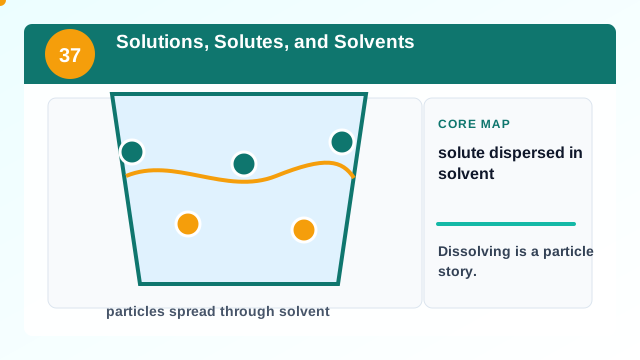
Visual Study Cue
Use the image above as a particle-and-symbol map. First name the visible chemistry idea, then point to the particle-level model, and finally connect the picture to a formula, unit, or equation from the lesson.
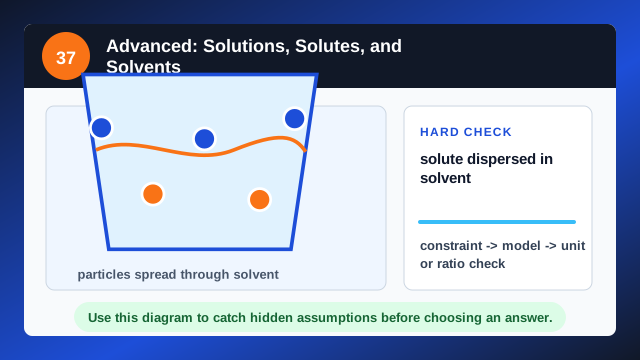
Advanced Visual Model
Now use the second image as a hard-question map. Identify the hidden constraint, the common wrong shortcut, and the check that would prove your answer is chemically reasonable. In harder Grade 11 chemistry, the diagram is not only decoration; it is a way to keep track of particles, units, charges, ratios, and evidence at the same time.
Core Model
Concentration describes how much solute is present relative to the amount of solution. More solute in the same volume means higher concentration.
Key Relationships to Remember
- Session target: describe solutions using solute, solvent, concentration, and particle models.
- Core model to preserve when numbers or wording change: Concentration describes how much solute is present relative to the amount of solution. More solute in the same volume means higher concentration.
- Worked-example anchor: Salt dissolving in water.
- Self-check anchor: In salt water, what is the solvent? Expected answer: water. Hint: The solvent is the substance doing the dissolving.
- Transfer rule: connect solution, solute, and dissociation before choosing an answer.
- Hard evidence check: solute particles, liters of solution, concentration, dilution, and ion mobility.
- Formula/evidence capsule for this unit:
- Molarity: \(M = \frac{\mathrm{mol\ solute}}{\mathrm{L\ solution}}\) (\(\mathrm{M}\) means \(\mathrm{mol/L}\)).
- Dilution: \(M_1V_1 = M_2V_2\), because moles of solute stay the same when only solvent is added.
- Conductivity needs mobile charged particles; strong electrolytes make many ions, nonelectrolytes make none.
Worked Example 1: Salt dissolving in water
When \(\mathrm{NaCl}\) dissolves, water molecules surround \(\mathrm{Na}^{+}\) and \(\mathrm{Cl}^{-}\) ions. The oxygen side of water is attracted to \(\mathrm{Na}^{+}\), while the hydrogen side is attracted to \(\mathrm{Cl}^{-}\). The ions separate and spread throughout the water, forming a homogeneous solution.
Pause and ask: What evidence or rule made the solution move forward? In chemistry, that reason is usually conservation of atoms, charge balance, particle attraction, energy change, or a mole ratio.
Worked Example 2: A second angle on the same idea
A saturated solution contains the maximum amount of solute that can dissolve under given conditions. If more solute is added, it remains undissolved unless conditions change.
Fresh Transfer Challenge
For this session only, change one meaningful condition in Salt dissolving in water: change the stock concentration or particle type and predict concentration plus conductivity. Then state what stays the same, what changes, and which evidence would prove the new answer.
High-Difficulty Extension
For Solutions, Solutes, and Solvents, the hard version is not simply remembering the phrase solution. The hard version is using the lesson's core model, Concentration describes how much solute is present relative to the amount of solution. More solute in the same volume means higher concentration., in an unfamiliar situation. Your answer should explicitly check solute particles, concentration units, dilution logic, and ion mobility. If the solution never uses the session focus - to describe solutions using solute, solvent, concentration, and particle models - then it is probably only a surface-level answer. A strong response names the hidden constraint, connects it to particles or measurements, and then proves the result with a formula, equation, graph, or evidence statement.
Hard-Question Strategy
For this session, solve hard questions in four passes. First, classify the chemistry idea. Second, draw or describe the particles. Third, write the symbolic relationship: formula, equation, charge balance, unit conversion, or mole ratio. Fourth, test the answer for reasonableness. Hard questions often feel new because the surface story changes, but the hidden structure is usually one of the course's core models.
Mini Investigation or Study Task
Draw three beakers at the particle level: dilute solution, concentrated solution, and saturated solution with undissolved solute.
In salt water, what is the solvent?
The solvent is the substance doing the dissolving.
Independent Practice
- Identify solute and solvent in sugar water.
- Explain what aqueous means.
- Describe how a concentrated solution differs from a dilute one at the particle level.
Error-Log Reflection
After you finish, write one sentence beginning with "The chemistry idea \(\mathrm{I}\) must remember is..." Then write one sentence beginning with "The evidence or unit that tells me what to do is..." This turns practice into self-correction.
Know More
- Use particle diagrams to compare dilute, concentrated, and saturated solutions.
- Clarify dissociation for ionic solutes and simple dispersion for molecular solutes.
- Add hydration ideas for ions in water.
Skill Builder
- Identify solute and solvent.
- Describe solution concentration qualitatively.
- Explain dissolving at the particle level.
Common Mistake
Students may confuse more solute with a different solvent role. Repair this by asking which substance does the dissolving.
Transfer Task
Describe three beakers at the particle level without using only visual words like 'stronger' or 'weaker'.
References
- Flowers, \(\mathrm{P}\)., Theopold, \(\mathrm{K}\)., Langley, R., Robinson, W. R., & OpenStax. (2019). Chemistry 2e. OpenStax. https://openstax.org/details/books/chemistry-2e
- NGSS Lead States. (2013). Next Generation Science Standards: For states, by states. The National Academies Press. https://www.nextgenscience.org/
- American Chemical Society. (2017). Safety in academic chemistry laboratories (8th ed.). American Chemical Society.
- Scite-indexed chemistry education source consulted: Connecting Macroscopic, Molecular, and Symbolic Representations with Immersive Technologies in High School Chemistry: The Case of Redox Reactions. https://doi.org/10.3390/educsci12070428
- Scite-indexed chemistry education source consulted: Effectiveness of Inquiry-Based Lessons Using Particulate Level Models To Develop High School Students' Understanding of Conceptual Stoichiometry. https://doi.org/10.1021/acs.jchemed.5b01010
- Scite-indexed chemistry education source consulted: Designing and Using an Atomic Model Kit with \(\mathrm{H}\), \(\mathrm{C}\), \(\mathrm{N}\), and \(\mathrm{O}\) Model Atoms Having a Mass Ratio of 1:12:14:16 to Teach the Concept of Mole and Associated Stoichiometric Relationships. https://doi.org/10.1021/acs.jchemed.9b00665
No teacher notes have been added for this session.
No additional resources have been added for this session.
Lesson Discussion
Ask a question about this lesson. A teacher or admin can answer here.
Sign in to ask a question or save this lesson.
No questions yet for this lesson.