Week 3, Session 2: Limits at Infinity and Horizontal Asymptotes
Grade 11 AP Calculus AB: One-Semester Course · preview lesson
Session Focus
So far every limit has been about \(x\) approaching a finite number. Today \(x\) grows without bound. Limits at infinity describe the end behavior of a function, and when they are finite they give horizontal asymptotes (CED Topic 1.15).
Learning Objectives
By the end of this session you should be able to:
- Evaluate limits of rational functions as \(x \to \pm\infty\) by comparing degrees.
- Handle radicals as \(x \to -\infty\) using \(\sqrt{x^2} = |x|\).
- Use limits at infinity to identify horizontal asymptotes, including functions with two different ones.
Key Language
limit at infinity, end behavior, horizontal asymptote, dominant term, degree
Teacher Explanation
The statement \(\displaystyle\lim_{x \to \infty} f(x) = L\) means \(f(x)\) can be made as close to \(L\) as we like by taking \(x\) large enough. When this happens (or when \(x \to -\infty\) gives \(L\)), the line \(y = L\) is a horizontal asymptote.
The basic fact is that \(\displaystyle\lim_{x \to \pm\infty} \frac{1}{x^n} = 0\) for any positive \(n\). To use it on a rational function, divide every term by the highest power of \(x\) in the denominator. The result is a rule you should know but also be able to justify:
- If the degree of the numerator is less than the degree of the denominator, the limit is 0.
- If the degrees are equal, the limit is the ratio of the leading coefficients.
- If the degree of the numerator is greater, the function is unbounded; there is no horizontal asymptote.
Radicals need care. Because \(\sqrt{x^2} = |x|\), and \(|x| = -x\) when \(x < 0\), a function such as \(\dfrac{\sqrt{4x^2 + 1}}{x}\) can approach different values at \(+\infty\) and \(-\infty\).
Exponential functions have their own end behavior: \(\displaystyle\lim_{x \to \infty} e^{-x} = 0\) and \(\displaystyle\lim_{x \to -\infty} e^{x} = 0\), while \(e^{x} \to \infty\) as \(x \to \infty\).
Visual Model
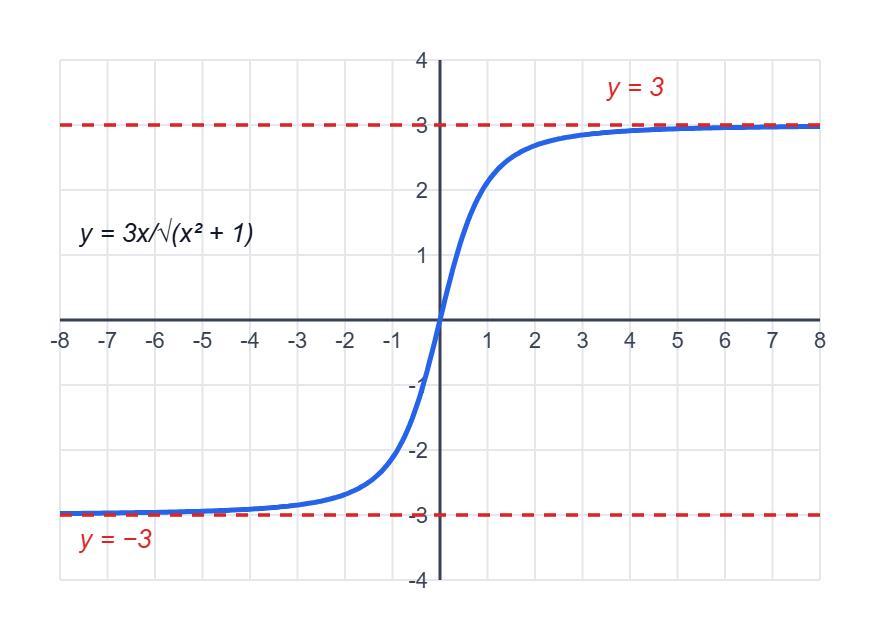
This function has two horizontal asymptotes, one at each end. A graph may also cross a horizontal asymptote; an asymptote describes end behavior only.
Core Rule
Divide numerator and denominator by the highest power of \(x\) in the denominator. When \(x \to -\infty\) and a square root is involved, remember that \(\sqrt{x^2} = -x\) for negative \(x\).
Worked Example 1: Equal degrees
Evaluate \(\displaystyle\lim_{x \to \infty} \frac{3x^2 - 5}{2x^2 + x}\).
Divide every term by \(x^2\): \(\dfrac{3 - \frac{5}{x^2}}{2 + \frac{1}{x}}\). As \(x \to \infty\), the small terms vanish, leaving \(\dfrac{3}{2}\). The horizontal asymptote is \(y = \frac{3}{2}\).
Worked Example 2: Two different horizontal asymptotes
Evaluate \(\displaystyle\lim_{x \to \infty} \frac{3x}{\sqrt{x^2 + 1}}\) and \(\displaystyle\lim_{x \to -\infty} \frac{3x}{\sqrt{x^2 + 1}}\).
Factor \(x^2\) out of the root: \(\sqrt{x^2 + 1} = \sqrt{x^2}\sqrt{1 + \frac{1}{x^2}} = |x|\sqrt{1 + \frac{1}{x^2}}\).
As \(x \to \infty\), \(|x| = x\), so the expression becomes \(\dfrac{3}{\sqrt{1 + 1/x^2}} \to 3\).
As \(x \to -\infty\), \(|x| = -x\), so the expression becomes \(\dfrac{3x}{-x\sqrt{1 + 1/x^2}} = \dfrac{-3}{\sqrt{1 + 1/x^2}} \to -3\).
The graph has horizontal asymptotes \(y = 3\) and \(y = -3\), exactly as the picture shows.
Worked Example 3: A difference with a radical
Evaluate \(\displaystyle\lim_{x \to \infty} \left(\sqrt{x^2 + 6x} - x\right)\).
This is \(\infty - \infty\), which is indeterminate. Multiply by the conjugate:
\[\frac{(x^2 + 6x) - x^2}{\sqrt{x^2 + 6x} + x} = \frac{6x}{\sqrt{x^2 + 6x} + x} = \frac{6}{\sqrt{1 + \frac{6}{x}} + 1} \to \frac{6}{2} = 3.\]
What is \(\displaystyle\lim_{x \to \infty} \frac{4x + 1}{x^2 + 3}\)?
The numerator has lower degree than the denominator. Dividing by \(x^2\) gives \(\frac{4/x + 1/x^2}{1 + 3/x^2} \to \frac{0}{1} = 0\).
Common Errors to Avoid
- Using the leading-coefficient rule when the degrees are not equal.
- Treating \(\sqrt{x^2}\) as \(x\) when \(x \to -\infty\).
- Assuming \(\infty - \infty = 0\) or \(\frac{\infty}{\infty} = 1\). Both are indeterminate.
Independent Practice
- Find all horizontal asymptotes of \(f(x) = \dfrac{2x^3 + x}{4 - x^3}\).
- Evaluate \(\displaystyle\lim_{x \to -\infty} \frac{\sqrt{4x^2 + 1}}{x - 3}\).
- Use the Squeeze Theorem to evaluate \(\displaystyle\lim_{x \to \infty} \frac{\sin x}{x}\).
Error-Log Reflection
When you finish, write two sentences in your notebook. The first begins with "The step I must watch most carefully is..." The second begins with "The clue that tells me to use this method is..." Keep these sentences in one running error log for the whole course. Before every unit assessment, reread the log; it is a record of your own decision-making, and it is the fastest review tool you will have.
References
- College Board. (2020). AP Calculus AB and BC course and exam description (Effective Fall 2020). https://apcentral.collegeboard.org/media/pdf/ap-calculus-ab-and-bc-course-and-exam-description.pdf
- Strang, G., & Herman, E. (2016). Calculus volume 1. OpenStax. https://openstax.org/details/books/calculus-volume-1
- Stewart, J., Clegg, D., & Watson, S. (2021). Calculus: Early transcendentals (9th ed.). Cengage Learning.
No teacher notes have been added for this session.
No additional resources have been added for this session.
Lesson Discussion
Ask a question about this lesson. A teacher or admin can answer here.
Sign in to ask a question or save this lesson.
No questions yet for this lesson.