Week 4, Session 1: Average and Instantaneous Rates of Change
Grade 11 AP Calculus AB: One-Semester Course · preview lesson
Session Focus
Unit 2 begins with the question that opened the course: how fast is something changing at a single instant? In Unit 1 you built the tool, the limit. Today you use it to define the instantaneous rate of change precisely, in two equivalent forms, and to interpret rates in context with units (CED Topic 2.1).
Learning Objectives
By the end of this session you should be able to:
- Compute average rates of change from formulas, tables, and context.
- Express the instantaneous rate of change at \(x = a\) as a limit of a difference quotient in two forms.
- Recognize a given limit as an instantaneous rate of change of a specific function at a specific point.
Key Language
difference quotient, secant line, tangent line, average rate of change, instantaneous rate of change
Teacher Explanation
The average rate of change of \(f\) on \([a, a + h]\) is the difference quotient
\[\frac{f(a + h) - f(a)}{h}.\]
It is the slope of the secant line through \((a, f(a))\) and \((a + h, f(a + h))\).
The instantaneous rate of change of \(f\) at \(x = a\) is the limit of this quotient as \(h \to 0\):
\[\lim_{h \to 0} \frac{f(a + h) - f(a)}{h}.\]
Geometrically, it is the slope of the tangent line at \((a, f(a))\).
There is a second, equivalent form. If you call the second point \(x\) instead of \(a + h\), then \(h = x - a\), and \(h \to 0\) exactly when \(x \to a\):
\[\lim_{x \to a} \frac{f(x) - f(a)}{x - a}.\]
Both forms appear on the AP exam. You should be able to read either one and say "this is the instantaneous rate of change of \(f\) at \(a\)."
Visual Model
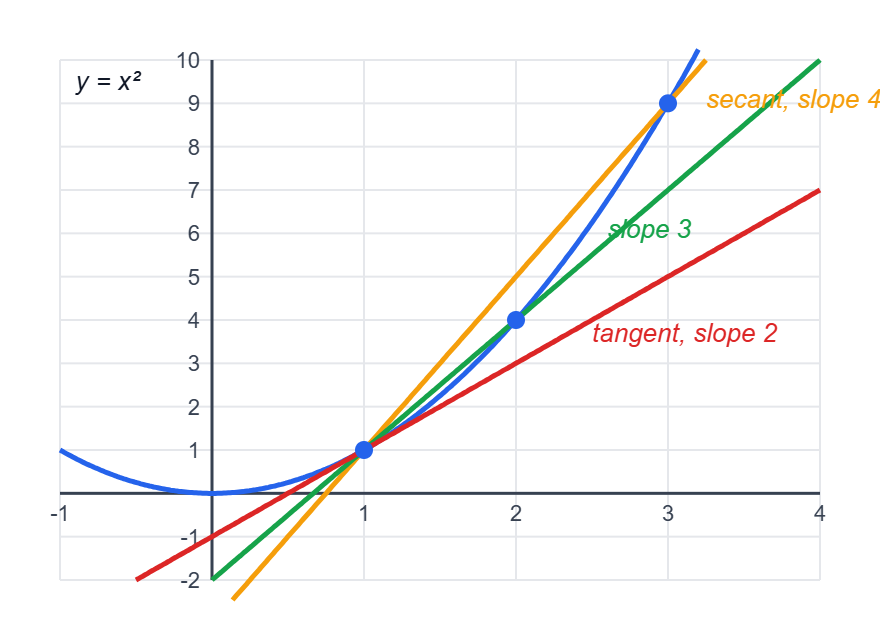
As the second point slides toward \((1, 1)\), the secant slopes 4, 3, \(\ldots\) close in on the tangent slope 2.
Core Rule
Average rate: two points, one division. Instantaneous rate: the limit of average rates as the interval shrinks to a point. In context, both carry units of output per unit of input.
Worked Example 1: Both limit forms
Find the instantaneous rate of change of \(f(x) = x^2 + 2x\) at \(x = 1\).
Form 1: \(f(1 + h) = 1 + 2h + h^2 + 2 + 2h = h^2 + 4h + 3\) and \(f(1) = 3\). So
\[\lim_{h \to 0} \frac{h^2 + 4h}{h} = \lim_{h \to 0} (h + 4) = 4.\]
Form 2:
\[\lim_{x \to 1} \frac{x^2 + 2x - 3}{x - 1} = \lim_{x \to 1} \frac{(x + 3)(x - 1)}{x - 1} = \lim_{x \to 1} (x + 3) = 4.\]
The two forms agree, as they must.
Worked Example 2: Estimating a rate from data
The temperature of a room, in degrees Fahrenheit, is recorded at \(t\) hours: \(T(2) = 60\), \(T(4) = 66\), \(T(6) = 75\). Estimate the rate at which the temperature is changing at \(t = 4\).
The best estimate uses the interval that surrounds \(t = 4\) as closely as the data allow: \(\dfrac{T(6) - T(2)}{6 - 2} = \dfrac{15}{4} = 3.75\) degrees Fahrenheit per hour. In a sentence: at 4 hours, the temperature is increasing at approximately 3.75 degrees Fahrenheit per hour.
Worked Example 3: Recognizing a limit
What does \(\displaystyle\lim_{h \to 0} \frac{(2 + h)^3 - 8}{h}\) represent, and what is its value?
Match it to Form 1: \(f(a + h) = (2 + h)^3\) and \(f(a) = 8 = 2^3\), so \(f(x) = x^3\) and \(a = 2\). It is the instantaneous rate of change of \(x^3\) at \(x = 2\). Expanding, \((2 + h)^3 - 8 = 12h + 6h^2 + h^3\), so the quotient is \(12 + 6h + h^2 \to 12\).
What is the average rate of change of \(f(x) = x^3\) on \([1, 3]\)?
\(\frac{27 - 1}{3 - 1} = \frac{26}{2} = 13\).
Common Errors to Avoid
- Writing \(f(a + h) = f(a) + h\) or \(f(a) + f(h)\).
- Reporting a rate without units, or with the units of the output only.
- Using a one-sided interval from a table when a symmetric interval around the point is available.
Independent Practice
- Use Form 2 to find the instantaneous rate of change of \(g(x) = 3x^2 - x\) at \(x = 2\).
- Identify \(f\) and \(a\) for \(\displaystyle\lim_{x \to 4} \frac{\sqrt{x} - 2}{x - 4}\), then evaluate it.
- A car's position (in miles) is \(s(t)\) at \(t\) hours. Write a sentence interpreting \(\dfrac{s(3) - s(1)}{2} = 48\).
Error-Log Reflection
When you finish, write two sentences in your notebook. The first begins with "The step I must watch most carefully is..." The second begins with "The clue that tells me to use this method is..." Keep these sentences in one running error log for the whole course. Before every unit assessment, reread the log; it is a record of your own decision-making, and it is the fastest review tool you will have.
References
- College Board. (2020). AP Calculus AB and BC course and exam description (Effective Fall 2020). https://apcentral.collegeboard.org/media/pdf/ap-calculus-ab-and-bc-course-and-exam-description.pdf
- Strang, G., & Herman, E. (2016). Calculus volume 1. OpenStax. https://openstax.org/details/books/calculus-volume-1
- Stewart, J., Clegg, D., & Watson, S. (2021). Calculus: Early transcendentals (9th ed.). Cengage Learning.
No teacher notes have been added for this session.
No additional resources have been added for this session.
Lesson Discussion
Ask a question about this lesson. A teacher or admin can answer here.
Sign in to ask a question or save this lesson.
No questions yet for this lesson.