Week 1, Session 2: Thinking Like a Biologist
Grade 11 Biology: Term 1 Foundations · preview lesson
Estimated time: 80 minutes
Science practice: Planning Investigations and Analyzing Data
Start with a question
Someone tells you, “Plants grow better when music is playing.” That statement sounds testable, but it is still too vague. What kind of plant? What counts as “better”? What music, at what volume, and for how long? Science begins with curiosity, but it moves forward by turning curiosity into questions that evidence can answer.
By the end, you can
- distinguish observations, inferences, hypotheses, and predictions;
- identify independent, dependent, and controlled variables; and
- evaluate whether data justify a conclusion.
Learn the idea
An observation is information gathered with the senses or measuring tools: “The plant is 14.2 centimeters tall.” An inference is an interpretation: “The plant grew slowly because it lacked nitrogen.” The inference may be sensible, but it needs evidence.
A useful hypothesis is a tentative explanation grounded in prior knowledge. A prediction states what should happen if that explanation is reasonable. For example: “Blue light is absorbed efficiently by chlorophyll, so plants grown under blue light will produce oxygen faster than identical plants under green light.” This sentence gives a reason and a measurable expectation.
In a controlled experiment, the independent variable is intentionally changed. The dependent variable is measured as the response. Other relevant conditions become controlled variables. A control group or comparison condition helps reveal what would happen without the treatment. A fair test changes one main factor while holding plausible alternatives steady.
Repeating measurements improves reliability by reducing the influence of random variation. Using an appropriate method improves validity, meaning the investigation actually tests the proposed idea. Ten repeated measurements with a poorly chosen ruler can be reliable but not valid. Scientists report uncertainty, look for outliers, and avoid changing a conclusion simply because the result was unexpected.
Correlation also deserves caution. Ice-cream sales and sunburn cases rise together in summer, but ice cream does not cause sunburn. Warm, sunny weather affects both. A hidden confounding variable can create a relationship that looks causal.
Study the visual
Alt text: A student compares aquatic plants in identical beakers under different colored lights while recording bubble production.
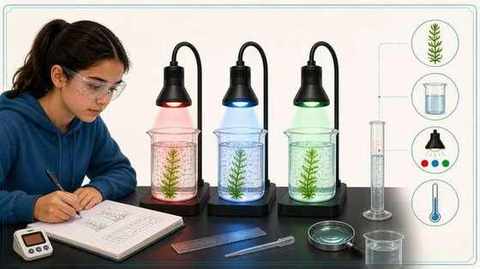
Identify the independent variable, dependent variable, and at least four controlled variables. The light color is changed. Oxygen production could be estimated through bubbles per minute, although collecting oxygen volume would be more accurate. Plant species and size, water temperature, lamp distance, carbon dioxide availability, trial time, and container volume should stay consistent.
Try it yourself
Design a safe investigation of how water temperature affects the time a sugar cube takes to dissolve. Write a question, hypothesis with reasoning, variables, procedure, data table, and one safety note. Do not run the test unless an adult approves the temperatures and containers.
Check yourself
- “The leaves are yellow” is an observation or inference?
- In a caffeine-and-heart-rate study, what is the dependent variable?
- Why is a large sample usually better than one subject?
- A study finds that students who sleep longer earn higher grades. What can you conclude?
Answer and feedback
- Observation. A cause for the yellow color would be an inference.
- Heart rate, measured after a defined caffeine dose and time.
- Individuals vary. A larger sample makes one unusual result less influential and better represents the population.
- The variables are associated, but this alone does not prove that extra sleep caused the grades. Study habits, health, and schedule could influence both.
Key vocabulary: observation, inference, hypothesis, prediction, variable, control, reliability, validity, correlation
Exit reflection: What is one change that would make your proposed investigation more trustworthy?
-
Session 2 illustration
Enroll to download
No additional resources have been added for this session.
Lesson Discussion
Ask a question about this lesson. A teacher or admin can answer here.
Sign in to ask a question or save this lesson.
No questions yet for this lesson.