Week 5, Session 10: The Cell Membrane: A Living Boundary
Grade 11 Biology: Term 1 Foundations · preview lesson
Estimated time: 75 minutes
NGSS connection: HS-LS1-2, HS-LS1-3
Start at the edge
A cell cannot remain alive if everything inside freely mixes with everything outside. At the same time, a completely sealed cell would starve and accumulate waste. The plasma membrane solves both problems by creating a flexible, selective, responsive boundary.
By the end, you can
- describe the fluid mosaic model;
- predict how different substances cross a membrane; and
- relate membrane components to transport, signaling, and recognition.
Learn the idea
The membrane's foundation is a phospholipid bilayer. Each phospholipid has a polar, hydrophilic head and two nonpolar, hydrophobic tails. In water, heads face the watery cytoplasm and extracellular fluid while tails turn inward. The bilayer forms because of chemical interactions, not because each molecule is consciously arranged.
The membrane is fluid: many lipids and proteins move sideways. It is a mosaic because different proteins, carbohydrates, and lipids are embedded or attached. Cholesterol helps moderate fluidity in animal-cell membranes, reducing excessive movement at high temperatures and preventing tight packing at low temperatures.
Small nonpolar molecules such as oxygen and carbon dioxide can pass through the lipid region fairly easily. Ions and most large or polar molecules face the membrane's hydrophobic interior and require transport proteins. Channel proteins create selective pores. Carrier proteins bind a substance and change shape. Aquaporins are channels that greatly speed water movement.
Other proteins act as receptors, enzymes, anchors, or identity tags. Carbohydrate chains attached to proteins or lipids help cells recognize one another. The specific mix of membrane molecules varies among cell types and even among regions of one cell.
Selective permeability is dynamic. A signal can open an ion channel. A transporter can become more abundant. A membrane can bend, fuse, and form a vesicle. The boundary is active and responsive, even when transport itself does not require ATP.
Study the visual
Alt text: A molecular close-up shows phospholipids, cholesterol, channel and receptor proteins, and carbohydrate chains at a cell boundary.
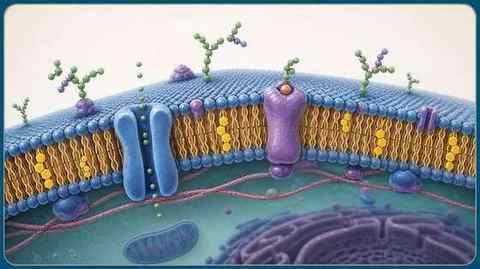
Locate the water-facing heads and inward-facing tails. Predict where a polar amino acid on a membrane protein is likely to face and where a nonpolar amino acid might sit. Protein chemistry helps stabilize the protein in both watery and lipid environments.
Build a membrane model
Draw ten phospholipids in a bilayer and add cholesterol, a channel, a receptor, and a carbohydrate chain. Use arrows to show oxygen, sodium ions, and a large protein approaching. Decide which can cross directly, which needs help, and which may need a vesicle.
Check yourself
- Why does a bilayer form in water?
- What does “fluid mosaic” mean?
- Why can oxygen cross more easily than sodium ions?
- Name one function of a membrane protein unrelated to transport.
Answer and feedback
- Hydrophilic heads interact with water while hydrophobic tails cluster away from it.
- Components can move within a patchwork of many molecule types.
- Oxygen is small and nonpolar; a charged sodium ion is unfavorable in the hydrophobic interior.
- Receptor signaling, enzymatic activity, attachment to cytoskeleton, or cell recognition.
Key vocabulary: phospholipid bilayer, hydrophilic, hydrophobic, fluid mosaic, selective permeability, channel, carrier, receptor
Exit reflection: How does the membrane behave more like a busy border than a plastic bag?
-
Session 10 illustration
Enroll to download
No additional resources have been added for this session.
Lesson Discussion
Ask a question about this lesson. A teacher or admin can answer here.
Sign in to ask a question or save this lesson.
No questions yet for this lesson.