13. One-Step and Two-Step Linear Equations
GED® Math Basics · preview lesson
13. One-Step and Two-Step Linear Equations
Learning goals
- Solve one-step equations with all four operations.
- Solve two-step equations with signed and decimal coefficients.
- Check solutions by substitution.
- Translate practical fixed-fee and unknown-quantity situations into equations.
Entry retrieval and orientation
Retrieve expression evaluation from Session 12. Replace a proposed solution in the original equation and decide whether the resulting statement is true.
Begin without notes. Spend three to five minutes writing what you remember, even if the first attempt is incomplete. Retrieval is useful because it reveals what is available from memory rather than what merely feels familiar on the page. After the attempt, compare it with the lesson and correct it in a different color. Keep the correction specific: identify the decision, operation, sign, unit, or interpretation that needs attention.
Why this session matters
Solving an equation means finding every value that makes its two sides equal. The balance principle explains the process: applying the same valid operation to both sides preserves equality. Inverse operations then undo the steps around the variable.
Mathematical readiness includes more than producing a number. A complete solution states what is known, what is being asked, which relationship connects those quantities, how the calculation proceeds, and why the result is reasonable. Throughout this session, read units as part of the mathematics. When a context changes, preserve the underlying relationship while adapting the representation.
Visual model
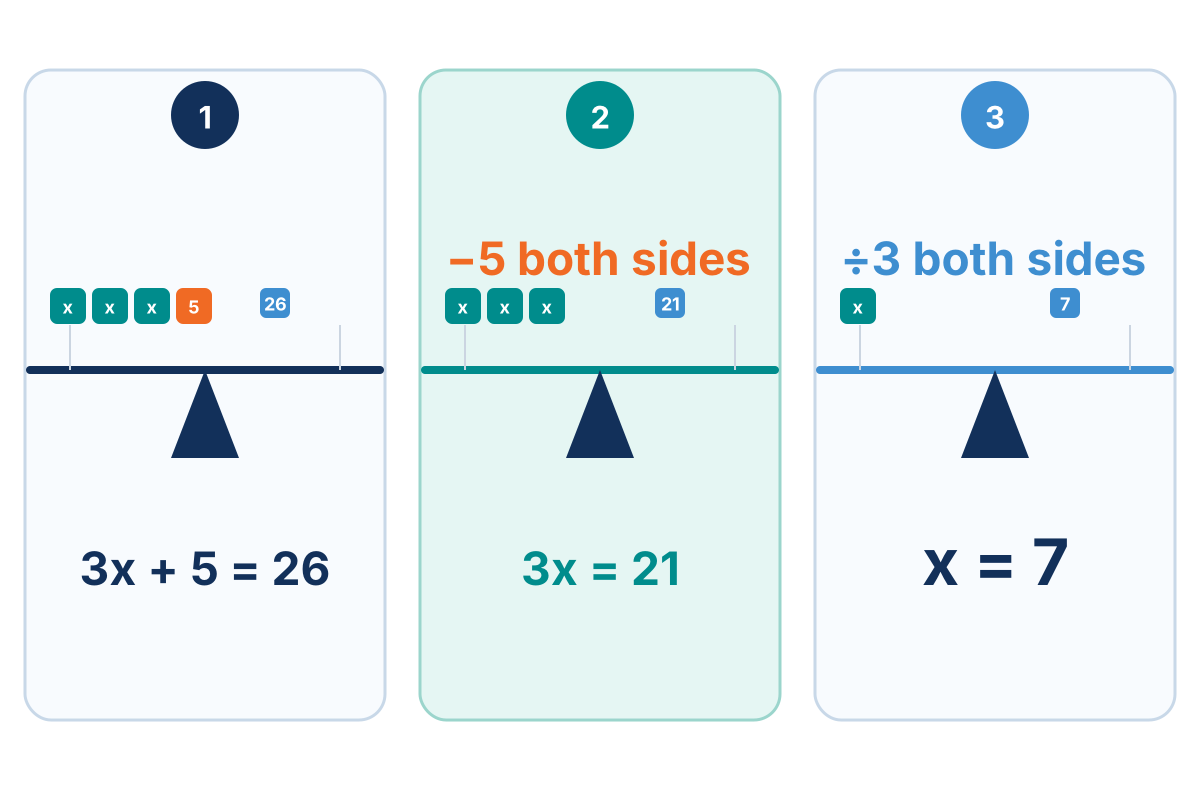
How to read this visual. Each operation is applied equally to both sides: subtract 5 to obtain 3x = 21, then divide both sides by 3 to obtain x = 7.
Core lesson
Core idea 1. An equation is balanced because its left and right expressions represent the same value. A solution is not merely the last number written; it is a value that survives substitution into the original statement.
Core idea 2. Inverse operations undo one another: addition and subtraction, multiplication and division, squaring and square roots in suitable settings. To isolate a variable, reverse the order in which operations act on it.
Core idea 3. A two-step equation such as 3x + 5 = 26 is solved by removing the added 5 before dividing by 3. Dividing too early can work only if every term is divided, which often introduces avoidable fractions.
Core idea 4. Word problems become equations after the unknown is defined and the fixed and variable quantities are separated. Units help determine which quantities may be added.
These ideas work together. Do not treat a formula or procedure as an isolated password. Ask what each number represents, which values may legitimately be combined, and what must remain invariant while the calculation changes form. A method becomes transferable when you can explain both what to do and why the step preserves the quantity or relationship in the problem.
A reliable problem-solving method
- Define the variable and write the equality.
- Simplify either side if needed.
- Undo addition or subtraction around the variable.
- Undo multiplication or division.
- Substitute the result into the original equation.
Before calculating, make a rough prediction. The prediction may concern sign, magnitude, direction of change, position on a graph, or the power on a unit. After calculating, compare the exact result with that prediction. If they disagree, pause and inspect the setup before repeating the same keystrokes. A second method—substitution, inverse operation, alternate representation, or bounding estimate—provides stronger evidence than simply repeating one procedure.
Connect multiple representations
- A balance scale models equal operations on both sides.
- Flow diagrams show operations acting on a variable and inverse operations reversing them.
- Cost tables distinguish a fixed fee from a per-unit term.
Practice translating among words, symbols, tables, diagrams, and graphs. Translation is not an optional decoration: it often exposes information that is hard to see in the original form. Describe what stays the same across representations. For example, a rate remains the same comparison whether it appears as a verbal 'per' statement, a fraction with units, a table pattern, a graph slope, or a coefficient in an equation.
Ten fully worked examples
The examples begin with focused practice and become more mixed. For each one, pause after reading the problem and write a plan before revealing the solution. Then cover the completed work and reproduce it from a blank page. The goal is to learn a decision process, not to memorize the displayed numbers.
Worked example 1
Problem. Solve x + 9 = 23.
Answer. x = 14
Plan. Model equality, reverse operations in a controlled order, and prove the solution by substitution into the original equation. In this example, identify the quantities and explain why this relationship fits before doing arithmetic.
Calculation. Undo addition by subtracting 9 from both sides: x = 23 - 9 = 14.
Verification. Substitute: 14 + 9 = 23.
Self-explanation prompt. Cover the solution and reproduce it. Then name the first decision that made the remaining calculation possible, and explain why one tempting alternative method would fail.
Worked example 2
Problem. Solve y - 17 = -4.
Answer. y = 13
Plan. Model equality, reverse operations in a controlled order, and prove the solution by substitution into the original equation. In this example, identify the quantities and explain why this relationship fits before doing arithmetic.
Calculation. Undo subtraction by adding 17 to both sides: y = -4 + 17 = 13.
Verification. Check: 13 - 17 = -4.
Self-explanation prompt. Cover the solution and reproduce it. Then name the first decision that made the remaining calculation possible, and explain why one tempting alternative method would fail.
Worked example 3
Problem. Solve 6m = 54.
Answer. m = 9
Plan. Model equality, reverse operations in a controlled order, and prove the solution by substitution into the original equation. In this example, identify the quantities and explain why this relationship fits before doing arithmetic.
Calculation. Divide both sides by the coefficient 6: m = 54/6 = 9.
Verification. Check: 6 x 9 = 54.
Self-explanation prompt. Cover the solution and reproduce it. Then name the first decision that made the remaining calculation possible, and explain why one tempting alternative method would fail.
Worked example 4
Problem. Solve n/8 = 7.
Answer. n = 56
Plan. Model equality, reverse operations in a controlled order, and prove the solution by substitution into the original equation. In this example, identify the quantities and explain why this relationship fits before doing arithmetic.
Calculation. Multiply both sides by 8: n = 7 x 8 = 56.
Verification. Check: 56/8 = 7.
Self-explanation prompt. Cover the solution and reproduce it. Then name the first decision that made the remaining calculation possible, and explain why one tempting alternative method would fail.
Worked example 5
Problem. Solve 3x + 5 = 26.
Answer. x = 7
Plan. Model equality, reverse operations in a controlled order, and prove the solution by substitution into the original equation. In this example, identify the quantities and explain why this relationship fits before doing arithmetic.
Calculation. Undo operations in reverse order: subtract 5 to get 3x = 21, then divide by 3 to get x = 7.
Verification. Check: 3(7) + 5 = 26.
Self-explanation prompt. Cover the solution and reproduce it. Then name the first decision that made the remaining calculation possible, and explain why one tempting alternative method would fail.
Worked example 6
Problem. Solve 4 - 2p = 18.
Answer. p = -7
Plan. Model equality, reverse operations in a controlled order, and prove the solution by substitution into the original equation. In this example, identify the quantities and explain why this relationship fits before doing arithmetic.
Calculation. Subtract 4 from both sides: -2p = 14. Divide by -2 to get p = -7.
Verification. Check: 4 - 2(-7) = 4 + 14 = 18.
Self-explanation prompt. Cover the solution and reproduce it. Then name the first decision that made the remaining calculation possible, and explain why one tempting alternative method would fail.
Worked example 7
Problem. Solve x/5 - 3 = 9.
Answer. x = 60
Plan. Model equality, reverse operations in a controlled order, and prove the solution by substitution into the original equation. In this example, identify the quantities and explain why this relationship fits before doing arithmetic.
Calculation. Add 3 to get x/5 = 12, then multiply by 5: x = 60.
Verification. Check: 60/5 - 3 = 12 - 3 = 9.
Self-explanation prompt. Cover the solution and reproduce it. Then name the first decision that made the remaining calculation possible, and explain why one tempting alternative method would fail.
Worked example 8
Problem. A gym charges a $25 registration fee plus $18 per month. The first bill is $97. How many months are included?
Answer. 4 months
Plan. Model equality, reverse operations in a controlled order, and prove the solution by substitution into the original equation. In this example, identify the quantities and explain why this relationship fits before doing arithmetic.
Calculation. Write 25 + 18m = 97. Subtract 25 to get 18m = 72; divide by 18 to get m = 4.
Verification. Fee plus four months is 25 + 72 = 97.
Self-explanation prompt. Cover the solution and reproduce it. Then name the first decision that made the remaining calculation possible, and explain why one tempting alternative method would fail.
Worked example 9
Problem. The perimeter of an equilateral triangle is 42 cm. Find one side.
Answer. 14 cm
Plan. Model equality, reverse operations in a controlled order, and prove the solution by substitution into the original equation. In this example, identify the quantities and explain why this relationship fits before doing arithmetic.
Calculation. Three equal sides give 3s = 42. Divide by 3: s = 14 cm.
Verification. Three sides of 14 cm total 42 cm.
Self-explanation prompt. Cover the solution and reproduce it. Then name the first decision that made the remaining calculation possible, and explain why one tempting alternative method would fail.
Worked example 10
Problem. A number decreased by 35% of itself is 78. Find the number.
Answer. 120
Plan. Model equality, reverse operations in a controlled order, and prove the solution by substitution into the original equation. In this example, identify the quantities and explain why this relationship fits before doing arithmetic.
Calculation. Keeping 65% gives 0.65x = 78. Divide by 0.65 to get x = 120.
Verification. Thirty-five percent of 120 is 42, and 120 - 42 = 78.
Self-explanation prompt. Cover the solution and reproduce it. Then name the first decision that made the remaining calculation possible, and explain why one tempting alternative method would fail.
Common mistakes and how to repair them
- Mistake: Moving a term across the equals sign without explaining a sign change Correction: Use the same inverse operation on both sides. Write a one-sentence reason the correction is mathematically valid, not merely a rule to memorize.
- Mistake: Dividing only one term on a side Correction: An operation applies to the entire expression on that side. Write a one-sentence reason the correction is mathematically valid, not merely a rule to memorize.
- Mistake: Stopping without checking Correction: Substitution catches sign and arithmetic errors quickly. Write a one-sentence reason the correction is mathematically valid, not merely a rule to memorize.
An error log should record the first point where correct reasoning diverged, not only the final wrong answer. Classify the error as interpretation, representation, formula choice, operation, sign, substitution, arithmetic, unit, rounding, or final-answer communication. Then rewrite the problem with one change in numbers and solve it correctly. This turns feedback into a reusable prevention habit.
Adult-life transfer
This session's reasoning appears in:
- membership and phone plans
- unknown dimensions
- reverse-percent and rate problems
For one application, create your own realistic values and state any assumptions. Solve it, then change one condition and predict how the answer should change before recalculating. This variation step distinguishes genuine understanding from imitation. A strong model also acknowledges constraints: counts may need whole numbers, lengths cannot be negative, spending cannot exceed a budget, and reported precision should match the given data.
Independent practice and spaced review
Use a three-pass routine. On the first pass, complete two near examples immediately after study so the new method is stable. On the second pass, wait until later the same day and solve two problems without notes. On the third pass, return after at least one day and mix this topic with earlier sessions so the method is not announced. Mark confidence before checking; high confidence paired with an error deserves special attention because it signals a misconception rather than a simple lapse.
Build a six-item retrieval set: two direct problems from this session, two application problems with unfamiliar wording, and two cumulative problems from earlier sessions. For every missed item, study the explanation briefly, close it, and solve the problem again from the beginning. Do not copy line by line while looking. The second attempt should be a retrieval attempt, and a third parallel problem should confirm that the correction transfers.
Explain one solution aloud as if teaching a learner who chose a common distractor. Name why that distractor is tempting and identify the exact mathematical principle that rejects it. Finally, write a one-minute summary containing the main relationship, a unit or sign check, and one situation in which the method should not be used. This summary becomes the entry retrieval prompt for a later study session.
Mastery checklist
- I can meet each learning goal without copying a worked example.
- I can select the method when the problem does not name the topic.
- I can show a representation, calculation, and verification.
- I can explain one common mistake and repair it.
- I can solve at least twelve of fifteen aligned practice questions and correct every miss.
- I can return after a delay and solve a mixed problem with appropriate units and a complete answer sentence.
No teacher notes have been added for this session.
No additional resources have been added for this session.
Lesson Discussion
Ask a question about this lesson. A teacher or admin can answer here.
Sign in to ask a question or save this lesson.
No questions yet for this lesson.