20. Pythagorean Theorem and Coordinate Geometry
GED® Math Basics · preview lesson
20. Pythagorean Theorem and Coordinate Geometry
Learning goals
- Find a missing leg or hypotenuse in a right triangle.
- Use the converse to test whether a triangle is right.
- Calculate coordinate distance and midpoint.
- Use coordinate differences to measure and analyze figures.
Entry retrieval and orientation
Retrieve exponents and roots from Session 4 and slope differences from Session 15. Recognize 3-4-5, 5-12-13, 6-8-10, and 8-15-17 triples.
Begin without notes. Spend three to five minutes writing what you remember, even if the first attempt is incomplete. Retrieval is useful because it reveals what is available from memory rather than what merely feels familiar on the page. After the attempt, compare it with the lesson and correct it in a different color. Keep the correction specific: identify the decision, operation, sign, unit, or interpretation that needs attention.
Why this session matters
The Pythagorean theorem links the side lengths of right triangles and powers many coordinate-distance calculations. Coordinate geometry converts horizontal and vertical movement into lengths, midpoints, areas, and geometric evidence.
Mathematical readiness includes more than producing a number. A complete solution states what is known, what is being asked, which relationship connects those quantities, how the calculation proceeds, and why the result is reasonable. Throughout this session, read units as part of the mathematics. When a context changes, preserve the underlying relationship while adapting the representation.
Visual model
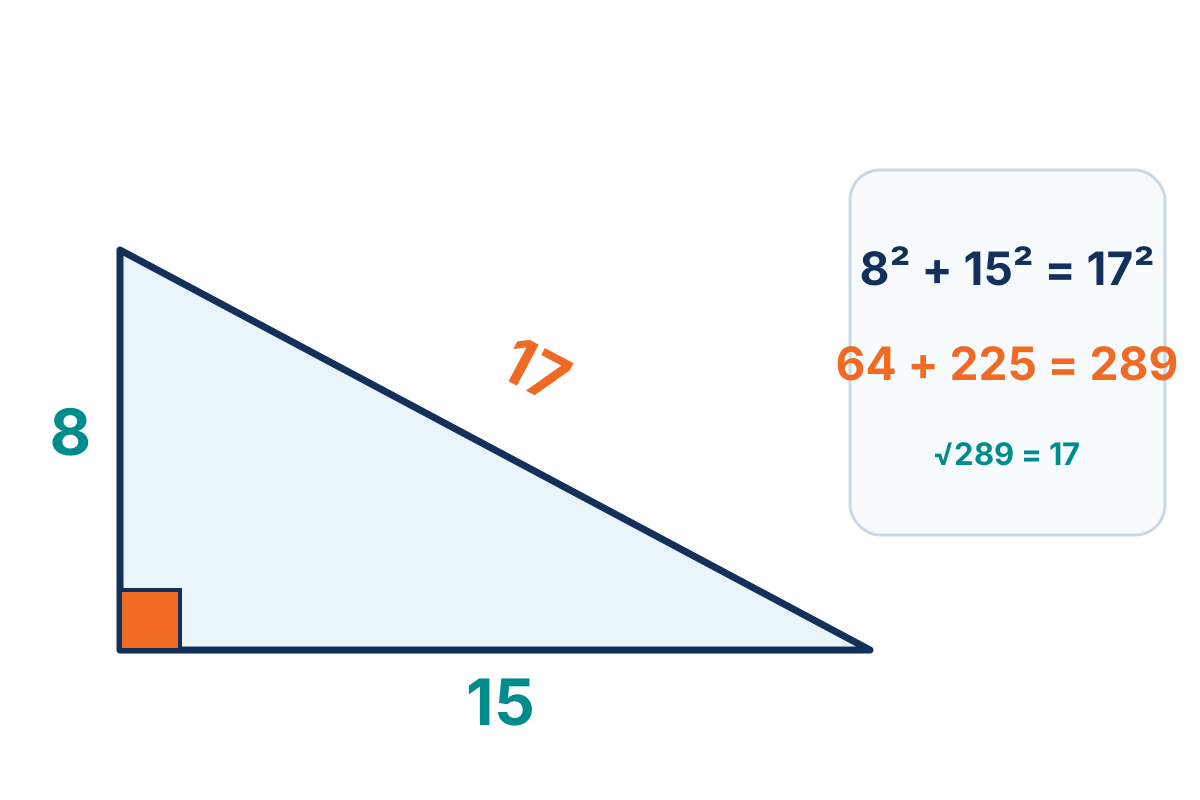
How to read this visual. The legs meet at the right angle, so their squared lengths add: 8 squared + 15 squared = 64 + 225 = 289. Since 289 is 17 squared, the hypotenuse is 17.
Core lesson
Core idea 1. For a right triangle, a^2 + b^2 = c^2, where c must be the hypotenuse opposite the right angle. Finding a leg requires subtraction of squares; finding the hypotenuse requires addition.
Core idea 2. The converse tests side lengths: square the longest side and compare it with the sum of the other two squares. Equality confirms a right triangle.
Core idea 3. The distance formula is the Pythagorean theorem applied to horizontal and vertical coordinate differences. Squaring removes direction, while the final square root returns a length.
Core idea 4. A midpoint averages x-coordinates and y-coordinates separately. Horizontal or vertical distances can be found directly with absolute coordinate differences, and coordinate rectangles use those differences as dimensions.
These ideas work together. Do not treat a formula or procedure as an isolated password. Ask what each number represents, which values may legitimately be combined, and what must remain invariant while the calculation changes form. A method becomes transferable when you can explain both what to do and why the step preserves the quantity or relationship in the problem.
A reliable problem-solving method
- Sketch or identify the right triangle.
- Label the hypotenuse and coordinate differences.
- Write the theorem, distance, or midpoint relationship.
- Substitute, simplify, and round only if required.
- Check length order, coordinate location, and units.
Before calculating, make a rough prediction. The prediction may concern sign, magnitude, direction of change, position on a graph, or the power on a unit. After calculating, compare the exact result with that prediction. If they disagree, pause and inspect the setup before repeating the same keystrokes. A second method—substitution, inverse operation, alternate representation, or bounding estimate—provides stronger evidence than simply repeating one procedure.
Connect multiple representations
- A right-triangle sketch identifies legs and hypotenuse.
- A coordinate grid turns differences into rise and run.
- Exact radical and decimal forms represent the same nonperfect distance at different precision.
Practice translating among words, symbols, tables, diagrams, and graphs. Translation is not an optional decoration: it often exposes information that is hard to see in the original form. Describe what stays the same across representations. For example, a rate remains the same comparison whether it appears as a verbal 'per' statement, a fraction with units, a table pattern, a graph slope, or a coefficient in an equation.
Ten fully worked examples
The examples begin with focused practice and become more mixed. For each one, pause after reading the problem and write a plan before revealing the solution. Then cover the completed work and reproduce it from a blank page. The goal is to learn a decision process, not to memorize the displayed numbers.
Worked example 1
Problem. A right triangle has legs 9 and 12. Find the hypotenuse.
Answer. 15
Plan. Expose the right triangle or coordinate changes, select the relationship, compute carefully, and verify the result against geometry and scale. In this example, identify the quantities and explain why this relationship fits before doing arithmetic.
Calculation. Use c = sqrt(9^2 + 12^2) = sqrt(81 + 144) = sqrt(225) = 15.
Verification. This is the 3-4-5 triangle scaled by 3.
Self-explanation prompt. Cover the solution and reproduce it. Then name the first decision that made the remaining calculation possible, and explain why one tempting alternative method would fail.
Worked example 2
Problem. A right triangle has hypotenuse 13 and one leg 5. Find the other leg.
Answer. 12
Plan. Expose the right triangle or coordinate changes, select the relationship, compute carefully, and verify the result against geometry and scale. In this example, identify the quantities and explain why this relationship fits before doing arithmetic.
Calculation. Use b = sqrt(13^2 - 5^2) = sqrt(169 - 25) = sqrt(144) = 12.
Verification. Check 5^2 + 12^2 = 13^2.
Self-explanation prompt. Cover the solution and reproduce it. Then name the first decision that made the remaining calculation possible, and explain why one tempting alternative method would fail.
Worked example 3
Problem. Does a triangle with sides 7, 24, and 25 form a right triangle?
Answer. Yes; 7^2 + 24^2 = 25^2
Plan. Expose the right triangle or coordinate changes, select the relationship, compute carefully, and verify the result against geometry and scale. In this example, identify the quantities and explain why this relationship fits before doing arithmetic.
Calculation. Test the longest side: 7^2 + 24^2 = 49 + 576 = 625, and 25^2 = 625.
Verification. Equality confirms a right angle opposite the side of length 25.
Self-explanation prompt. Cover the solution and reproduce it. Then name the first decision that made the remaining calculation possible, and explain why one tempting alternative method would fail.
Worked example 4
Problem. Find the distance between (2, 3) and (8, 11).
Answer. 10
Plan. Expose the right triangle or coordinate changes, select the relationship, compute carefully, and verify the result against geometry and scale. In this example, identify the quantities and explain why this relationship fits before doing arithmetic.
Calculation. Differences are 6 and 8. Distance = sqrt(6^2 + 8^2) = sqrt(100) = 10.
Verification. A 6-8-10 right triangle connects the points.
Self-explanation prompt. Cover the solution and reproduce it. Then name the first decision that made the remaining calculation possible, and explain why one tempting alternative method would fail.
Worked example 5
Problem. Find the midpoint of (-4, 6) and (10, -2).
Answer. (3, 2)
Plan. Expose the right triangle or coordinate changes, select the relationship, compute carefully, and verify the result against geometry and scale. In this example, identify the quantities and explain why this relationship fits before doing arithmetic.
Calculation. Average coordinates separately: ((-4 + 10)/2, (6 + -2)/2) = (6/2, 4/2) = (3, 2).
Verification. The horizontal and vertical changes from the midpoint to each endpoint have equal size.
Self-explanation prompt. Cover the solution and reproduce it. Then name the first decision that made the remaining calculation possible, and explain why one tempting alternative method would fail.
Worked example 6
Problem. Find the horizontal distance between (-7, 4) and (5, 4).
Answer. 12 units
Plan. Expose the right triangle or coordinate changes, select the relationship, compute carefully, and verify the result against geometry and scale. In this example, identify the quantities and explain why this relationship fits before doing arithmetic.
Calculation. The y-values match, so subtract x-values and take absolute value: |5 - (-7)| = 12.
Verification. Distance cannot be negative.
Self-explanation prompt. Cover the solution and reproduce it. Then name the first decision that made the remaining calculation possible, and explain why one tempting alternative method would fail.
Worked example 7
Problem. A ladder reaches 15 ft up a wall and its base is 8 ft from the wall. How long is the ladder?
Answer. 17 ft
Plan. Expose the right triangle or coordinate changes, select the relationship, compute carefully, and verify the result against geometry and scale. In this example, identify the quantities and explain why this relationship fits before doing arithmetic.
Calculation. The ladder is the hypotenuse: sqrt(15^2 + 8^2) = sqrt(225 + 64) = sqrt(289) = 17 ft.
Verification. The ladder must be longer than either leg, and 8-15-17 is a known triple.
Self-explanation prompt. Cover the solution and reproduce it. Then name the first decision that made the remaining calculation possible, and explain why one tempting alternative method would fail.
Worked example 8
Problem. A rectangular screen is 16 inches wide and 9 inches high. Find its diagonal to the nearest tenth.
Answer. 18.4 inches
Plan. Expose the right triangle or coordinate changes, select the relationship, compute carefully, and verify the result against geometry and scale. In this example, identify the quantities and explain why this relationship fits before doing arithmetic.
Calculation. Diagonal = sqrt(16^2 + 9^2) = sqrt(256 + 81) = sqrt(337), about 18.4 inches.
Verification. The diagonal should exceed 16 but be less than 25.
Self-explanation prompt. Cover the solution and reproduce it. Then name the first decision that made the remaining calculation possible, and explain why one tempting alternative method would fail.
Worked example 9
Problem. One endpoint is (2, -1) and the midpoint is (6, 4). Find the other endpoint.
Answer. (10, 9)
Plan. Expose the right triangle or coordinate changes, select the relationship, compute carefully, and verify the result against geometry and scale. In this example, identify the quantities and explain why this relationship fits before doing arithmetic.
Calculation. For x, (2 + x)/2 = 6, so x = 10. For y, (-1 + y)/2 = 4, so y = 9.
Verification. The midpoint of (2, -1) and (10, 9) is (6, 4).
Self-explanation prompt. Cover the solution and reproduce it. Then name the first decision that made the remaining calculation possible, and explain why one tempting alternative method would fail.
Worked example 10
Problem. A coordinate rectangle has vertices (1, 2), (9, 2), (9, 7), and (1, 7). Find its area.
Answer. 40 square units
Plan. Expose the right triangle or coordinate changes, select the relationship, compute carefully, and verify the result against geometry and scale. In this example, identify the quantities and explain why this relationship fits before doing arithmetic.
Calculation. Horizontal length is |9 - 1| = 8; vertical width is |7 - 2| = 5. Area = 8 x 5 = 40.
Verification. Counting coordinate intervals, not grid lines, confirms dimensions 8 by 5.
Self-explanation prompt. Cover the solution and reproduce it. Then name the first decision that made the remaining calculation possible, and explain why one tempting alternative method would fail.
Common mistakes and how to repair them
- Mistake: Treating the longest visible side as a leg Correction: The hypotenuse is opposite the right angle. Write a one-sentence reason the correction is mathematically valid, not merely a rule to memorize.
- Mistake: Adding squares for a missing leg Correction: Subtract the known leg square from the hypotenuse square. Write a one-sentence reason the correction is mathematically valid, not merely a rule to memorize.
- Mistake: Adding coordinates for distance Correction: Use coordinate differences, squares, and a square root. Write a one-sentence reason the correction is mathematically valid, not merely a rule to memorize.
An error log should record the first point where correct reasoning diverged, not only the final wrong answer. Classify the error as interpretation, representation, formula choice, operation, sign, substitution, arithmetic, unit, rounding, or final-answer communication. Then rewrite the problem with one change in numbers and solve it correctly. This turns feedback into a reusable prevention habit.
Adult-life transfer
This session's reasoning appears in:
- ladders and diagonals
- maps and navigation
- screen sizes and coordinate plans
For one application, create your own realistic values and state any assumptions. Solve it, then change one condition and predict how the answer should change before recalculating. This variation step distinguishes genuine understanding from imitation. A strong model also acknowledges constraints: counts may need whole numbers, lengths cannot be negative, spending cannot exceed a budget, and reported precision should match the given data.
Independent practice and spaced review
Use a three-pass routine. On the first pass, complete two near examples immediately after study so the new method is stable. On the second pass, wait until later the same day and solve two problems without notes. On the third pass, return after at least one day and mix this topic with earlier sessions so the method is not announced. Mark confidence before checking; high confidence paired with an error deserves special attention because it signals a misconception rather than a simple lapse.
Build a six-item retrieval set: two direct problems from this session, two application problems with unfamiliar wording, and two cumulative problems from earlier sessions. For every missed item, study the explanation briefly, close it, and solve the problem again from the beginning. Do not copy line by line while looking. The second attempt should be a retrieval attempt, and a third parallel problem should confirm that the correction transfers.
Explain one solution aloud as if teaching a learner who chose a common distractor. Name why that distractor is tempting and identify the exact mathematical principle that rejects it. Finally, write a one-minute summary containing the main relationship, a unit or sign check, and one situation in which the method should not be used. This summary becomes the entry retrieval prompt for a later study session.
Mastery checklist
- I can meet each learning goal without copying a worked example.
- I can select the method when the problem does not name the topic.
- I can show a representation, calculation, and verification.
- I can explain one common mistake and repair it.
- I can solve at least twelve of fifteen aligned practice questions and correct every miss.
- I can return after a delay and solve a mixed problem with appropriate units and a complete answer sentence.
No teacher notes have been added for this session.
No additional resources have been added for this session.
Lesson Discussion
Ask a question about this lesson. A teacher or admin can answer here.
Sign in to ask a question or save this lesson.
No questions yet for this lesson.