18. Perimeter, Circumference, and Composite Boundaries
GED® Order of Operations, Calculator and Formula Skills · preview lesson
Session 18: Perimeter, Circumference, and Composite Boundaries
Your goal for this session
By the end of this session, you should be able to explain the main idea in your own words, solve a GED®-style problem one step at a time, and recognize the most tempting error before it happens.
Start with the big idea
Perimeter and circumference describe a boundary. Tracing that boundary before calculating prevents area formulas and hidden interior edges from sneaking into the work.
Take your time. Strong math work is not about skipping steps; it is about making each step easy to see and easy to check.
Visual guide
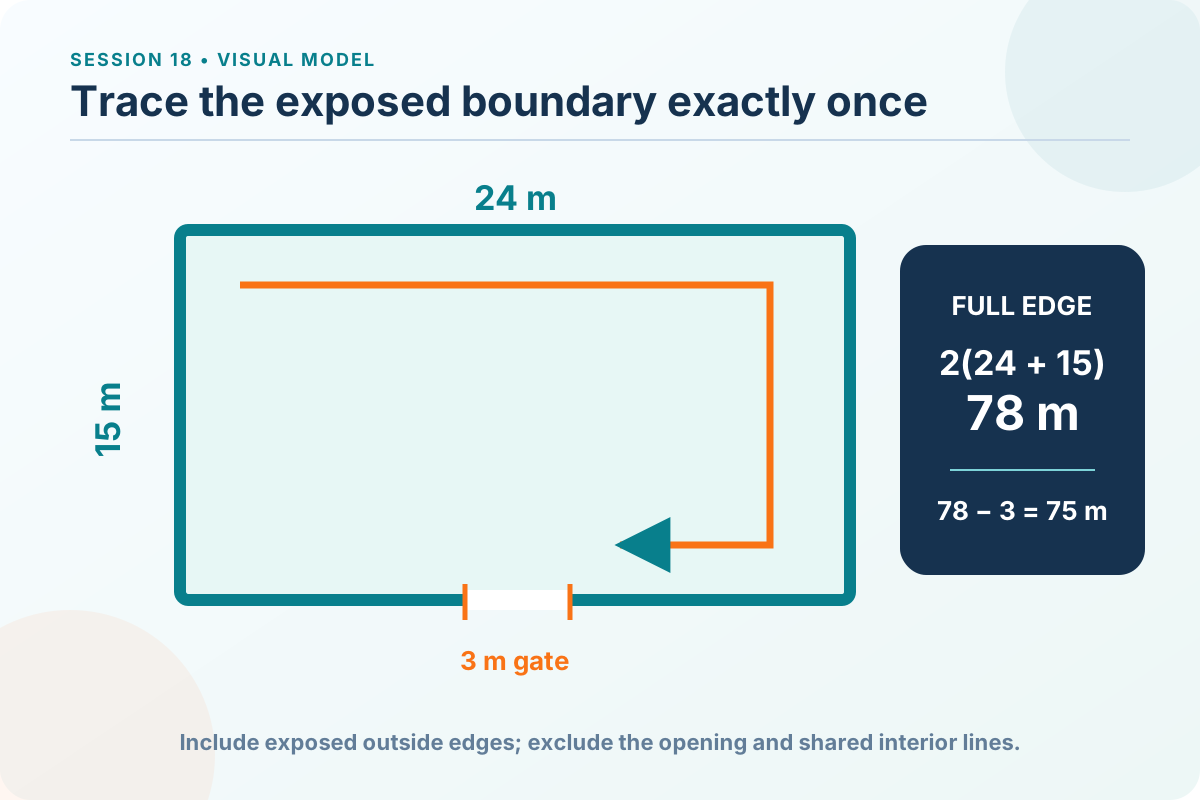
How to read this visual. Trace only the outside boundary. The full perimeter is 2(24 + 15) = 78 meters; subtract the 3-meter opening to get 75 meters of fencing.
Learn it in plain English
Perimeter and circumference measure distance around a boundary. Their answers use linear units such as feet, meters, or inches.
For a rectangle:
\[
P=2l+2w.
\]
If (l=11) ft and (w=6) ft:
\[
P=2(11)+2(6)=34\text{ ft}.
\]
For a circle, use either:
\[
C=\pi d
\]
or
\[
C=2\pi r.
\]
Choose the form that matches the given diameter or radius. If (d=10) cm and (pi\approx3.14), then (C\approx31.4) cm.
For a composite boundary, trace only the exposed outside edges. Shared interior edges are not part of the perimeter. Mark each used length once and find missing lengths from the diagram before adding.
Real-life applications include fencing, trim, framing, edging, track distance, and cable around an object.
Common misconception: using square units for perimeter or including an interior dividing line. Boundary distance is one-dimensional, even when it surrounds a two-dimensional region.
Academic habit: trace the requested boundary with a finger or pencil before calculating.
A circle has diameter 10 cm. Using \(C=\pi d\) and \(\pi=3.14\), find its circumference.
Multiply 3.14 by the diameter 10 and use linear centimeters.
A reliable four-step routine
- Underline the target and list the givens with compatible units.
- Sketch, select a formula, or write a rate that models the situation.
- Substitute and solve in labeled stages without rounding early.
- State the answer in context and check size, sign, and unit.
Ten GED®-style worked examples
Worked example 1
GED®-style problem. Find the perimeter of a rectangle 11 ft long and 6 ft wide.
Step 1 — Understand. Read the last sentence first. Identify exactly what must be found and note any unit, sign, grouping, or rounding instruction.
Step 2 — Plan. Use P = 2l + 2w.
Step 3 — Solve. P = 2(11) + 2(6) = 22 + 12 = 34 ft.
Step 4 — Check. Adding all four sides, 11 + 6 + 11 + 6, also gives 34.
Common trap. Count each exposed boundary segment once and exclude shared interior edges.
Worked example 2
GED®-style problem. Find the circumference of a circle with diameter 10 cm using π ≈ 3.14.
Step 1 — Understand. Read the last sentence first. Identify exactly what must be found and note any unit, sign, grouping, or rounding instruction.
Step 2 — Plan. Use C = πd because diameter is given.
Step 3 — Solve. C = 3.14(10) = 31.4 cm.
Step 4 — Check. The circumference is a little more than three diameters, as expected.
Common trap. Count each exposed boundary segment once and exclude shared interior edges.
Worked example 3
GED®-style problem. Find the circumference of a circle with radius 7 in using π ≈ 22/7.
Step 1 — Understand. Read the last sentence first. Identify exactly what must be found and note any unit, sign, grouping, or rounding instruction.
Step 2 — Plan. Use C = 2πr.
Step 3 — Solve. C = 2(22/7)(7) = 44 in.
Step 4 — Check. The sevens cancel and leave 2 × 22.
Common trap. Count each exposed boundary segment once and exclude shared interior edges.
Worked example 4
GED®-style problem. A square patio has side length 8.5 m. Find its perimeter.
Step 1 — Understand. Read the last sentence first. Identify exactly what must be found and note any unit, sign, grouping, or rounding instruction.
Step 2 — Plan. A square has four equal sides.
Step 3 — Solve. P = 4s = 4(8.5) = 34 m.
Step 4 — Check. Two sides total 17 m, so all four total 34 m.
Common trap. Count each exposed boundary segment once and exclude shared interior edges.
Worked example 5
GED®-style problem. An L-shaped boundary has outside segments 8, 3, 5, 4, 3, and 7 feet. Find perimeter.
Step 1 — Understand. Read the last sentence first. Identify exactly what must be found and note any unit, sign, grouping, or rounding instruction.
Step 2 — Plan. Trace the outside once and add every listed exposed segment.
Step 3 — Solve. P = 8 + 3 + 5 + 4 + 3 + 7 = 30 ft.
Step 4 — Check. There are six exposed segments and each was counted once.
Common trap. Count each exposed boundary segment once and exclude shared interior edges.
Worked example 6
GED®-style problem. A semicircular garden has a straight diameter of 12 m. Find its full boundary using π ≈ 3.14.
Step 1 — Understand. Read the last sentence first. Identify exactly what must be found and note any unit, sign, grouping, or rounding instruction.
Step 2 — Plan. Take half the circle circumference and add the straight diameter.
Step 3 — Solve. Full circle C = πd = 3.14(12) = 37.68 m. Half is 18.84 m. Add diameter: 18.84 + 12 = 30.84 m.
Step 4 — Check. The curved part plus straight base must exceed the 18.84 m arc alone.
Common trap. Count each exposed boundary segment once and exclude shared interior edges.
Worked example 7
GED®-style problem. A rectangular room is 14 ft by 10 ft with a 3-ft doorway where no baseboard is needed. Find baseboard length.
Step 1 — Understand. Read the last sentence first. Identify exactly what must be found and note any unit, sign, grouping, or rounding instruction.
Step 2 — Plan. Find full perimeter, then subtract the doorway opening.
Step 3 — Solve. P = 2(14) + 2(10) = 48 ft. Baseboard = 48 - 3 = 45 ft.
Step 4 — Check. The answer is slightly less than the full room perimeter.
Common trap. Count each exposed boundary segment once and exclude shared interior edges.
Worked example 8
GED®-style problem. A running track is 400 m per lap. How far are 6.5 laps?
Step 1 — Understand. Read the last sentence first. Identify exactly what must be found and note any unit, sign, grouping, or rounding instruction.
Step 2 — Plan. Multiply boundary distance per lap by number of laps.
Step 3 — Solve. Distance = 400(6.5) = 2,600 m, or 2.6 km.
Step 4 — Check. Six laps are 2,400 m and half a lap is 200 m, totaling 2,600.
Common trap. Count each exposed boundary segment once and exclude shared interior edges.
Worked example 9
GED®-style problem. A circular table has circumference 62.8 in. Find diameter using π ≈ 3.14.
Step 1 — Understand. Read the last sentence first. Identify exactly what must be found and note any unit, sign, grouping, or rounding instruction.
Step 2 — Plan. Rearrange C = πd to d = C/π.
Step 3 — Solve. d = 62.8/3.14 = 20 in.
Step 4 — Check. 3.14(20) = 62.8, restoring the circumference.
Common trap. Count each exposed boundary segment once and exclude shared interior edges.
Worked example 10
GED®-style problem. A learner adds an interior divider to the perimeter of a composite figure. Explain the error.
Step 1 — Understand. Read the last sentence first. Identify exactly what must be found and note any unit, sign, grouping, or rounding instruction.
Step 2 — Plan. Perimeter includes only the exposed outside boundary unless the question explicitly includes the divider.
Step 3 — Solve. Remove the shared interior length from the sum and count only edges touched while tracing the outside.
Step 4 — Check. A finger trace around the exterior never crosses the interior divider.
Common trap. Count each exposed boundary segment once and exclude shared interior edges.
Friendly recap
Before moving on, say the key rule aloud, solve one example without looking, and explain why one common wrong method fails. If your answer has a unit, sign, or rounding instruction, include it in the final sentence. That small habit makes your work clearer and much more reliable on the GED®.
No teacher notes have been added for this session.
No additional resources have been added for this session.
Lesson Discussion
Ask a question about this lesson. A teacher or admin can answer here.
Sign in to ask a question or save this lesson.
No questions yet for this lesson.