19. Area Formulas and Composite Regions
GED® Order of Operations, Calculator and Formula Skills · preview lesson
Session 19: Area Formulas and Composite Regions
Your goal for this session
By the end of this session, you should be able to explain the main idea in your own words, solve a GED®-style problem one step at a time, and recognize the most tempting error before it happens.
Start with the big idea
Area measures flat coverage. Breaking a composite region into familiar shapes turns an intimidating diagram into several small, solvable pieces.
Take your time. Strong math work is not about skipping steps; it is about making each step easy to see and easy to check.
Visual guide
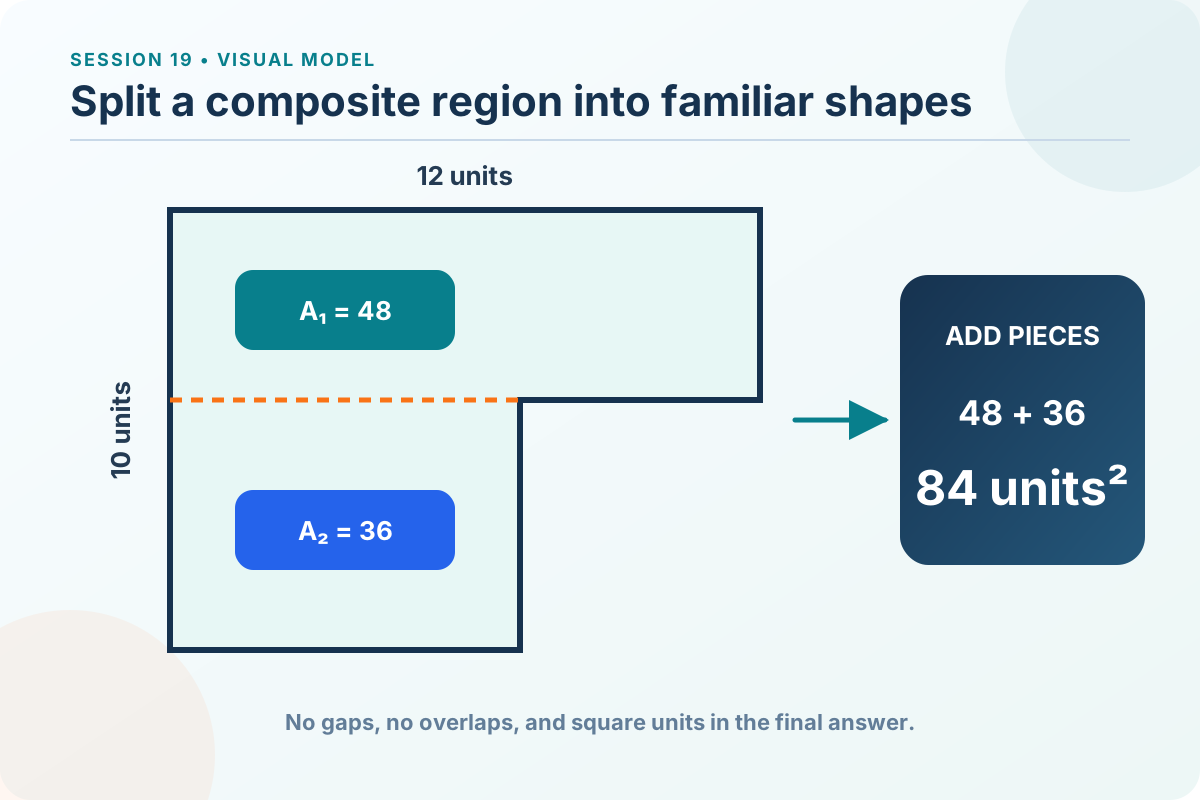
How to read this visual. Draw a clean split that creates familiar rectangles without overlap. Find each small area, add them, and report square units because area measures flat coverage.
Learn it in plain English
Area measures the amount of flat surface inside a boundary, so answers use square units.
Common formulas include:
\[
A_{\text{rectangle}}=lw,
\qquad
A_{\text{triangle}}=\frac12 bh,
\qquad
A_{\text{circle}}=\pi r^2.
\]
For a triangle with base 12 m and perpendicular height 7 m:
\[
A=\frac12(12)(7)=42\text{ m}^2.
\]
The height must be perpendicular to the base; a slanted side is not automatically the height.
To find the area of a composite region:
- Split it into familiar non-overlapping shapes.
- Label the needed dimensions.
- Calculate each area.
- Add included pieces or subtract cutouts.
- Attach square units.
Example: a (10\text{ m}\times8\text{ m}) rectangle with a (2\text{ m}\times3\text{ m}) rectangular opening has area:
\[
80-6=74\text{ m}^2.
\]
Common misconception: using the circle's diameter as (r) in (A=\pi r^2). Radius is half the diameter and must be squared before multiplying by (pi).
Academic habit: write the unit exponent as part of the calculation, not as an afterthought.
Find the area of a triangle with base 12 m and height 7 m.
One half times 12 times 7 equals 42.
A reliable four-step routine
- Underline the target and list the givens with compatible units.
- Sketch, select a formula, or write a rate that models the situation.
- Substitute and solve in labeled stages without rounding early.
- State the answer in context and check size, sign, and unit.
Ten GED®-style worked examples
Worked example 1
GED®-style problem. Find the area of a rectangle 12 m by 7 m.
Step 1 — Understand. Read the last sentence first. Identify exactly what must be found and note any unit, sign, grouping, or rounding instruction.
Step 2 — Plan. Use A = lw.
Step 3 — Solve. A = 12(7) = 84 m².
Step 4 — Check. An array with 12 columns and 7 rows contains 84 unit squares.
Common trap. Use perpendicular height in area formulas and remember that circle area uses radius squared.
Worked example 2
GED®-style problem. Find the area of a triangle with base 12 ft and perpendicular height 7 ft.
Step 1 — Understand. Read the last sentence first. Identify exactly what must be found and note any unit, sign, grouping, or rounding instruction.
Step 2 — Plan. Use A = 1/2 bh.
Step 3 — Solve. A = 1/2(12)(7) = 42 ft².
Step 4 — Check. The matching rectangle area is 84 ft², and the triangle is half.
Common trap. Use perpendicular height in area formulas and remember that circle area uses radius squared.
Worked example 3
GED®-style problem. Find the area of a circle with radius 5 cm using π ≈ 3.14.
Step 1 — Understand. Read the last sentence first. Identify exactly what must be found and note any unit, sign, grouping, or rounding instruction.
Step 2 — Plan. Use A = πr² and square the radius first.
Step 3 — Solve. A = 3.14(5²) = 3.14(25) = 78.5 cm².
Step 4 — Check. A 10 by 10 square has area 100, so a circle inside it should have less area.
Common trap. Use perpendicular height in area formulas and remember that circle area uses radius squared.
Worked example 4
GED®-style problem. A circle has diameter 14 in. Find area using π ≈ 22/7.
Step 1 — Understand. Read the last sentence first. Identify exactly what must be found and note any unit, sign, grouping, or rounding instruction.
Step 2 — Plan. Convert diameter to radius before using A = πr².
Step 3 — Solve. r = 14/2 = 7 in. A = (22/7)(7²) = (22/7)(49) = 154 in².
Step 4 — Check. The radius, not diameter, was squared.
Common trap. Use perpendicular height in area formulas and remember that circle area uses radius squared.
Worked example 5
GED®-style problem. A trapezoid has bases 8 m and 14 m and height 5 m. Find area.
Step 1 — Understand. Read the last sentence first. Identify exactly what must be found and note any unit, sign, grouping, or rounding instruction.
Step 2 — Plan. Use A = 1/2(b₁ + b₂)h.
Step 3 — Solve. A = 1/2(8 + 14)(5) = 1/2(22)(5) = 55 m².
Step 4 — Check. The average base is 11 and 11 × 5 = 55.
Common trap. Use perpendicular height in area formulas and remember that circle area uses radius squared.
Worked example 6
GED®-style problem. A 10 m by 8 m floor has a 2 m by 3 m opening. Find usable area.
Step 1 — Understand. Read the last sentence first. Identify exactly what must be found and note any unit, sign, grouping, or rounding instruction.
Step 2 — Plan. Find the large rectangle area and subtract the cutout.
Step 3 — Solve. Large area = 10(8) = 80 m². Opening = 2(3) = 6 m². Usable area = 80 - 6 = 74 m².
Step 4 — Check. The result is less than the original 80 m² by exactly 6 m².
Common trap. Use perpendicular height in area formulas and remember that circle area uses radius squared.
Worked example 7
GED®-style problem. A composite shape is a 6 ft by 4 ft rectangle plus a triangle with base 6 ft and height 3 ft. Find total area.
Step 1 — Understand. Read the last sentence first. Identify exactly what must be found and note any unit, sign, grouping, or rounding instruction.
Step 2 — Plan. Calculate the non-overlapping pieces and add.
Step 3 — Solve. Rectangle = 6(4) = 24 ft². Triangle = 1/2(6)(3) = 9 ft². Total = 33 ft².
Step 4 — Check. The total exceeds the rectangle area by the triangle's 9 ft².
Common trap. Use perpendicular height in area formulas and remember that circle area uses radius squared.
Worked example 8
GED®-style problem. A wall is 15 ft by 9 ft and has two windows, each 3 ft by 4 ft. Find paintable area.
Step 1 — Understand. Read the last sentence first. Identify exactly what must be found and note any unit, sign, grouping, or rounding instruction.
Step 2 — Plan. Subtract both window areas from the wall area.
Step 3 — Solve. Wall = 15(9) = 135 ft². Windows = 2[3(4)] = 24 ft². Paintable area = 135 - 24 = 111 ft².
Step 4 — Check. The paintable area is positive and less than the full wall.
Common trap. Use perpendicular height in area formulas and remember that circle area uses radius squared.
Worked example 9
GED®-style problem. A square has area 121 cm². Find its side length.
Step 1 — Understand. Read the last sentence first. Identify exactly what must be found and note any unit, sign, grouping, or rounding instruction.
Step 2 — Plan. Invert A = s² with a square root.
Step 3 — Solve. s = √121 = 11 cm.
Step 4 — Check. 11 × 11 = 121 cm².
Common trap. Use perpendicular height in area formulas and remember that circle area uses radius squared.
Worked example 10
GED®-style problem. A learner uses a slanted side of 10 ft as triangle height when the perpendicular height is 8 ft and base is 12 ft. Repair the work.
Step 1 — Understand. Read the last sentence first. Identify exactly what must be found and note any unit, sign, grouping, or rounding instruction.
Step 2 — Plan. Triangle area uses perpendicular height.
Step 3 — Solve. A = 1/2(12)(8) = 48 ft². The 10-ft slanted side is not used in this area formula.
Step 4 — Check. A matching 12 by 8 rectangle has area 96, and half is 48.
Common trap. Use perpendicular height in area formulas and remember that circle area uses radius squared.
Friendly recap
Before moving on, say the key rule aloud, solve one example without looking, and explain why one common wrong method fails. If your answer has a unit, sign, or rounding instruction, include it in the final sentence. That small habit makes your work clearer and much more reliable on the GED®.
No teacher notes have been added for this session.
No additional resources have been added for this session.
Lesson Discussion
Ask a question about this lesson. A teacher or admin can answer here.
Sign in to ask a question or save this lesson.
No questions yet for this lesson.