22. Percent Applications, Tax, Discount, and Simple Interest
GED® Order of Operations, Calculator and Formula Skills · preview lesson
Session 22: Percent Applications, Tax, Discount, and Simple Interest
Your goal for this session
By the end of this session, you should be able to explain the main idea in your own words, solve a GED®-style problem one step at a time, and recognize the most tempting error before it happens.
Start with the big idea
Percent problems become simpler when every result is labeled: discount, sale price, tax, interest, or final total. The labels stop you from answering an intermediate question.
Take your time. Strong math work is not about skipping steps; it is about making each step easy to see and easy to check.
Visual guide
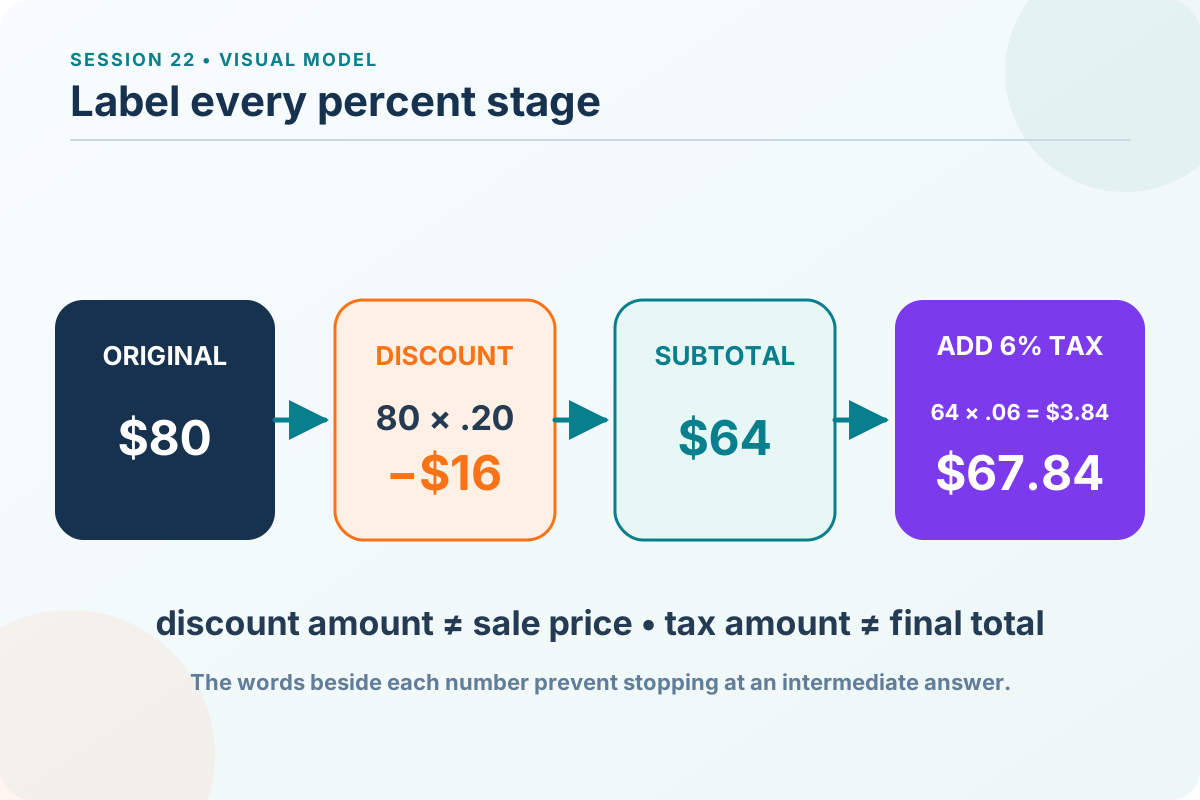
How to read this visual. A discount amount is not the sale price, and tax is applied to the discounted subtotal. Label every stage: $16 discount, $64 subtotal, $3.84 tax, and $67.84 final price.
Learn it in plain English
Percent applications use a common relationship:
\[
\text{part}=\text{percent as a decimal}\times\text{whole}.
\]
For a (25\%) discount on an ($80) item:
\[
0.25(80)=20.
\]
The discount is ($20), so the sale price is:
\[
80-20=$60.
\]
If (8\%) sales tax is then applied to the ($60) sale price:
\[
0.08(60)=4.80,
\qquad
60+4.80=$64.80.
\]
The order matters: tax is applied to the discounted price in this example.
Simple interest uses:
\[
I=Prt,
\]
where (P) is principal, (r) is the annual rate as a decimal, and (t) is time in years. For (P=600), (r=0.05), and (t=2):
\[
I=(600)(0.05)(2)=60.
\]
Common misconception: confusing the amount of discount with the final price, or using 5 instead of 0.05 for (5\%).
Academic habit: label each money result—discount, tax, interest, or final total—before moving to the next step.
An 80-dollar item is discounted 25 percent. What is the sale price before tax?
The discount is 20 dollars, so subtract it from 80 dollars.
A reliable four-step routine
- Underline the target and list the givens with compatible units.
- Sketch, select a formula, or write a rate that models the situation.
- Substitute and solve in labeled stages without rounding early.
- State the answer in context and check size, sign, and unit.
Ten GED®-style worked examples
Worked example 1
GED®-style problem. Find 30% of 150.
Step 1 — Understand. Read the last sentence first. Identify exactly what must be found and note any unit, sign, grouping, or rounding instruction.
Step 2 — Plan. Convert 30% to 0.30 and multiply by the whole.
Step 3 — Solve. 0.30(150) = 45.
Step 4 — Check. Ten percent is 15, so three groups of 10% equal 45.
Common trap. The discount amount is not the sale price, and the tax amount is not the final total.
Worked example 2
GED®-style problem. An $80 jacket is 25% off. Find the sale price.
Step 1 — Understand. Read the last sentence first. Identify exactly what must be found and note any unit, sign, grouping, or rounding instruction.
Step 2 — Plan. Find the discount amount, then subtract it.
Step 3 — Solve. Discount = 0.25(80) = $20. Sale price = 80 - 20 = $60.
Step 4 — Check. A 25% discount leaves 75%; 0.75(80) also gives $60.
Common trap. The discount amount is not the sale price, and the tax amount is not the final total.
Worked example 3
GED®-style problem. A $60 purchase has 8% sales tax. Find the total.
Step 1 — Understand. Read the last sentence first. Identify exactly what must be found and note any unit, sign, grouping, or rounding instruction.
Step 2 — Plan. Calculate tax, then add it to the original price.
Step 3 — Solve. Tax = 0.08(60) = $4.80. Total = $60 + $4.80 = $64.80.
Step 4 — Check. The final amount is 108% of $60; 1.08(60) = $64.80.
Common trap. The discount amount is not the sale price, and the tax amount is not the final total.
Worked example 4
GED®-style problem. A restaurant bill is $42.50. Find an 18% tip and total.
Step 1 — Understand. Read the last sentence first. Identify exactly what must be found and note any unit, sign, grouping, or rounding instruction.
Step 2 — Plan. Multiply by 0.18 for tip, round to cents, then add.
Step 3 — Solve. Tip = 42.50(0.18) = $7.65. Total = 42.50 + 7.65 = $50.15.
Step 4 — Check. A 20% tip would be $8.50, so $7.65 for 18% is reasonable.
Common trap. The discount amount is not the sale price, and the tax amount is not the final total.
Worked example 5
GED®-style problem. A price rises from $50 to $65. Find percent increase.
Step 1 — Understand. Read the last sentence first. Identify exactly what must be found and note any unit, sign, grouping, or rounding instruction.
Step 2 — Plan. Find the increase and divide by the original value.
Step 3 — Solve. Increase = 65 - 50 = 15. Percent increase = 15/50 = 0.30 = 30%.
Step 4 — Check. Thirty percent of $50 is $15.
Common trap. The discount amount is not the sale price, and the tax amount is not the final total.
Worked example 6
GED®-style problem. A population falls from 2,400 to 2,040. Find percent decrease.
Step 1 — Understand. Read the last sentence first. Identify exactly what must be found and note any unit, sign, grouping, or rounding instruction.
Step 2 — Plan. Find the decrease and divide by the original population.
Step 3 — Solve. Decrease = 2,400 - 2,040 = 360. Then 360/2,400 = 0.15 = 15%.
Step 4 — Check. Fifteen percent of 2,400 is 360.
Common trap. The discount amount is not the sale price, and the tax amount is not the final total.
Worked example 7
GED®-style problem. Find simple interest on $600 at 5% for 2 years.
Step 1 — Understand. Read the last sentence first. Identify exactly what must be found and note any unit, sign, grouping, or rounding instruction.
Step 2 — Plan. Use I = Prt with r = 0.05.
Step 3 — Solve. I = 600(0.05)(2) = 30(2) = $60.
Step 4 — Check. The account earns $30 per year, so two years earns $60.
Common trap. The discount amount is not the sale price, and the tax amount is not the final total.
Worked example 8
GED®-style problem. An item costs $120 after a 20% discount. Find the original price.
Step 1 — Understand. Read the last sentence first. Identify exactly what must be found and note any unit, sign, grouping, or rounding instruction.
Step 2 — Plan. The sale price is 80% of the original, so divide by 0.80.
Step 3 — Solve. Original price = 120/0.80 = $150.
Step 4 — Check. Twenty percent of $150 is $30, and $150 - $30 = $120.
Common trap. The discount amount is not the sale price, and the tax amount is not the final total.
Worked example 9
GED®-style problem. A salesperson earns 6% commission on $4,500 in sales. Find commission.
Step 1 — Understand. Read the last sentence first. Identify exactly what must be found and note any unit, sign, grouping, or rounding instruction.
Step 2 — Plan. Multiply sales by the decimal commission rate.
Step 3 — Solve. Commission = 0.06(4,500) = $270.
Step 4 — Check. One percent is $45, so six percent is 6($45) = $270.
Common trap. The discount amount is not the sale price, and the tax amount is not the final total.
Worked example 10
GED®-style problem. A learner says a $20 discount on an $80 item means the sale price is $20. Diagnose the label error.
Step 1 — Understand. Read the last sentence first. Identify exactly what must be found and note any unit, sign, grouping, or rounding instruction.
Step 2 — Plan. Separate the discount amount from the remaining price.
Step 3 — Solve. $20 is the amount removed. The sale price is $80 - $20 = $60.
Step 4 — Check. The customer pays what remains, not the amount saved.
Common trap. The discount amount is not the sale price, and the tax amount is not the final total.
Friendly recap
Before moving on, say the key rule aloud, solve one example without looking, and explain why one common wrong method fails. If your answer has a unit, sign, or rounding instruction, include it in the final sentence. That small habit makes your work clearer and much more reliable on the GED®.
No teacher notes have been added for this session.
No additional resources have been added for this session.
Lesson Discussion
Ask a question about this lesson. A teacher or admin can answer here.
Sign in to ask a question or save this lesson.
No questions yet for this lesson.