Session 7: Federalism & State/Local Government
GED® Social Studies Test Preparation Online Course · preview lesson
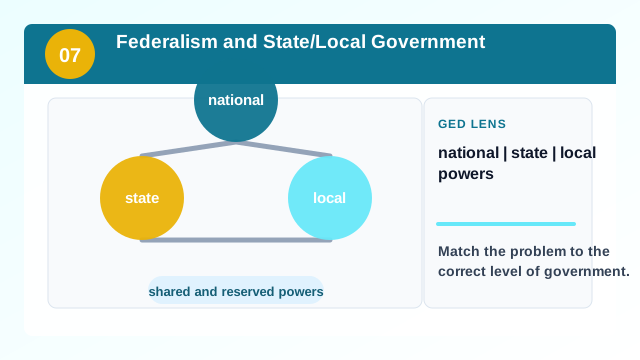
Visual Study Cue
Use the image above as a map for this session. First identify the civics concept, historical event, economic model, geographic pattern, or source skill; then connect it to the evidence in the lesson.
Evidence Model
Use the second image for GED®-style reasoning: identify the source or data, decide what claim it supports, and eliminate answer choices that go beyond the evidence.
What You Will Learn
By the end of this session you will be able to define federalism, classify powers as delegated, reserved, or concurrent, explain how federal and state authority interact, and describe the basic structure of state and local government.
---
What Is Federalism?
Federalism is a system of government in which power is divided between a national (federal) government and state governments, with each level holding certain powers independently. The United States chose federalism as a middle path between a weak confederation (like the failed Articles of Confederation) and a unitary state where all power rests with the central government.
Federalism serves several purposes:
- Allows states to serve as "laboratories of democracy" — testing new policies before they go national (e.g., Massachusetts health care reform preceded the Affordable Care Act)
- Brings government closer to the people — local issues handled locally
- Divides power to prevent tyranny
- Lets states reflect local values on issues where national consensus is absent
---
The Three Types of Governmental Powers
| Type | Definition | Examples |
|---|---|---|
| Delegated (Enumerated) Powers | Powers specifically granted to the federal government by the Constitution | Coin money, declare war, regulate interstate commerce, establish post offices, conduct foreign policy |
| Reserved Powers | Powers kept by the states under the 10th Amendment ("powers not delegated to the United States…are reserved to the States") | Education, marriage laws, driver's licenses, intrastate commerce, establish local governments, conduct elections |
| Concurrent Powers | Powers shared by both federal and state governments | Levy taxes, borrow money, build roads, establish courts, enforce laws, charter banks |
Memory tip: Think of it as a layer cake — federal on top, state below, concurrent in the middle where the layers mix.
Which amendment reserves powers not granted to the federal government to the states?
It is the last amendment in the Bill of Rights.
---
When Federal and State Law Conflict: The Supremacy Clause
The Supremacy Clause (Article VI) makes federal law the "supreme Law of the Land." When a valid federal law directly conflicts with a state law, federal law wins — this is called federal preemption.
Key example: After marijuana was legalized in several states, those state laws still conflicted with the federal Controlled Substances Act. Because of the Supremacy Clause, federal law technically still applies — though enforcement priorities can vary.
However, the federal government cannot simply commandeer state governments to enforce federal law. The anti-commandeering doctrine (Printz v. United States, 1997) says the federal government cannot order state officials to carry out federal programs.
---
The Evolution of Federalism
Federalism has changed dramatically over U.S. history:
| Era | Name | Description |
|---|---|---|
| 1789–1930s | Dual Federalism ("Layer Cake") | Federal and state governments operate in clearly separate spheres; minimal overlap |
| 1930s–1960s | Cooperative Federalism ("Marble Cake") | Federal and state governments work together; federal grants fund state programs with conditions (New Deal era) |
| 1960s–1980s | Creative/Coercive Federalism | Federal government attaches strings to grants; states must comply to receive funds (Civil Rights Act compliance) |
| 1980s–present | New Federalism | Movement to return power to states; block grants with fewer conditions (Reagan era onward) |
Federal grants are the main tool the federal government uses to influence state policy without direct commands:
- Categorical grants — money for a specific purpose with strict conditions (e.g., funds only for building highways)
- Block grants — money for a broad policy area with fewer conditions (e.g., funds for general welfare programs)
What is the term for when federal law overrides a conflicting state law?
The Supremacy Clause makes federal law supreme.
---
State Government Structure
Every state has its own constitution and mirrors the three-branch federal structure:
- Executive: Governor (elected, typically 4-year term) — enforces state law, commands National Guard, proposes budget, can veto state legislation
- Legislative: State legislature — makes state laws; 49 states have bicameral legislatures (Nebraska is the only unicameral state)
- Judicial: State courts — handle the vast majority of legal cases in the U.S. (criminal, civil, family, traffic); state supreme court is final authority on state law questions
States exclusively control:
- Public education (K–12 curriculum, school funding)
- Marriage and divorce laws
- Traffic and vehicle regulations
- Professional licensing (doctors, lawyers, teachers)
- Intrastate business regulations
---
Local Government
Below the states, local governments handle the most everyday functions citizens interact with:
- Counties (called "parishes" in Louisiana, "boroughs" in Alaska) — the primary subdivision of a state
- Municipalities — cities, towns, villages incorporated under state law
- Special districts — single-purpose governments (school districts, fire districts, water districts)
- Townships — subdivisions of counties, common in northeastern and midwestern states
Local governments derive all their power from state governments — they have no independent constitutional status. Their powers can be expanded or reduced by the state legislature.
---
Interstate Relations (Article IV)
The Constitution requires states to cooperate with each other through several clauses:
- Full Faith and Credit Clause — states must honor the legal acts, records, and court judgments of other states (e.g., a contract valid in Ohio must be recognized in Texas)
- Privileges and Immunities Clause — states cannot discriminate against residents of other states in fundamental rights (e.g., cannot charge out-of-state citizens higher criminal penalties)
- Extradition — states must return fugitives who flee across state lines
---
Key Terms
- Federalism — division of power between national and state governments
- 10th Amendment — reserves to states all powers not given to the federal government
- Preemption — federal law overrides conflicting state law under the Supremacy Clause
- Block grant — federal money given to states for broad purposes with few strings attached
- Categorical grant — federal money for a specific purpose with detailed requirements
- Devolution — the movement to transfer power and responsibility from the federal government back to the states
No teacher notes have been added for this session.
No additional resources have been added for this session.
Lesson Discussion
Ask a question about this lesson. A teacher or admin can answer here.
Sign in to ask a question or save this lesson.
No questions yet for this lesson.