Session 26: Human Geography & Culture
GED® Social Studies Test Preparation Online Course · preview lesson
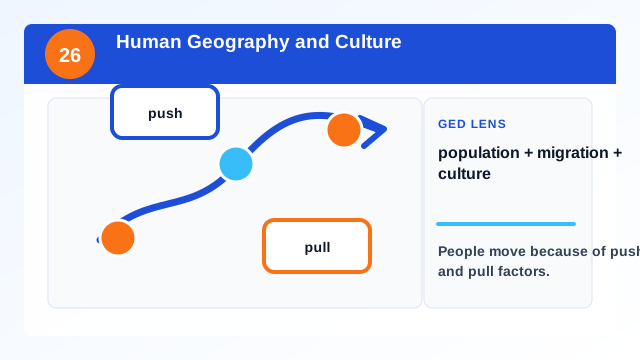
Visual Study Cue
Use the image above as a map for this session. First identify the civics concept, historical event, economic model, geographic pattern, or source skill; then connect it to the evidence in the lesson.
Evidence Model
Use the second image for GED®-style reasoning: identify the source or data, decide what claim it supports, and eliminate answer choices that go beyond the evidence.
What You Will Learn
By the end of this session you will understand why people are distributed unevenly across Earth, explain the push and pull factors that drive migration, analyze the process of urbanization, and describe how culture shapes human societies and spreads across the globe.
---
Population Geography: Where People Live and Why
Earth's population reached 8 billion people in 2022. But people are not spread evenly — some areas are densely packed while others are nearly empty.
Population density = number of people per square mile (or square kilometer) of land area.
Why are some areas densely populated?
- Fertile soil for agriculture (Nile Valley, Ganges Plain, Mississippi Valley)
- Access to water (rivers, coasts, lakes)
- Mild, temperate climate (most of Europe, eastern U.S., East Asia)
- Economic opportunity (major cities, industrial centers)
Why are some areas sparsely populated?
- Extreme climate (deserts, polar regions, high mountains)
- Lack of fresh water
- Poor soil (rainforest soils are often poor for farming despite lush growth)
- Geographic isolation (remote islands, mountain valleys)
Most densely populated regions:
- East Asia (China, Japan, South Korea, Taiwan)
- South Asia (India, Bangladesh, Pakistan) — India surpassed China as world's most populous nation in 2023
- Western Europe
- Northeastern United States / Great Lakes region
- Nile River Valley
Most sparsely populated regions:
- Sahara and Arabian deserts
- Amazon rainforest interior
- Siberia and northern Canada
- Antarctica (no permanent population)
---
Population Growth and the Demographic Transition
World population grew slowly for most of human history — then exploded:
- 1 billion people: reached around 1800
- 2 billion: 1927
- 4 billion: 1974
- 8 billion: 2022
This acceleration was driven by the demographic transition — the shift in birth and death rates as societies industrialize:
| Stage | Birth Rate | Death Rate | Population Growth | Example |
|---|---|---|---|---|
| Stage 1 (pre-industrial) | High | High | Slow | Traditional/subsistence societies |
| Stage 2 (early industrial) | High | Falls | Rapid growth | 19th-century Europe; today's least developed nations |
| Stage 3 (late industrial) | Falls | Low | Slowing | Industrializing nations, much of Latin America |
| Stage 4 (post-industrial) | Low | Low | Stable or slight growth | U.S., Europe, Japan |
| Stage 5 (emerging) | Very low | Low | Population decline | Japan, Germany, some European nations |
Key concepts:
- Birth rate — number of live births per 1,000 people per year
- Death rate — number of deaths per 1,000 people per year
- Natural increase rate = birth rate − death rate (population growth from births/deaths only, not migration)
- Total fertility rate (TFR) — average number of children a woman has in her lifetime; replacement level = 2.1
What is the demographic transition model?
Most developed nations are in Stage 4 or 5; the population explosion of the 20th century was driven by Stage 2 nations.
---
Migration: People on the Move
Migration is the movement of people from one place to another with the intent to settle. People have always migrated — today approximately 281 million people (3.6% of world population) live outside their country of birth.
Push Factors — conditions that drive people AWAY from an origin:
- Poverty, unemployment, lack of economic opportunity
- War, violence, and persecution (political, ethnic, religious)
- Natural disasters (earthquakes, floods, drought)
- Environmental degradation
- Discrimination and lack of political freedom
Pull Factors — conditions that attract people TO a destination:
- Economic opportunity (jobs, higher wages)
- Political freedom and safety
- Family reunification (joining relatives already there)
- Educational opportunities
- Better quality of life (healthcare, infrastructure)
Types of Migration:
| Type | Description | Example |
|---|---|---|
| Voluntary migration | People choose to move to improve their lives | European immigrants to the U.S. in the 1800s–1900s |
| Forced migration | People are compelled to move against their will | Transatlantic slave trade; refugee flight from war |
| Internal migration | Movement within a country | Great Migration of Black Americans from South to North (1910–1970) |
| International migration | Movement between countries | Mexicans immigrating to the United States |
| Refugees | People forced to flee their country due to persecution or war | Syrian refugees fleeing the civil war after 2011 |
| Asylum seekers | People who flee to another country and request legal protection | Central American migrants seeking asylum at U.S. border |
The Great Migration (1910–1970): Approximately 6 million Black Americans moved from the rural South to Northern and Western cities to escape Jim Crow laws and find industrial employment. This transformed American demographics, politics, and culture — and was driven by both push factors (racial violence, Jim Crow oppression) and pull factors (factory jobs in Detroit, Chicago, New York).
What is the difference between a refugee and a voluntary migrant?
Refugees are protected under the UN Refugee Convention (1951).
---
Urbanization: The City Century
Urbanization — the process by which more people move from rural areas to cities. For the first time in human history, more than half the world's population (56%) lives in cities — and this share is growing rapidly.
Why urbanization happens:
- Cities offer more jobs (especially manufacturing and service sector)
- Better access to education, healthcare, and services
- Higher wages attract rural migrants
Global urban trends:
- In 1800, only 3% of the world's population lived in cities
- In 1950, 30% lived in cities
- Today: 56%; projected 68% by 2050
Megacities — cities with populations over 10 million:
- Tokyo (37 million) — world's largest
- Delhi (33 million)
- Shanghai (29 million)
- São Paulo (22 million)
- Mexico City (22 million)
- New York City (19 million)
Urbanization challenges:
- Slums/informal settlements (called favelas in Brazil, shanty towns, informal housing) — rapid urban growth without adequate planning creates overcrowding, lack of sanitation, poor infrastructure
- Traffic congestion and air pollution
- Urban heat islands — cities are warmer than surrounding countryside due to concrete and reduced vegetation
- Gentrification — wealthier residents move into previously low-income urban areas, raising rents and displacing original residents
---
Culture: The Fabric of Human Society
Culture is the shared beliefs, values, customs, behaviors, arts, language, and social institutions of a group of people. Culture is learned (not inherited biologically) and shared.
Components of Culture:
- Language — primary carrier of culture; ~7,000 languages spoken in the world today; the most widely spoken are Mandarin Chinese, Spanish, English, Hindi, and Arabic
- Religion — shared system of beliefs about ultimate reality, morality, and the sacred
- Customs and traditions — practices passed down through generations (food, clothing, celebrations, greetings)
- Values and norms — shared standards of right and wrong behavior
- Arts — music, visual arts, literature, architecture expressing cultural identity
- Social institutions — family structure, government, education, economy organized around cultural values
Cultural Diffusion — the spread of cultural elements (ideas, practices, technologies, foods, music) from one culture to another through:
- Trade — merchants carried ideas along the Silk Road
- Migration — immigrants bring their cultures to new places
- Conquest — colonial powers imposed their languages and religions
- Media and technology — today, the internet and social media accelerate cultural diffusion globally
Examples of cultural diffusion:
- Pizza (Italian) is now a global food
- English words appear in virtually every language
- Democracy (Greek concept) became a global political ideal
- Buddhism spread from India throughout Asia via trade routes
---
Major World Religions
Religion is one of the most powerful cultural forces shaping human geography — it influences where people live, how they govern themselves, what they eat, what days are sacred, and how conflicts arise:
| Religion | Approximate Followers | Origin | Key Beliefs |
|---|---|---|---|
| Christianity | 2.4 billion | Middle East (1st century CE) | Jesus Christ as savior; resurrection; Trinity; heaven/hell |
| Islam | 1.9 billion | Arabia (7th century CE) | One God (Allah); Muhammad as final prophet; Five Pillars |
| Hinduism | 1.2 billion | South Asia (oldest living religion) | Multiple deities; dharma; karma; reincarnation; caste |
| Buddhism | 500 million | South Asia (5th century BCE) | Siddhartha Gautama; end suffering through Eightfold Path; Nirvana |
| Judaism | 15 million | Middle East (ancient) | Covenant with God; Torah; ethical monotheism; chosen people |
| Sikhism | 25 million | South Asia (15th century CE) | One God; equality; service; Guru Granth Sahib |
Geographic distribution:
- Christianity: dominant in the Americas, Europe, sub-Saharan Africa
- Islam: dominant in North Africa, Middle East, Central Asia, parts of Southeast Asia
- Hinduism: concentrated in South Asia (India, Nepal)
- Buddhism: East and Southeast Asia
- Judaism: Israel and diaspora communities worldwide
---
Demographics and Age Structure
Demographics — the statistical study of human populations. Key demographic measures:
- Age structure — the distribution of a population by age group
- Population pyramid — a graph showing the age and sex distribution of a population
- Wide base = high birth rate = young, rapidly growing population (developing nations)
- Narrow base = low birth rate = aging population (developed nations)
Dependency ratio — the ratio of dependent people (children under 15 + elderly over 65) to working-age adults (15–64). A high dependency ratio means fewer workers supporting more dependents.
Aging populations — a major challenge for developed nations (U.S., Japan, Germany): as baby boomers retire, fewer workers support more retirees through Social Security and Medicare. This is why immigration policy is partly an economic debate — younger immigrants help maintain the working-age population.
---
Key Terms
- Population density — number of people per unit of land area
- Demographic transition — the shift from high birth/death rates to low birth/death rates as societies industrialize
- Push factor — condition that drives people away from a location
- Pull factor — condition that attracts people to a location
- Urbanization — the process of population concentration in cities
- Cultural diffusion — the spread of cultural elements from one society to another
- Refugee — a person who has fled their country due to persecution, war, or violence
No teacher notes have been added for this session.
No additional resources have been added for this session.
Lesson Discussion
Ask a question about this lesson. A teacher or admin can answer here.
Sign in to ask a question or save this lesson.
No questions yet for this lesson.