Week 3, Session 2: Rutherford, Bohr and Chadwick
Year 9 Chemistry: Term 1 · preview lesson
Lesson route
Estimated study time: 50–65 minutes
Learning goals
You will learn to:
- describe the alpha-particle scattering experiment;
- use the results to justify the nuclear model;
- state the key contribution of Bohr and Chadwick;
- evaluate how strongly a model is supported by evidence.
1. Rutherford's scattering evidence
Rutherford's research group directed positive alpha particles at very thin gold foil.
Results:
- most alpha particles passed straight through;
- some were deflected through small angles;
- a very small number were deflected through large angles or returned toward the source.
The plum-pudding model predicted only small deflections because positive charge was thought to be spread throughout the atom. Large deflections were therefore surprising.
2. Reasoning from the evidence
- Most particles passed through, so most of the atom must be empty space.
- Some positive alpha particles were deflected, so positive charge is concentrated rather than spread out.
- Very few showed large deflections, so the positive region is tiny compared with the atom.
- Large deflections also require a concentrated mass, so most atomic mass lies in the nucleus.
This produced the nuclear model: a small, dense, positively charged nucleus surrounded by electrons.
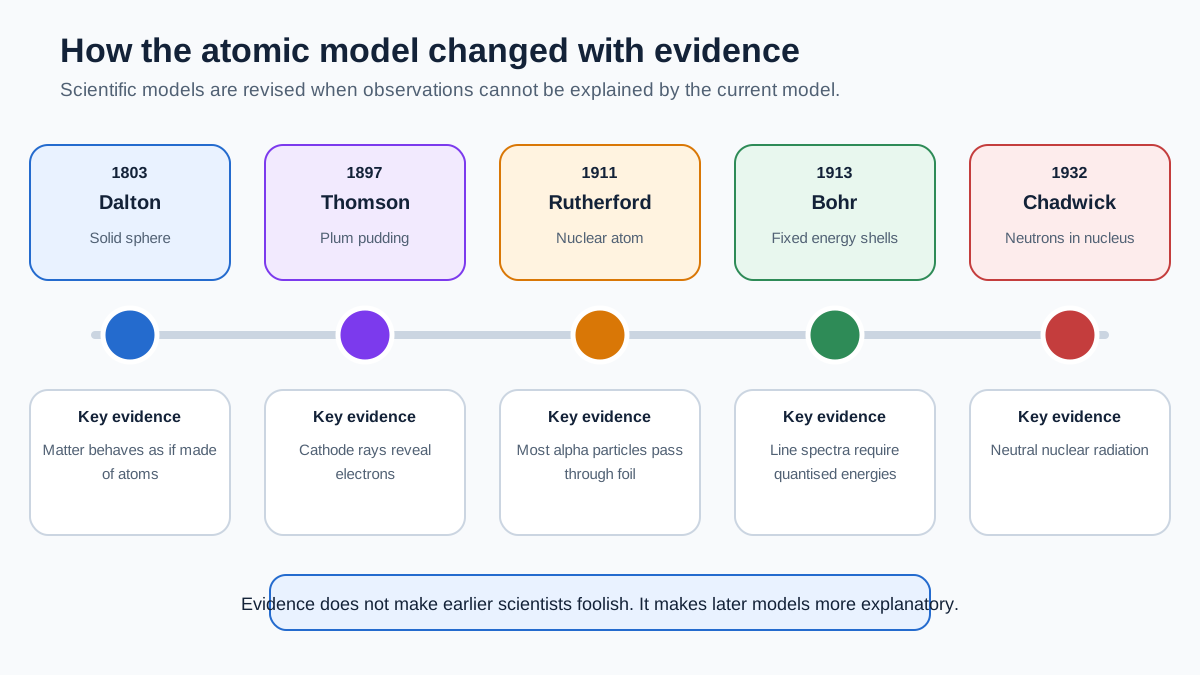
3. Bohr and Chadwick
Niels Bohr proposed that electrons occupy allowed energy levels or shells rather than any orbit. The school shell model is a simplified version of this idea. It is useful for explaining patterns in the first 20 elements.
James Chadwick found evidence for the neutron in 1932. Neutrons have no electrical charge and contribute mass to the nucleus. Their discovery explained why nuclear mass could be greater than the number of protons alone.
4. A model is not a photograph
The familiar diagram of electrons moving on circular lines is a teaching model. Modern quantum theory represents electron locations using probability distributions rather than miniature planets. At Key Stage 3, the shell model remains useful for explaining periodic patterns.
Structured response
Question: How did alpha scattering disprove the plum-pudding model?
A high-quality answer should include:
- the unexpected result;
- the prediction of the old model;
- the conclusion about positive charge and empty space.
Self-check
What did the fact that most alpha particles passed through the foil suggest?
Only a small central region strongly affects the particles.
Which particle did Chadwick discover?
It is neutral and found in the nucleus.
Session summary
Rutherford's alpha-scattering evidence required a small, dense positive nucleus and a mostly empty atom. Bohr introduced allowed electron energy levels. Chadwick identified the neutron. Each step increased the model's explanatory power.
Deepen your understanding
A. Rutherford's scattering experiment
Rutherford's research group directed positively charged alpha particles at a very thin sheet of gold. A fluorescent screen detected where the particles travelled. The pattern was surprising:
- most alpha particles passed straight through;
- some were deflected through small angles;
- a very small number were deflected through large angles or returned backward.
The thin foil reduced the chance that one particle would undergo many separate collisions. Gold could be made extremely thin, only a few hundred atoms thick.
B. From observations to the nuclear model
Use proportional reasoning. If most particles pass through, most of the atom must be empty space. If a small number are strongly deflected, positive charge and most mass must be concentrated in a very small region. Because alpha particles are positive, strong repulsion requires a concentrated positive centre.
This led to the nuclear model:
- a tiny, dense, positively charged nucleus;
- electrons outside the nucleus;
- mostly empty space between nucleus and electrons.
The plum-pudding model predicted only small deflections because its positive charge was spread out. It could not explain rare large-angle scattering.
C. Scale of the nucleus
An atom has a radius of about \(10^{-10}\,\mathrm{m}\). A nucleus has a radius of roughly \(10^{-15}\) to \(10^{-14}\,\mathrm{m}\), depending on the atom. The nucleus is therefore tens of thousands of times smaller in radius than the atom. Yet it contains almost all of the mass.
Scale analogies can help, but they are imperfect. If an atom were represented by a large stadium, its nucleus might be smaller than a small object near the centre, with electrons occupying the surrounding region. The analogy highlights empty space, not exact electron paths.
D. Bohr's contribution
Rutherford's model did not explain why electrons did not continuously lose energy and collapse into the nucleus. It also did not fully explain atomic line spectra. Bohr proposed that electrons occupy specific energy levels. Electrons can move between levels by absorbing or emitting definite amounts of energy.
At Key Stage 3, these levels are represented as shells. Modern quantum theory uses orbitals and probability distributions rather than fixed circular tracks, but the shell model remains useful for the first 20 elements.
E. Chadwick and the neutron
The positive charge of the nucleus could be explained by protons, but measured nuclear masses were often larger than the proton count alone. Chadwick studied penetrating radiation produced when alpha particles struck beryllium. The radiation knocked protons from paraffin wax. From energy and momentum evidence, he inferred the presence of a neutral particle with a mass similar to a proton: the neutron.
Neutrons explain why isotopes of the same element can have different masses without different charges.
F. Compare the models
| Model | Main feature | Evidence that forced change |
|---|---|---|
| Dalton | Indivisible sphere | Cathode rays showed smaller negative particles |
| Thomson | Electrons in spread-out positive charge | Large alpha deflections required a concentrated nucleus |
| Rutherford | Tiny positive nucleus | Spectra and stability required more detail about electrons |
| Bohr | Electrons in energy levels | Later quantum evidence refined fixed-orbit ideas |
| Chadwick addition | Neutrons in nucleus | Nuclear mass exceeded proton mass alone |
Extended response frame
Claim: The atom is mostly empty space.
Evidence: Most alpha particles passed through gold foil with little or no deflection.
Reasoning: If positive charge and mass filled the whole atom, many particles would be deflected. The observed pattern fits an atom with a very small nucleus and a large empty region.
Further self-check
Which observation gave the strongest evidence for a small dense nucleus?
A spread-out positive charge could not cause rare strong repulsion.
What problem did the neutron help explain?
Neutrons add mass without adding charge.
Academic sources
- OpenStax Chemistry 2e, Section 2.2: Evolution of Atomic Theory
- Royal Society of Chemistry, How to teach atomic structure at 14–16
The lesson paraphrases and adapts these sources for Key Stage 3. OpenStax material is used with attribution under its published licence.
-
Teacher Notes: Deeper Explanations and Extension Material
Enroll to download
-
OpenStax Chemistry 2e, Section 2.2: Evolution of Atomic Theory
Textbook account of how evidence changed atomic models over time.
Open Link Enroll to check off -
Royal Society of Chemistry, How to teach atomic structure at 14–16
Teaching guidance for building accurate atomic-structure explanations.
Open Link Enroll to check off
Lesson Discussion
Ask a question about this lesson. A teacher or admin can answer here.
Sign in to ask a question or save this lesson.
No questions yet for this lesson.