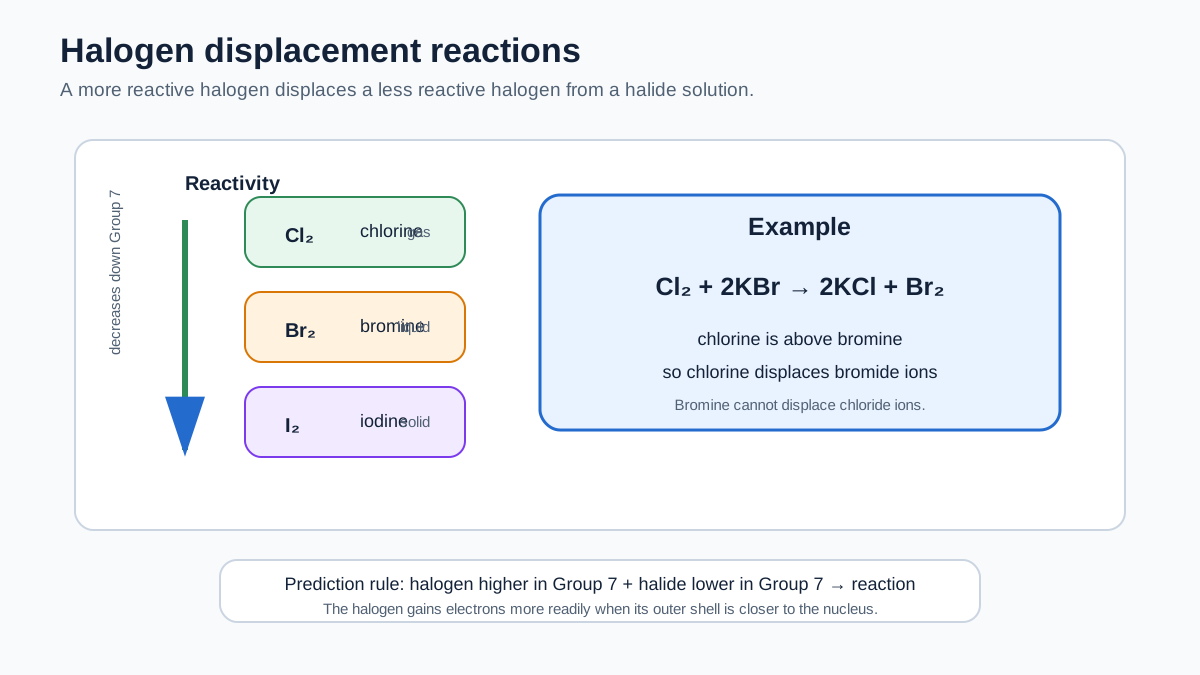
Chlorine displaces bromide because chlorine is more reactive. Iodine cannot displace chloride because iodine is less reactive than chlorine.
4. Prediction table
Added halogen
Chloride solution
Bromide solution
Iodide solution
Chlorine
No displacement
Reaction
Reaction
Bromine
No reaction
No displacement
Reaction
Iodine
No reaction
No reaction
No displacement
"No displacement" for the same halogen and halide is not a new chemical change.
Safety
Halogens are hazardous. Chlorine and bromine must not be handled in an unsupervised setting. Self-study should use data, diagrams or teacher-approved videos.
Self-check
Quick Check
Which halogen is more reactive, chlorine or iodine?
Reactivity decreases down Group 7.
Quick Check
Will bromine displace chloride ions from potassium chloride solution?
Bromine is below chlorine and is less reactive.
Independent study
Write balanced equations for chlorine with potassium iodide and bromine with sodium iodide. For each, identify the displaced halogen.
Session summary
Halogens have seven outer electrons and form diatomic molecules. Reactivity decreases down the group because attraction for an incoming electron weakens. A more reactive halogen displaces a less reactive halogen from its halide.
Deepen your understanding
A. Halogens are diatomic non-metals
Elemental fluorine, chlorine, bromine and iodine exist as diatomic molecules:
\[
\mathrm{F_2,\ Cl_2,\ Br_2,\ I_2}
\]
Each atom has seven outer electrons and tends to gain one electron, forming a \(1-\) halide ion. Element names end in -ine, while ion names end in -ide: chlorine forms chloride, bromine forms bromide and iodine forms iodide.
B. Physical trends down Group 7
At room temperature:
chlorine is a pale green gas;
bromine is a red-brown liquid with hazardous vapour;
iodine is a grey-black solid that forms purple vapour when warmed.
Melting and boiling points increase down the group because larger molecules have more electrons and stronger temporary intermolecular attractions. This physical trend is different from the chemical reactivity trend.
C. Reactivity decreases down the group
Halogens react by gaining an electron:
\[
\mathrm{X_2+2e^-\rightarrow2X^-}
\]
Down the group, the outer shell is farther from the nucleus and more shielded. Attraction between the nucleus and an incoming electron becomes weaker. Electron gain is less favourable, so reactivity decreases:
\[
\mathrm{F_2>Cl_2>Br_2>I_2}
\]
D. Displacement reactions
A more reactive halogen displaces a less reactive halogen from a halide compound.
\[
\mathrm{Cl_2+2KBr\rightarrow2KCl+Br_2}
\]
Chlorine gains electrons from bromide ions. Bromide ions lose electrons and form bromine. The net ionic form is:
\[
\mathrm{Cl_2+2Br^-\rightarrow2Cl^-+Br_2}
\]
If iodine is added to potassium chloride, no reaction occurs because iodine is less reactive than chlorine and cannot displace chloride.
E. Use a prediction matrix
Added halogen
Chloride
Bromide
Iodide
Chlorine
No displacement
Displaces bromine
Displaces iodine
Bromine
No reaction
No displacement
Displaces iodine
Iodine
No reaction
No reaction
No displacement
"No displacement" means no new halogen forms. Colour observations can be difficult because halogen and halide solutions may have overlapping colours and depend on solvent and concentration.
F. Electron-transfer reasoning
In chlorine plus potassium bromide:
chlorine molecules gain electrons, so chlorine is reduced;
bromide ions lose electrons, so bromide is oxidised.
The terms oxidation and reduction are GCSE extension ideas here. The core KS3 explanation is that chlorine has a stronger tendency to gain electrons than bromine.
G. Safety and environmental control
Halogens and their vapours can be toxic, corrosive or irritating. Bromine should not be handled in an open classroom. School work usually uses very dilute solutions or microscale methods in a fume cupboard under trained supervision. Never mix household chlorine products with acids or ammonia because dangerous gases can form.
Worked prediction
Question: What happens when bromine water is added to potassium iodide solution?
Answer: Bromine is above iodine in Group 7 and is more reactive. It displaces iodide ions to form bromide ions and iodine:
\[
\mathrm{Br_2+2KI\rightarrow2KBr+I_2}
\]
Further self-check
Quick Check
Why does Group 7 reactivity decrease down the group?
Halogens react by gaining electrons.
Quick Check
Can iodine displace bromide ions from potassium bromide?
Iodine is less reactive than bromine.
Displacement reasoning drill
For every proposed reaction, ask two questions: Which halogen is free, and which halide ion is in the compound? The free halogen reacts only if it is higher in Group 7 than the halogen represented by the halide.
Example: \(\mathrm{Br_2+2NaCl}\). Bromine is below chlorine, so no displacement occurs. Example: \(\mathrm{Cl_2+2NaI}\). Chlorine is above iodine, so iodine forms and the balanced equation is \(\mathrm{Cl_2+2NaI\rightarrow2NaCl+I_2}\).
Create three more examples and justify each result before writing an equation. This prevents the common habit of balancing an impossible reaction. First decide whether the chemistry occurs, then represent it symbolically.
In chemistry, halogens is the name given to the group of non-metal elements in Group 7 of the Periodic Table. This group includes fluorine, chlorine, bromine, and iodine.
From your lesson, key features that define the halogens include:
They are reactive non-metals.
They have seven electrons in their outer shell.
They form diatomic molecules (pairs of atoms bonded together, such as Cl2 or Br2).
Fun extra fact (from general knowledge): The word halogen comes from Greek words meaning "salt-former" or "salt-maker". They were given this name because when halogens react with metals, they form compounds called salts (for example, when chlorine reacts with sodium, it makes sodium chloride, which is table salt!).
Does this help clarify what halogens are? Let me know if you have any more questions!