Week 3, Session 3: Protons, Neutrons and Electrons
Year 9 Chemistry: Term 1 · preview lesson
Lesson route
Estimated study time: 45–60 minutes
Learning goals
You will learn to:
- state the charge, relative mass and location of each subatomic particle;
- explain why a neutral atom has no overall charge;
- compare the size of the nucleus with the atom;
- use precise terms: nucleus, shell, proton, neutron and electron.
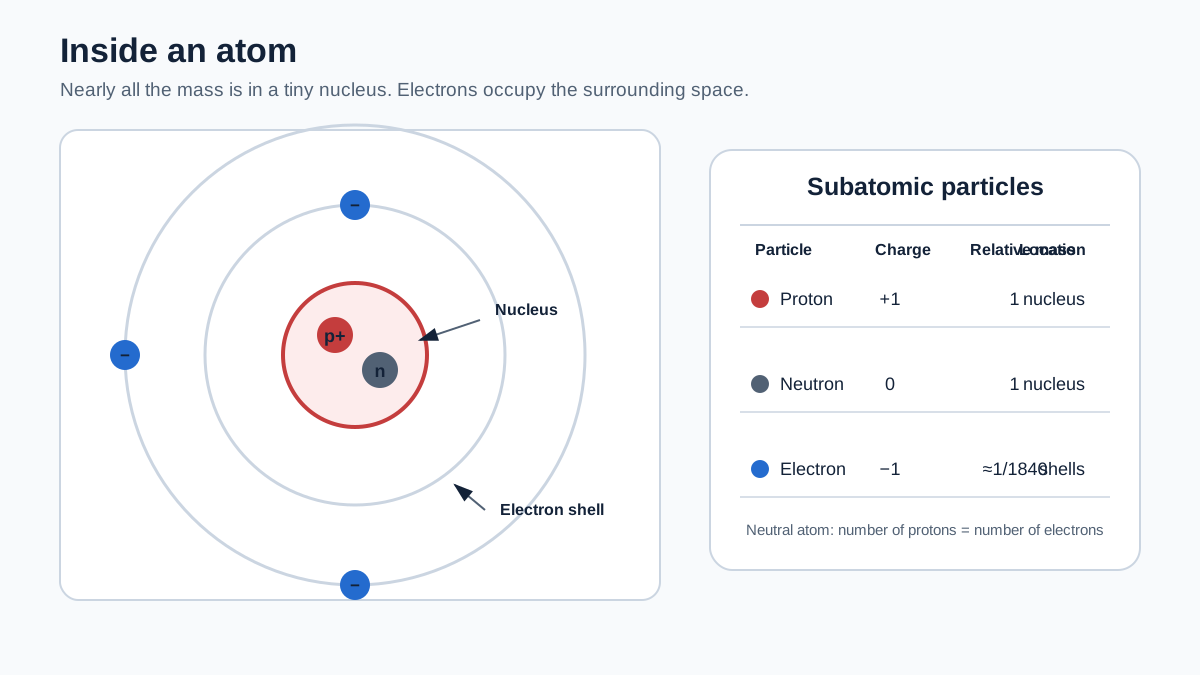
1. Particle properties
| Particle | Relative charge | Relative mass | Location |
|---|---|---|---|
| Proton | \(+1\) | \(1\) | Nucleus |
| Neutron | \(0\) | \(1\) | Nucleus |
| Electron | \(-1\) | about \(\frac{1}{1840}\) | Shells around nucleus |
Protons and neutrons are called nucleons because they are located in the nucleus. Electrons contribute very little to the mass of an atom, although they control most chemical behaviour.
2. Charge balance
A neutral atom has equal numbers of protons and electrons:
\[ (+1 \times N_p) + (-1 \times N_e) = 0 \]
For a neutral atom, \(N_p=N_e\). Neutrons do not affect charge.
Example: A magnesium atom has 12 protons, 12 electrons and usually 12 neutrons. Total charge:
\[ (+12) + (-12) = 0 \]
If an atom loses or gains electrons, it becomes an ion. The nucleus does not normally change during a chemical reaction.
3. Scale
An atom has a radius of roughly \(10^{-10}\,\mathrm{m}\). A nucleus has a radius of roughly \(10^{-14}\,\mathrm{m}\). The exact comparison varies, but the nucleus is many thousands of times smaller in radius than the atom.
Most diagrams enlarge the nucleus so it can be seen. They are not drawn to scale.
Explain the statement
"The nucleus is tiny but contains nearly all the mass."
A complete explanation says that protons and neutrons have relative mass 1 and lie in the nucleus, while electrons have a much smaller relative mass.
Self-check
Which subatomic particles contribute most of an atom's mass?
Both are in the nucleus and have relative mass 1.
Why is an atom with 11 protons and 11 electrons neutral?
Neutrons contribute no charge.
Independent study
Create a comparison table from memory. Then close your notes and redraw it. Check all nine facts: charge, mass and location for three particles.
Session summary
The nucleus contains positive protons and neutral neutrons. Negative electrons occupy shells around it. Equal proton and electron numbers make an atom neutral. The nucleus occupies very little volume but contains nearly all atomic mass.
Deepen your understanding
A. Identity, mass and charge
Each subatomic particle plays a different role:
- The number of protons identifies the element.
- Protons and neutrons account for almost all atomic mass.
- Electrons determine much of an atom's chemical behaviour.
- The balance between protons and electrons determines overall charge.
Changing the number of neutrons creates an isotope of the same element. Changing the number of electrons creates an ion. Changing the number of protons creates a different element.
B. Relative values and actual scale
The table uses relative mass and relative charge because the actual values are extremely small.
| Particle | Approximate mass, kg | Charge, C |
|---|---|---|
| Proton | \(1.67\times10^{-27}\) | \(+1.60\times10^{-19}\) |
| Neutron | \(1.675\times10^{-27}\) | 0 |
| Electron | \(9.11\times10^{-31}\) | \(-1.60\times10^{-19}\) |
The electron mass is about \(1/1836\) of a proton mass. At school level this is often rounded to about \(1/1840\). Because electron mass is so small, mass number counts protons and neutrons only.
C. Electrostatic attraction
Opposite charges attract. The positively charged nucleus attracts negative electrons. Like charges repel. These electrostatic forces help explain why electrons remain associated with the atom and why removing an electron requires energy.
Do not imagine electrons as tiny planets held by gravity. Electrical attraction is far stronger at atomic scale, and modern electrons do not follow fixed classical paths.
D. Neutral atoms and ions
For a neutral atom:
\[ \text{number of protons} = \text{number of electrons} \]
If an atom loses one electron, it has one more proton than electrons and forms a \(+1\) ion. If it gains two electrons, it has two more electrons than protons and forms a \(-2\) ion.
Example: Magnesium has 12 protons. A neutral magnesium atom has 12 electrons. A magnesium ion, \(\mathrm{Mg^{2+}}\), has lost two electrons and therefore has 10 electrons. Its nucleus still contains 12 protons.
E. Atoms are mostly empty space, but matter feels solid
The nuclear model says atoms are mostly empty space. Yet a desk feels solid because electron clouds in neighbouring atoms repel and quantum rules resist the same electron states being occupied. At Key Stage 3, describe this simply as strong electrical interactions between atoms preventing matter from passing through itself.
"Empty space" does not mean no forces act there. Electric fields extend through the space around charged particles.
F. Read a particle statement carefully
Statement: "An atom has no charge because it contains neutrons."
This is incorrect. Neutrons contribute no charge, but neutrality comes from equal numbers of positive protons and negative electrons.
Statement: "Electrons contribute no mass."
This is also an approximation. Electrons have mass, but it is very small compared with proton and neutron mass, so it is ignored in the mass number.
Worked comparison
An atom contains 17 protons, 18 neutrons and 17 electrons.
- Element identity: chlorine, because atomic number 17 means chlorine.
- Mass number: \(17+18=35\).
- Overall charge: zero, because 17 positive charges balance 17 negative charges.
- Symbol: \(^{35}_{17}\mathrm{Cl}\).
Further self-check
Which change would turn an atom into a different element?
Element identity is defined by atomic number.
Why are electrons ignored when calculating mass number?
Mass number counts nucleons in the nucleus.
Academic sources
- OpenStax Chemistry 2e, Section 2.3: Atomic Structure and Symbolism
- Royal Society of Chemistry, How to teach atomic structure at 14–16
The lesson paraphrases and adapts these sources for Key Stage 3. OpenStax material is used with attribution under its published licence.
-
Teacher Notes: Deeper Explanations and Extension Material
Enroll to download
-
OpenStax Chemistry 2e, Section 2.3: Atomic Structure and Symbolism
Reference reading for protons, neutrons, electrons, symbols and particle-count problems.
Open Link Enroll to check off -
Royal Society of Chemistry, How to teach atomic structure at 14–16
Teacher guidance for common atomic-structure misconceptions and progression.
Open Link Enroll to check off
Lesson Discussion
Ask a question about this lesson. A teacher or admin can answer here.
Sign in to ask a question or save this lesson.
No questions yet for this lesson.