Week 4, Session 1: Duality, Symbolism and Jekyll's Confession
Year 9 English: Full 48-Session Course · preview lesson
Week 4, Session 1
Unit 2: Gothic Fiction and the Nineteenth Century
Estimated study time: 70-90 minutes
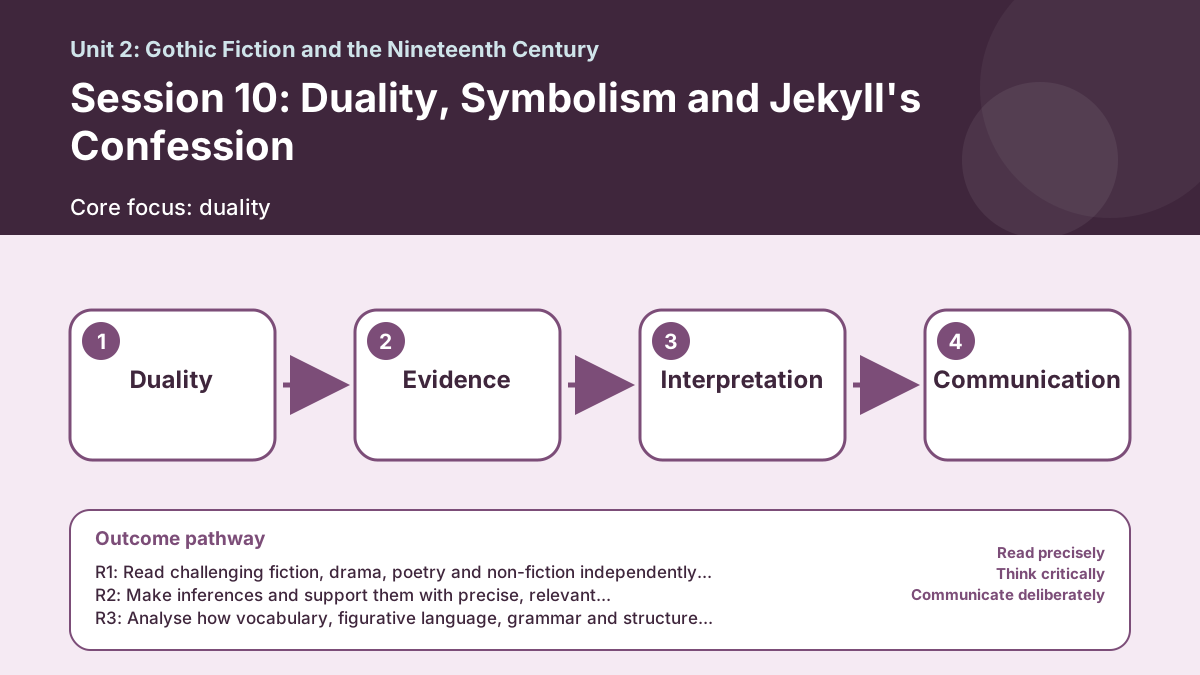
Core focus: duality
Learning outcomes
By the end of this session, you should be able to:
- define duality accurately and distinguish it from a vague device label;
- establish literal meaning before making an inference;
- select a short, relevant quotation and explain how its wording supports a claim;
- analyse language, structure, tone and purpose as connected choices;
- apply the session method in writing and formal spoken English.
This session contributes to these course outcomes:
- R1: Read challenging fiction, drama, poetry and non-fiction independently and with secure literal understanding.
- R2: Make inferences and support them with precise, relevant textual evidence.
- R3: Analyse how vocabulary, figurative language, grammar and structure create meaning and effect.
- R5: Analyse setting, plot, characterisation, poetic convention and stagecraft.
- R6: Make critical comparisons within and across texts, allowing for alternative interpretations.
The unit lens
Gothic writing tests the boundaries between reason and fear, civilisation and disorder, public respectability and private desire. This unit uses a whole-text pathway through Robert Louis Stevenson's The Strange Case of Dr Jekyll and Mr Hyde, with a comparative extract from Mary Shelley's Frankenstein. Students analyse setting, the uncanny, duality, symbolism, narrative withholding and the moral questions raised by scientific ambition. Context supports interpretation, but it never replaces close attention to the language on the page.
The method
Read Gothic fiction at three levels. First, track what literally happens. Second, identify how description, viewpoint and withheld information shape uncertainty. Third, connect recurring patterns such as doors, darkness, fog, divided spaces and altered bodies to larger ideas about secrecy, identity and responsibility.
1. Core concept: duality
Definition: a pattern of division or opposition within a person, society or idea, often showing that two forces are connected.
Duality in Jekyll and Hyde is more complex than 'good versus evil'. Jekyll describes competing desires, public reputation and private
indulgence. He imagines separation as freedom from accountability, yet his experiment intensifies rather than solves the conflict.
A theme is developed through plot, symbol, setting, language and consequence. Readers should trace how an idea changes across the
whole work.
The confession is written retrospectively. Jekyll knows the disaster that follows, so words such as 'doomed', 'shipwreck' and
'curse' frame earlier desire through later knowledge. His abstract reasoning can also distance him from concrete victims. A critical
reading asks whether the language of universal human division explains his actions or excuses them.
A reliable English response moves through four stages. First, state a claim that answers the question. Second, choose evidence that is
precise enough to analyse. Third, explain the relevant wording, grammar, image, sound, structural position or performance choice. Fourth,
return to the larger idea and test whether another interpretation remains possible. The stages should form one line of reasoning rather
than four disconnected sentences.
2. Vocabulary and terminology
| Term | Working definition |
|---|---|
| duality | a connected division between opposing forces |
| theme | an idea developed through patterns across a text |
| extended metaphor | a comparison developed over several words or lines |
| nominalisation | turning an action or quality into a noun |
| accountability | being answerable for actions and consequences |
The session's vocabulary word is penitence, meaning remorse and regret for wrongdoing. Infer the meaning from both word structure
and context before checking a dictionary. Then use the word in a new sentence that preserves its grammatical role and register.
Context that supports, not replaces, reading
Victorian public culture placed strong value on reputation and self-control. Stevenson explores the pressures and hypocrisies that can develop when public and private selves are sharply divided.
3. Core passage: Man Is Not Truly One
With every day, and from both sides of my intelligence, the moral and the intellectual, I drew steadily nearer to that truth, by whose partial discovery I have been doomed to such a dreadful shipwreck: that man is not truly one, but truly two.
It was on the moral side, and in my own person, that I learned to recognise the thorough and primitive duality of man; I saw that, of the two natures that contended in the field of my consciousness, even if I could rightly be said to be either, it was only because I was radically both.
I learned to dwell with pleasure, as a beloved daydream, on the thought of the separation of these elements. If each, I told myself, could be housed in separate identities, life would be relieved of all that was unbearable; the unjust might go his way, delivered from the aspirations and remorse of his more upright twin; and the just could walk steadfastly and securely on his upward path, doing the good things in which he found his pleasure, and no longer exposed to disgrace and penitence by the hands of this extraneous evil.
Source note: Adapted from Robert Louis Stevenson's The Strange Case of Dr Jekyll and Mr Hyde (1886), Chapter 10. Public domain text.
4. First reading: orientate yourself
On the first reading, resist the urge to annotate every line. Establish who or what is present, what changes, and what question the text
creates. The central idea here is: Jekyll explains his belief that human beings contain conflicting natures and his desire to separate them.
A defensible inference is: Jekyll's fantasy promises freedom from remorse, suggesting that avoiding responsibility is central to his experiment.
This inference is not a free guess. It is anchored in the precise evidence "delivered from the aspirations and remorse of his more upright twin". Other relevant details include
"doomed to such a dreadful shipwreck"; "contended in the field of my consciousness"; "beloved daydream". Each detail has a different function, so the most useful quotation depends on the exact claim.
5. Language and method
The principal method for this session is extended metaphor, especially in "contended in the field of my consciousness".
The mind becomes a battlefield, presenting Jekyll's conflict as continuous and violent while making it seem larger than individual choice.
Do not stop after naming the method. Ask what relationship it creates, which connotations or associations become available, and how the
choice changes the reader's understanding of character, setting, argument or theme. A device has no universal effect. Its work depends on
the words around it, its position, the speaker and the whole-text movement.
6. Tone, structure and purpose
A precise description of tone is philosophical but self-excusing. This judgement should be justified by a pattern, not by one isolated adjective.
The structural movement can be described as follows: The confession moves from a universal claim, to Jekyll's personal conflict, and then to an attractive fantasy of separating consequences.
The passage's likely purpose is to reveal the reasoning behind Jekyll's experiment and invite judgement of both its insight and its self-deception. Purpose is not the same as effect. Purpose concerns what the text is designed to
do in relation to audience and subject. Effect concerns how specific choices influence meaning, feeling or attention.
A useful alternative interpretation is: Jekyll's account may contain genuine psychological insight even though he uses it to avoid accountability. This does not cancel the first reading. It tests its limits and helps
the writer avoid unsupported certainty.
7. Worked analytical model
Model thesis
Jekyll presents duality as a universal human condition, but his fantasy of separation reveals a more personal wish to enjoy wrongdoing without remorse.
Model paragraph
Jekyll imagines that the unjust self could be "delivered from ... remorse", a religiously coloured verb that usually suggests rescue.
Here, however, the rescue is from conscience rather than evil. The choice makes moral accountability sound like an unfair burden.
His battlefield metaphor, where natures "contended", may explain inner conflict, but the confession then converts explanation into
permission. Stevenson therefore gives Jekyll an intellectually persuasive voice while allowing the reader to detect self-excuse.
The model succeeds because it does not move from quotation directly to a generic reader effect. It explains a particular word or
structural choice, relates that choice to the passage's movement, and makes a conceptual judgement. Notice also that the quotation is
short enough to remain under the writer's grammatical control.
8. Grammar for meaning: abstract nouns and nominalisation
Nominalisation turns actions or qualities into nouns, such as 'separate' to 'separation'. It can support formal reasoning but may also hide who acts and who is affected.
Grammar should be discussed when it contributes to meaning or accuracy. In analytical writing, sentence boundaries and reference chains
make reasoning visible. In creative writing, deliberate variation can control pace and emphasis. In spoken English, clause structure and
signposting help an audience follow on first hearing.
Grammar check: Which revision makes responsibility clearest?
Correct principle: Jekyll wanted to separate his desires so that he could act without feeling remorse.
Why: The revision uses an active subject and verb, making Jekyll's motive explicit.
Sentence-combining check: Which sentence best combines explanation and evaluation?
Strong version: Although Jekyll identifies real inner conflict, he uses it to imagine escape from responsibility.
Why: The concessive clause acknowledges insight before evaluating its use.
9. Misconception checkpoint
| Misconception | Correction |
|---|---|
| Duality means one side is completely good and the other completely evil. | The novel presents mixed motives, repression and responsibility. |
| A theme is one abstract word. | A theme is an idea developed through patterns and change. |
| Jekyll's confession must be accepted as objective truth. | It is a retrospective account shaped by self-presentation. |
Misconceptions often survive because a partial rule has been overgeneralised. Correct them by stating the more accurate rule and applying
it to a new example. Do not memorise only the correct option letter.
10. Guided practice
- Summarise the passage in one sentence without interpretation.
- Write one inference and place the shortest supporting quotation beside it.
- Analyse one word inside "contended in the field of my consciousness". Name its direct meaning, one connotation and its local effect.
- Map the passage in three or four structural stages using active verbs such as narrows, delays, contrasts or reframes.
- Write one alternative interpretation and identify what evidence strengthens or weakens it.
- Read the model paragraph aloud. Underline the claim, evidence, analysis and return to the whole idea.
- Complete the grammar and sentence-combining items without looking at the options, then compare your answer.
11. Independent application
Write a thesis and paragraph answering: How does Stevenson present duality as both insight and excuse? Integrate two short quotations.
Success criteria:
- the response answers a clear question or fulfils a defined purpose;
- evidence is brief, accurate and relevant;
- analysis explains exact wording or structure;
- paragraphs follow a coherent line of reasoning;
- vocabulary and grammar fit the intended register;
- editing improves meaning before surface proofreading.
12. Spoken English
Hold a philosophical dialogue: Does naming conflicting parts of the self increase self-knowledge or reduce responsibility?
A strong contribution makes a claim early, refers to evidence, builds on or challenges another idea accurately, and distinguishes certainty
from possibility. Formal spoken English does not require a particular accent. It requires language and organisation suited to the
occasion.
13. Retrieval self-check
What is the session's central concept?
State the term precisely before explaining it.
Which quotation provides the strongest evidence in the model reading?
The quotation is selected for relevance, not length.
What tone is created across the passage?
Use a pattern of details, not one isolated word.
What must follow a quotation in a strong analytical paragraph?
A quotation does not explain itself.
14. Session summary
The session has developed duality through a complete reading cycle: literal understanding, inference, evidence, close analysis,
structure, alternative interpretation, writing and spoken explanation. The twenty MCQs that follow are diagnostic. Read every explanation,
including those attached to correct answers, and add uncertain rules to an error log.
Reading before the next session
Read Jekyll and Hyde, Chapter 10. Track Jekyll's verbs of choice alongside his language of fate.
Curriculum and academic sources
- Department for Education. National curriculum in England: English programmes of study, Key Stage 3.
- Stevenson, R. L. The Strange Case of Dr Jekyll and Mr Hyde. Project Gutenberg eBook 43.
- Shelley, M. Frankenstein; or, The Modern Prometheus. Project Gutenberg eBook 84.
- The British Library. Gothic literature articles and collection materials.
- Primary text or passage note: Adapted from Robert Louis Stevenson's The Strange Case of Dr Jekyll and Mr Hyde (1886), Chapter 10. Public domain text.
The lesson paraphrases research and curriculum guidance for Year 9. Public-domain literary extracts have been lightly modernised for punctuation or accessibility only where the source note states this.
No teacher notes have been added for this session.
No additional resources have been added for this session.
Lesson Discussion
Ask a question about this lesson. A teacher or admin can answer here.
Sign in to ask a question or save this lesson.
No questions yet for this lesson.