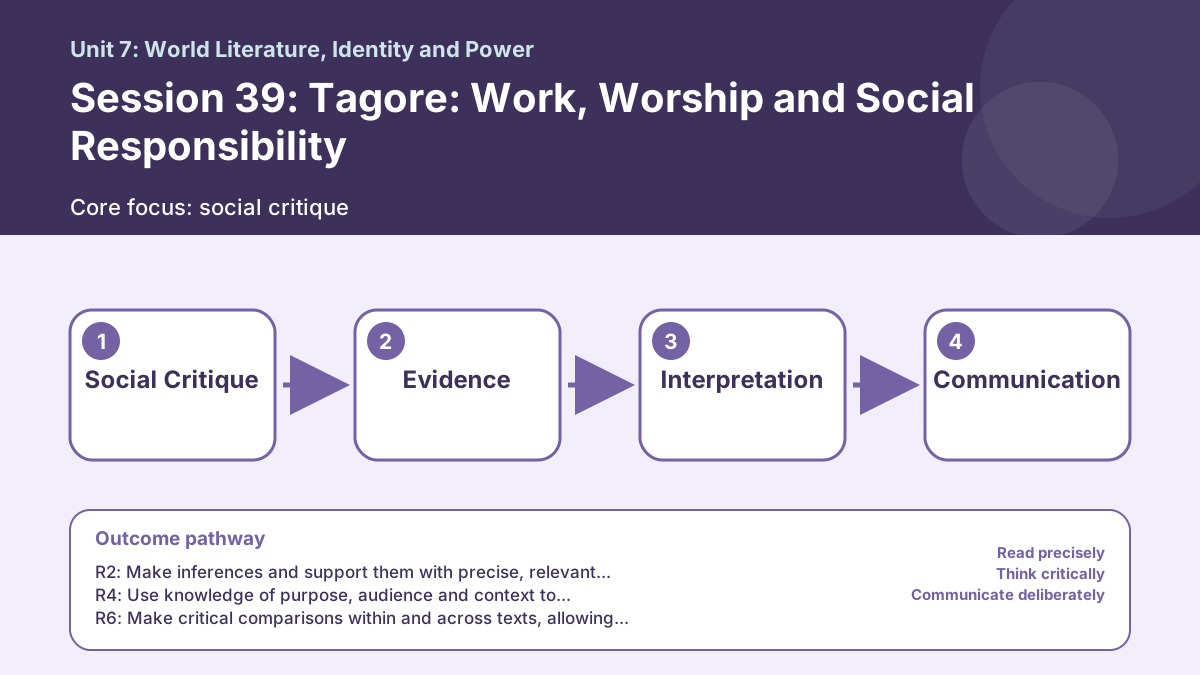
Week 13, Session 3: Tagore: Work, Worship and Social Responsibility
Year 9 English: Full 48-Session Course · preview lesson
Week 13, Session 3
Unit 7: World Literature, Identity and Power
Estimated study time: 70-90 minutes
Core focus: social critique
Learning outcomes
By the end of this session, you should be able to:
- define social critique accurately and distinguish it from a vague device label;
- establish literal meaning before making an inference;
- select a short, relevant quotation and explain how its wording supports a claim;
- analyse language, structure, tone and purpose as connected choices;
- apply the session method in writing and formal spoken English.
This session contributes to these course outcomes:
- R2: Make inferences and support them with precise, relevant textual evidence.
- R4: Use knowledge of purpose, audience and context to support comprehension and evaluation.
- R6: Make critical comparisons within and across texts, allowing for alternative interpretations.
- R8: Evaluate claims, evidence, bias, source quality and the responsible use of information.
- W2: Write sustained analytical essays with a coherent line of argument and integrated evidence.
The unit lens
This unit examines how writers represent identity, freedom, labour, language and belonging. It includes public-domain autobiographical and poetic writing by Frederick Douglass and Rabindranath Tagore, alongside original contemporary passages. Students distinguish a writer's individual perspective from a whole culture, examine how context shapes voice, and compare texts without reducing them to simple messages. Sensitive historical material is framed with content notes and precise vocabulary.
The method
Read contextually and critically. Establish who is speaking, what power relationships shape the situation, what audience the writer addresses, and how the language creates authority or resistance. Avoid treating one narrator as representative of every person who shares a background.
1. Core concept: social critique
Definition: a text's examination and judgement of social practices, values or power relationships.
In Gitanjali poem 11, Tagore addresses a worshipper who remains in a closed temple while labourers work outside. The poem's
imperatives challenge a separation between spiritual purity and material labour. Dust, torn clothing, sun and sweat become signs of
participation rather than contamination.
A critical reading should avoid opposing religion and work in a simplistic way. The poem offers a theological argument: the divine
is found with workers, and worship without solidarity is incomplete. The speaker uses second-person address, rhetorical questions
and repeated commands to move the addressee from enclosed meditation toward shared labour.
A reliable English response moves through four stages. First, state a claim that answers the question. Second, choose evidence that is
precise enough to analyse. Third, explain the relevant wording, grammar, image, sound, structural position or performance choice. Fourth,
return to the larger idea and test whether another interpretation remains possible. The stages should form one line of reasoning rather
than four disconnected sentences.
2. Vocabulary and terminology
| Term | Working definition |
|---|---|
| social critique | judgement of social practices or power |
| solidarity | active support and shared commitment |
| imperative | a command form |
| ritual | a repeated formal practice |
| participation | taking part in action rather than observing only |
The session's vocabulary word is deliverance, meaning rescue or liberation from difficulty or bondage. Infer the meaning from both word structure
and context before checking a dictionary. Then use the word in a new sentence that preserves its grammatical role and register.
Context that supports, not replaces, reading
Tagore's religious and social thought often connected spiritual life with education, rural reconstruction, human dignity and resistance to narrow divisions.
3. Core passage: Leave This Chanting
Leave this chanting and singing and telling of beads! Whom dost thou worship in this lonely dark corner of a temple with doors all shut? Open thine eyes and see thy God is not before thee!
He is there where the tiller is tilling the hard ground and where the pathmaker is breaking stones. He is with them in sun and in shower, and his garment is covered with dust. Put off thy holy mantle and even like him come down on the dusty soil.
Deliverance? Where is this deliverance to be found? Our master himself has joyfully taken upon him the bonds of creation; he is bound with us all for ever.
Come out of thy meditations and leave aside thy flowers and incense. What harm is there if thy clothes become tattered and stained? Meet him and stand by him in toil and in the sweat of thy brow.
Source note: Adapted from Rabindranath Tagore, Gitanjali, poem 11. Public domain English text.
4. First reading: orientate yourself
On the first reading, resist the urge to annotate every line. Establish who or what is present, what changes, and what question the text
creates. The central idea here is: The speaker argues that true worship requires leaving isolation and joining people in difficult labour.
A defensible inference is: The closed temple symbolises a spiritual practice separated from social responsibility.
This inference is not a free guess. It is anchored in the precise evidence "doors all shut". Other relevant details include
"hard ground"; "garment is covered with dust"; "stand by him in toil". Each detail has a different function, so the most useful quotation depends on the exact claim.
5. Language and method
The principal method for this session is imperatives and rhetorical questions, especially in "Open thine eyes ... Come out ... stand by him".
The sequence moves the addressee physically and morally from enclosed ritual toward solidarity.
Do not stop after naming the method. Ask what relationship it creates, which connotations or associations become available, and how the
choice changes the reader's understanding of character, setting, argument or theme. A device has no universal effect. Its work depends on
the words around it, its position, the speaker and the whole-text movement.
6. Tone, structure and purpose
A precise description of tone is urgent, challenging and devotional. This judgement should be justified by a pattern, not by one isolated adjective.
The structural movement can be described as follows: A command rejects closed worship; labourers are then presented as the divine location; questions redefine deliverance; final imperatives demand action.
The passage's likely purpose is to challenge worship that avoids labour and suffering, and to connect spiritual life with shared human work. Purpose is not the same as effect. Purpose concerns what the text is designed to
do in relation to audience and subject. Effect concerns how specific choices influence meaning, feeling or attention.
A useful alternative interpretation is: The poem may critique not ritual itself but ritual practised without engagement in the world. This does not cancel the first reading. It tests its limits and helps
the writer avoid unsupported certainty.
7. Worked analytical model
Model thesis
Tagore relocates holiness from the closed temple to shared labour, using repeated commands to make social participation part of spiritual responsibility.
Model paragraph
The temple is defined by "doors all shut", a physical detail that also suggests separation from people and work. The imperative
"Open thine eyes" demands a change in perception before movement. Later commands, "come down" and "stand by him", turn belief into
bodily solidarity. Dust and tattered clothes, usually treated as signs of impurity or poverty, become evidence of closeness to the
divine. The critique therefore targets withdrawal rather than devotion itself.
The model succeeds because it does not move from quotation directly to a generic reader effect. It explains a particular word or
structural choice, relates that choice to the passage's movement, and makes a conceptual judgement. Notice also that the quotation is
short enough to remain under the writer's grammatical control.
8. Grammar for meaning: imperative sequences and direct address
Imperatives can organise a persuasive progression. Archaic pronouns such as 'thou' and 'thy' mark direct singular address in this English version.
Grammar should be discussed when it contributes to meaning or accuracy. In analytical writing, sentence boundaries and reference chains
make reasoning visible. In creative writing, deliberate variation can control pace and emphasis. In spoken English, clause structure and
signposting help an audience follow on first hearing.
Grammar check: What progression is created by 'Open', 'come down' and 'stand by'?
Correct principle: The addressee is moved from seeing, to entering the world, to sustained solidarity.
Why: The sequence develops perception into action and relationship.
Sentence-combining check: Which sentence best captures the poem's qualification?
Strong version: The poem does not reject worship; it rejects worship that remains separated from labour and human need.
Why: The sentence avoids a false absolute and states the specific critique.
9. Misconception checkpoint
| Misconception | Correction |
|---|---|
| The poem says all religious ritual is useless. | It challenges isolated ritual without social engagement. |
| Dust and labour are included only as realistic background. | They are central to the poem's redefinition of holiness. |
| A translated archaic register makes the poem culturally simple. | The English version is one crafted form within a multilingual context. |
Misconceptions often survive because a partial rule has been overgeneralised. Correct them by stating the more accurate rule and applying
it to a new example. Do not memorise only the correct option letter.
10. Guided practice
- Summarise the passage in one sentence without interpretation.
- Write one inference and place the shortest supporting quotation beside it.
- Analyse one word inside "Open thine eyes ... Come out ... stand by him". Name its direct meaning, one connotation and its local effect.
- Map the passage in three or four structural stages using active verbs such as narrows, delays, contrasts or reframes.
- Write one alternative interpretation and identify what evidence strengthens or weakens it.
- Read the model paragraph aloud. Underline the claim, evidence, analysis and return to the whole idea.
- Complete the grammar and sentence-combining items without looking at the options, then compare your answer.
11. Independent application
Write a paragraph explaining how physical movement carries the poem's social argument. Analyse two imperatives and one setting contrast.
Success criteria:
- the response answers a clear question or fulfils a defined purpose;
- evidence is brief, accurate and relevant;
- analysis explains exact wording or structure;
- paragraphs follow a coherent line of reasoning;
- vocabulary and grammar fit the intended register;
- editing improves meaning before surface proofreading.
12. Spoken English
Deliver the first and final paragraphs as an address to a real audience. Explain how direct challenge can remain respectful.
A strong contribution makes a claim early, refers to evidence, builds on or challenges another idea accurately, and distinguishes certainty
from possibility. Formal spoken English does not require a particular accent. It requires language and organisation suited to the
occasion.
13. Retrieval self-check
What is the session's central concept?
State the term precisely before explaining it.
Which quotation provides the strongest evidence in the model reading?
The quotation is selected for relevance, not length.
What tone is created across the passage?
Use a pattern of details, not one isolated word.
What must follow a quotation in a strong analytical paragraph?
A quotation does not explain itself.
14. Session summary
The session has developed social critique through a complete reading cycle: literal understanding, inference, evidence, close analysis,
structure, alternative interpretation, writing and spoken explanation. The twenty MCQs that follow are diagnostic. Read every explanation,
including those attached to correct answers, and add uncertain rules to an error log.
Reading before the next session
Compare Gitanjali poems 11 and 35. Identify how each moves from enclosure toward wider action.
Curriculum and academic sources
- Department for Education. National curriculum in England: English programmes of study, Key Stage 3.
- Douglass, F. Narrative of the Life of Frederick Douglass. Project Gutenberg eBook 23.
- Tagore, R. Gitanjali. Project Gutenberg eBook 7164.
- Education Endowment Foundation. Improving Literacy in Secondary Schools.
- Primary text or passage note: Adapted from Rabindranath Tagore, Gitanjali, poem 11. Public domain English text.
The lesson paraphrases research and curriculum guidance for Year 9. Public-domain literary extracts have been lightly modernised for punctuation or accessibility only where the source note states this.
No teacher notes have been added for this session.
No additional resources have been added for this session.
Lesson Discussion
Ask a question about this lesson. A teacher or admin can answer here.
Sign in to ask a question or save this lesson.
No questions yet for this lesson.