Week 5, Session 2: Ambition and the Soliloquy: Macbeth Debates Murder
Year 9 English: Full 48-Session Course · preview lesson
Week 5, Session 2
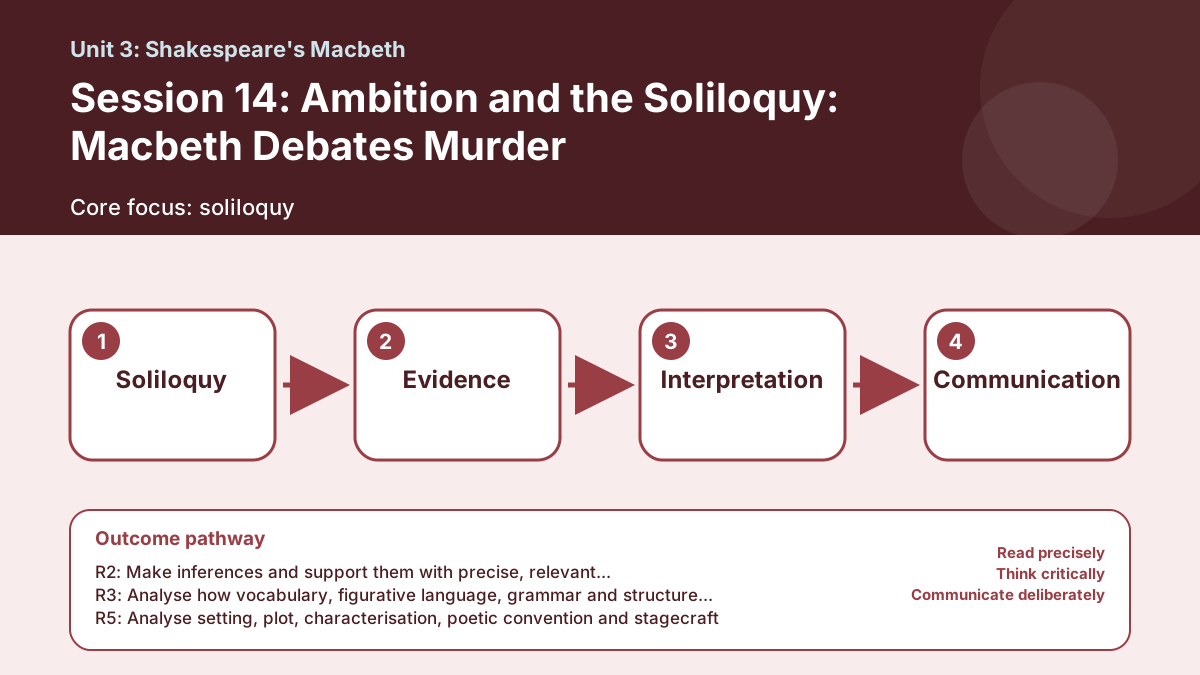
Unit 3: Shakespeare's Macbeth
Estimated study time: 70-90 minutes
Core focus: soliloquy
Learning outcomes
By the end of this session, you should be able to:
- define soliloquy accurately and distinguish it from a vague device label;
- establish literal meaning before making an inference;
- select a short, relevant quotation and explain how its wording supports a claim;
- analyse language, structure, tone and purpose as connected choices;
- apply the session method in writing and formal spoken English.
This session contributes to these course outcomes:
- R2: Make inferences and support them with precise, relevant textual evidence.
- R3: Analyse how vocabulary, figurative language, grammar and structure create meaning and effect.
- R5: Analyse setting, plot, characterisation, poetic convention and stagecraft.
- R7: Interpret drama as performance and evaluate how staging choices shape meaning.
- W2: Write sustained analytical essays with a coherent line of argument and integrated evidence.
The unit lens
Macbeth is studied as a complete play and as a performance text. The unit follows the tragic movement from prophecy and temptation to murder, tyranny, isolation and collapse. Students analyse soliloquies, imagery, rhetoric, dramatic irony and stagecraft while considering how different actors and directors can produce different meanings. Historical context is used selectively to illuminate kingship, succession, belief and theatre, not to dictate a single interpretation.
The method
When reading drama, attend to who speaks, who listens, what the audience knows, what happens on stage, and what might be communicated through pace, gesture, silence, lighting and positioning. A quotation is only one part of the evidence. Stage directions, entrances, exits and contrasts between scenes also shape the play's meaning.
1. Core concept: soliloquy
Definition: a speech in which a character, usually alone, reveals a developing train of thought to the audience.
A soliloquy stages thought as action. Macbeth does not merely announce ambition; he tests consequences, obligations, images and
excuses in real time. Syntax allows the audience to hear hesitation. Conditional clauses postpone commitment, while metaphors
transform moral ideas into physical objects such as a poisoned cup or an uncontrolled horse.
Analysis should trace movement. Macbeth begins by imagining an action without consequences, then remembers earthly judgement,
loyalty, hospitality and Duncan's virtues. He ends by naming ambition as his only motive. This recognition increases responsibility:
he understands the arguments against murder before choosing it. Performance decisions about pace, interruption and gesture can make
the speech sound calculating, terrified or self-divided.
A reliable English response moves through four stages. First, state a claim that answers the question. Second, choose evidence that is
precise enough to analyse. Third, explain the relevant wording, grammar, image, sound, structural position or performance choice. Fourth,
return to the larger idea and test whether another interpretation remains possible. The stages should form one line of reasoning rather
than four disconnected sentences.
2. Vocabulary and terminology
| Term | Working definition |
|---|---|
| soliloquy | a speech that stages a character's private thought |
| conditional clause | a clause expressing a possible condition |
| consequence | a result that follows an action |
| metaphor | a comparison stated as identity |
| moral agency | the capacity to choose and be responsible |
The session's vocabulary word is consequence, meaning a result or effect that follows an action. Infer the meaning from both word structure
and context before checking a dictionary. Then use the word in a new sentence that preserves its grammatical role and register.
Context that supports, not replaces, reading
Early modern ideas of hospitality, loyalty to a king and divine order intensify Macbeth's sense that Duncan is in 'double trust'.
3. Core passage: Vaulting Ambition
MACBETH
If it were done when it is done, then it were well
It were done quickly. If the assassination
Could trammel up the consequence, and catch
With his death success, that but this blow
Might be the be-all and the end-all here,
We would jump the life to come. But in these cases
We still have judgement here; that we but teach
Bloody instructions, which, being taught, return
To plague the inventor.
He is here in double trust:
First, as I am his kinsman and his subject,
Strong both against the deed; then, as his host,
Who should against his murderer shut the door,
Not bear the knife myself.
I have no spur
To prick the sides of my intent, but only
Vaulting ambition, which overleaps itself
And falls on the other side.
Source note: Adapted from William Shakespeare's Macbeth, Act 1, Scene 7. Public domain text.
4. First reading: orientate yourself
On the first reading, resist the urge to annotate every line. Establish who or what is present, what changes, and what question the text
creates. The central idea here is: Macbeth understands the moral, political and practical arguments against killing Duncan but identifies ambition as his motive.
A defensible inference is: Because Macbeth can articulate his duties clearly, the speech makes later murder a conscious choice rather than an ignorant mistake.
This inference is not a free guess. It is anchored in the precise evidence "I have no spur ... but only vaulting ambition". Other relevant details include
"trammel up the consequence"; "Bloody instructions ... return"; "double trust". Each detail has a different function, so the most useful quotation depends on the exact claim.
5. Language and method
The principal method for this session is extended equestrian metaphor, especially in "Vaulting ambition, which overleaps itself".
Ambition becomes a rider who jumps too far and falls, allowing Macbeth to predict that excess may destroy him.
Do not stop after naming the method. Ask what relationship it creates, which connotations or associations become available, and how the
choice changes the reader's understanding of character, setting, argument or theme. A device has no universal effect. Its work depends on
the words around it, its position, the speaker and the whole-text movement.
6. Tone, structure and purpose
A precise description of tone is anxious and morally lucid. This judgement should be justified by a pattern, not by one isolated adjective.
The structural movement can be described as follows: Conditional fantasies of consequence-free murder give way to judgement, social obligations and a final concise admission of motive.
The passage's likely purpose is to expose Macbeth's reasoning before Lady Macbeth pressures him, deepening both conflict and responsibility. Purpose is not the same as effect. Purpose concerns what the text is designed to
do in relation to audience and subject. Effect concerns how specific choices influence meaning, feeling or attention.
A useful alternative interpretation is: The speech may show that Macbeth's conscience remains powerful enough to resist until external manipulation changes the situation. This does not cancel the first reading. It tests its limits and helps
the writer avoid unsupported certainty.
7. Worked analytical model
Model thesis
Shakespeare makes Macbeth frighteningly self-aware: the soliloquy predicts both the moral return of violence and the self-destruction of ambition before he commits the murder.
Model paragraph
Macbeth imagines ambition as a rider that "overleaps itself / And falls". The reflexive "itself" makes destruction arise from the
quality's own excess, not from an accidental enemy. This image follows his admission that he has "no spur" except ambition, so the
speech strips away political necessity and names personal desire. Structurally, Shakespeare places this recognition after Macbeth's
detailed list of duties, making the murder a choice taken with unusually clear knowledge of its wrongness.
The model succeeds because it does not move from quotation directly to a generic reader effect. It explains a particular word or
structural choice, relates that choice to the passage's movement, and makes a conceptual judgement. Notice also that the quotation is
short enough to remain under the writer's grammatical control.
8. Grammar for meaning: conditional clauses
Conditional clauses present possible relationships: if X happens, Y follows. Macbeth's repeated 'if' clauses imagine impossible control over consequences and delay a direct statement of action.
Grammar should be discussed when it contributes to meaning or accuracy. In analytical writing, sentence boundaries and reference chains
make reasoning visible. In creative writing, deliberate variation can control pace and emphasis. In spoken English, clause structure and
signposting help an audience follow on first hearing.
Grammar check: What is the main effect of the repeated conditional opening 'If ... If ...'?
Correct principle: It shows Macbeth testing whether murder could be separated from its consequences.
Why: The conditional syntax keeps the act hypothetical while revealing Macbeth's wish to control outcomes.
Sentence-combining check: Which sentence best explains Macbeth's responsibility?
Strong version: Because Macbeth recognises his obligations and predicts violent consequences, his later choice cannot be explained by ignorance.
Why: The causal sentence connects knowledge to moral responsibility.
9. Misconception checkpoint
| Misconception | Correction |
|---|---|
| Ambition is always presented as evil. | The play condemns ambition when it overrides ethics and proportion. |
| A soliloquy is an objective statement of the author's view. | It stages one character's thought at a specific moment. |
| Macbeth does not understand that murder is wrong. | The speech gives detailed evidence of moral understanding. |
Misconceptions often survive because a partial rule has been overgeneralised. Correct them by stating the more accurate rule and applying
it to a new example. Do not memorise only the correct option letter.
10. Guided practice
- Summarise the passage in one sentence without interpretation.
- Write one inference and place the shortest supporting quotation beside it.
- Analyse one word inside "Vaulting ambition, which overleaps itself". Name its direct meaning, one connotation and its local effect.
- Map the passage in three or four structural stages using active verbs such as narrows, delays, contrasts or reframes.
- Write one alternative interpretation and identify what evidence strengthens or weakens it.
- Read the model paragraph aloud. Underline the claim, evidence, analysis and return to the whole idea.
- Complete the grammar and sentence-combining items without looking at the options, then compare your answer.
11. Independent application
Write a paragraph answering: How does Shakespeare present Macbeth as both tempted and responsible? Analyse syntax and one metaphor.
Success criteria:
- the response answers a clear question or fulfils a defined purpose;
- evidence is brief, accurate and relevant;
- analysis explains exact wording or structure;
- paragraphs follow a coherent line of reasoning;
- vocabulary and grammar fit the intended register;
- editing improves meaning before surface proofreading.
12. Spoken English
Perform the final four lines with two different physical actions for 'vaulting'. Explain which makes the self-destructive image clearest.
A strong contribution makes a claim early, refers to evidence, builds on or challenges another idea accurately, and distinguishes certainty
from possibility. Formal spoken English does not require a particular accent. It requires language and organisation suited to the
occasion.
13. Retrieval self-check
What is the session's central concept?
State the term precisely before explaining it.
Which quotation provides the strongest evidence in the model reading?
The quotation is selected for relevance, not length.
What tone is created across the passage?
Use a pattern of details, not one isolated word.
What must follow a quotation in a strong analytical paragraph?
A quotation does not explain itself.
14. Session summary
The session has developed soliloquy through a complete reading cycle: literal understanding, inference, evidence, close analysis,
structure, alternative interpretation, writing and spoken explanation. The twenty MCQs that follow are diagnostic. Read every explanation,
including those attached to correct answers, and add uncertain rules to an error log.
Reading before the next session
Read Macbeth, Act 1, Scenes 4 to 7. Track every reason Macbeth gives for and against murder.
Curriculum and academic sources
- Department for Education. National curriculum in England: English programmes of study, Key Stage 3.
- Shakespeare, W. Macbeth. Project Gutenberg eBook 1533.
- Folger Shakespeare Library. Macbeth.
- The British Library. Shakespeare collection and learning resources.
- Primary text or passage note: Adapted from William Shakespeare's Macbeth, Act 1, Scene 7. Public domain text.
The lesson paraphrases research and curriculum guidance for Year 9. Public-domain literary extracts have been lightly modernised for punctuation or accessibility only where the source note states this.
No teacher notes have been added for this session.
No additional resources have been added for this session.
Lesson Discussion
Ask a question about this lesson. A teacher or admin can answer here.
Sign in to ask a question or save this lesson.
No questions yet for this lesson.