Session 3: Adding and Subtracting Negative Numbers
Year 7 Mathematics: Term 1 · preview lesson
Lesson route
Estimated study time: 45–55 minutes
Learning goals
You will learn to:
- model addition and subtraction of negative numbers as movement on a number line;
- evaluate expressions such as \(-5+8\) and \(4-(-7)\);
- explain why subtracting a negative number is the same as adding a positive one.
1. Four movements
Every addition or subtraction can be pictured as starting at a point on the number line and moving in a direction.
- Adding a positive number moves right.
- Adding a negative number moves left.
- Subtracting a positive number moves left.
- Subtracting a negative number moves right.
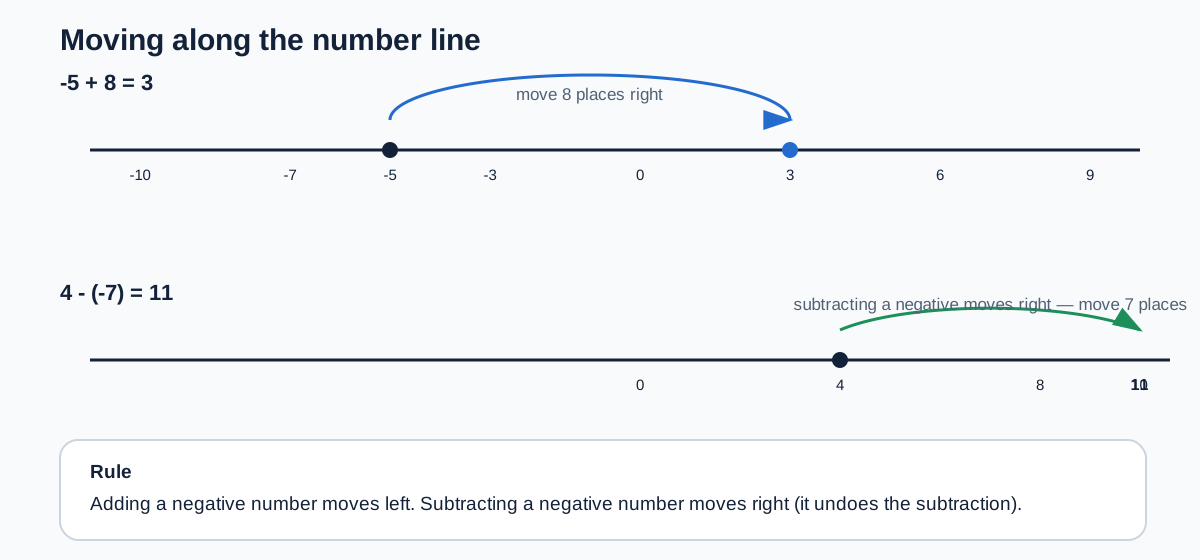
The first three feel natural once you picture them. The fourth is the one that trips students up, so it is worth dwelling on: subtracting a negative reverses the direction subtraction normally moves you, which sends you right instead of left — the same direction as adding a positive. This is why \(4-(-7)\) behaves exactly like \(4+7\): the two negative signs "cancel" the leftward movement into a rightward one.
2. Evaluating an addition
To evaluate \(-5+8\), start at \(-5\) on the number line and move 8 places to the right, since you are adding a positive 8. Moving from \(-5\) right by 8 lands on \(3\), so \(-5+8=3\). The size of the jump is always the second number; the direction is decided by whether that number is being added (and is positive) or added as a negative.
3. Evaluating a subtraction of a negative
To evaluate \(4-(-7)\), start at 4 and recognise that subtracting a negative number moves right, so you move 7 places to the right of 4, landing on \(11\). This gives \(4-(-7)=11\), the same answer you would get from \(4+7\). Whenever you see two signs sitting next to each other, such as \(-(-7)\) or \(+(-7)\), you can simplify them into a single sign first: two like signs together become a plus, two unlike signs together become a minus. So \(-(-7)\) becomes \(+7\), and \(4-(-7)\) becomes \(4+7=11\).
Worked example
Evaluate \(-9 - (-3) + (-2)\).
Simplify the signs first: \(-(-3)\) becomes \(+3\), and \(+(-2)\) stays as \(-2\), so the expression becomes \(-9+3-2\). Working left to right, \(-9+3\) is a move from \(-9\) right by 3, landing on \(-6\); then \(-6-2\) is a move from \(-6\) left by 2, landing on \(-8\). So \(-9-(-3)+(-2)=-8\).
A second worked example: temperature change
At midnight the temperature is \(-3^\circ\text{C}\). By 6 a.m. it has fallen a further \(5^\circ\text{C}\), and by midday it has risen \(11^\circ\text{C}\) from the 6 a.m. reading. To find the midday temperature, work through the changes one at a time rather than trying to combine everything at once. Falling \(5^\circ\text{C}\) from \(-3\) means adding a negative 5, which moves left from \(-3\) to \(-8\), so the 6 a.m. temperature is \(-8^\circ\text{C}\). Rising \(11^\circ\text{C}\) from \(-8\) means adding a positive 11, which moves right from \(-8\) by 11, landing on \(3\). So the midday temperature is \(3^\circ\text{C}\). Writing the whole calculation as one expression, \(-3-5+11=3\), matches what each individual movement gave.
Misconception checkpoint
- Subtracting a negative number does not make the answer smaller — it makes the answer larger, because it moves right, the same direction as adding.
- Two negative signs next to each other combine into a positive sign; they do not stay as "two negatives" in the working.
- The sign in front of a number belongs to that number. In \(-9+3-2\), the numbers being combined are \(-9\), \(+3\) and \(-2\).
Self-check
Evaluate -6 + 10
Start at -6 and move 10 places right.
Evaluate 3 - (-5)
Subtracting a negative is the same as adding: 3 + 5.
Why this matters
These skills appear constantly outside the classroom: a bank statement showing a payment reversal is a subtraction of a negative, a weather report describing a temperature "rising from \(-4^\circ\text{C}\) by \(9\) degrees" is an addition, and a lift or a mine shaft moving between floors above and below ground level uses exactly this number-line reasoning. Whenever a problem mentions "owed", "below", "reversed" or "the opposite of", it is worth pausing to check whether a double sign is hiding in the wording before you start calculating.
Independent study
A submarine at \(-40\) m rises by \(25\) m, then descends by \(60\) m. Write this as a single addition/subtraction expression, simplify any double signs, and find the submarine's final depth.
Session summary
Every addition or subtraction is a movement on the number line: adding a positive or subtracting a negative moves right; adding a negative or subtracting a positive moves left. Simplifying double signs before working left to right — two like signs become plus, two unlike signs become minus — turns any mixed expression into a straightforward chain of moves.
Further practice
No teacher notes have been added for this session.
No additional resources have been added for this session.
Lesson Discussion
Ask a question about this lesson. A teacher or admin can answer here.
Sign in to ask a question or save this lesson.
No questions yet for this lesson.