Session 44: Volume of Cuboids
Year 7 Mathematics: Term 1 · preview lesson
Lesson route
Estimated study time: 40–50 minutes
Learning goals
You will learn to:
- calculate the volume of a cuboid;
- understand volume as the number of unit cubes that fit inside a shape;
- find a missing dimension given the volume.
1. What volume measures
Volume measures the amount of 3D space a solid shape occupies, measured in cubic units (cm³, m³). One way to picture volume directly is to imagine filling a shape completely with unit cubes and counting how many fit inside.
2. Volume of a cuboid
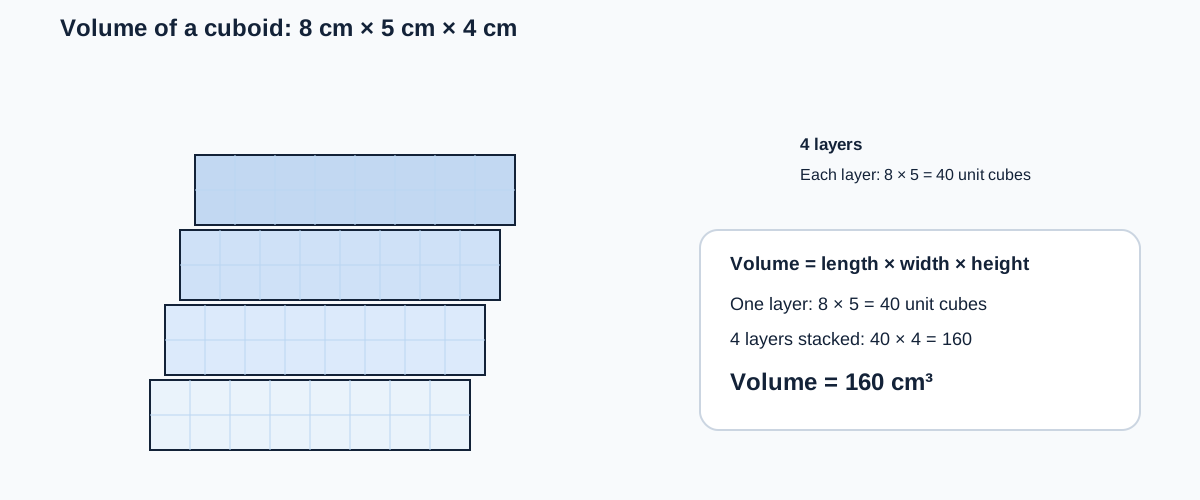
A cuboid's volume is found by multiplying all three dimensions together: \(V=l\times w\times h\). This matches the unit-cube picture exactly: one layer of the cuboid, matching its base, contains \(l\times w\) unit cubes; stacking \(h\) identical layers on top of each other gives a total of \(l\times w\times h\) unit cubes altogether.
3. Finding a missing dimension
If the volume and two dimensions are known, rearrange the volume formula into a one-step equation (Unit F) to find the missing dimension.
Worked example
Find the volume of a cuboid with length \(8\) cm, width \(5\) cm and height \(4\) cm.
Using the cuboid volume formula: \(V=l\times w\times h=8\times 5\times 4=160\text{ cm}^3\). Pictured as unit cubes, each of the 4 layers contains \(8\times 5=40\) unit cubes, and \(4\) layers give \(40\times 4=160\) unit cubes in total, matching the formula exactly.
A second worked example: finding a missing height
A cuboid has a volume of \(150\text{ cm}^3\), a length of \(10\) cm and a width of \(5\) cm. Find its height.
Substituting into the volume formula: \(150=10\times 5\times h\), which simplifies to \(150=50h\). Dividing both sides by 50: \(h=3\) cm. Checking: \(10\times 5\times 3=150\text{ cm}^3\), which matches.
Why this matters
Volume calculations like these sit behind everyday questions such as how much water a tank holds, how much soil fills a raised garden bed, or how many identical boxes fit inside a shipping container — anywhere three-dimensional space needs to be measured rather than just a flat surface. Recognising when a problem is asking for volume (a capacity, an amount of material, a "how much space") rather than area or perimeter is often the harder first step; the calculation itself is then just the length-times-width-times-height formula practised here.
Misconception checkpoint
- Volume is measured in cubic units (cm³, m³) — mixing this up with the square units used for area (Session 41) is a very common labelling error.
- All three dimensions must be multiplied together — stopping after multiplying only two of them gives an area, not a volume.
- When rearranging to find a missing dimension, divide by the product of the two known dimensions, not by just one of them.
Self-check
Find the volume of a cuboid with length 6 cm, width 4 cm and height 3 cm
Multiply all three dimensions together.
A cuboid has volume 96 cm³, length 8 cm and width 4 cm. Find its height
Divide the volume by the product of length and width.
Independent study
A water tank in the shape of a cuboid has length \(2\) m, width \(1.5\) m and height \(1\) m. Find its volume in cubic metres, then explain in one sentence what that volume represents in terms of unit cubes.
Session summary
A cuboid's volume is the product of its length, width and height, matching the picture of stacking unit-cube layers on top of one another. When the volume and two dimensions are already known, the remaining dimension is found by dividing the volume by the product of the other two.
Further practice
No teacher notes have been added for this session.
No additional resources have been added for this session.
Lesson Discussion
Ask a question about this lesson. A teacher or admin can answer here.
Sign in to ask a question or save this lesson.
No questions yet for this lesson.