Session 12: Equivalent Fractions and Simplifying
Year 7 Mathematics: Term 1 · preview lesson
Lesson route
Estimated study time: 40–50 minutes
Learning goals
You will learn to:
- generate equivalent fractions by multiplying or dividing;
- simplify a fraction to its lowest terms using the HCF;
- compare two fractions by converting them to a common denominator.
1. What makes fractions equivalent
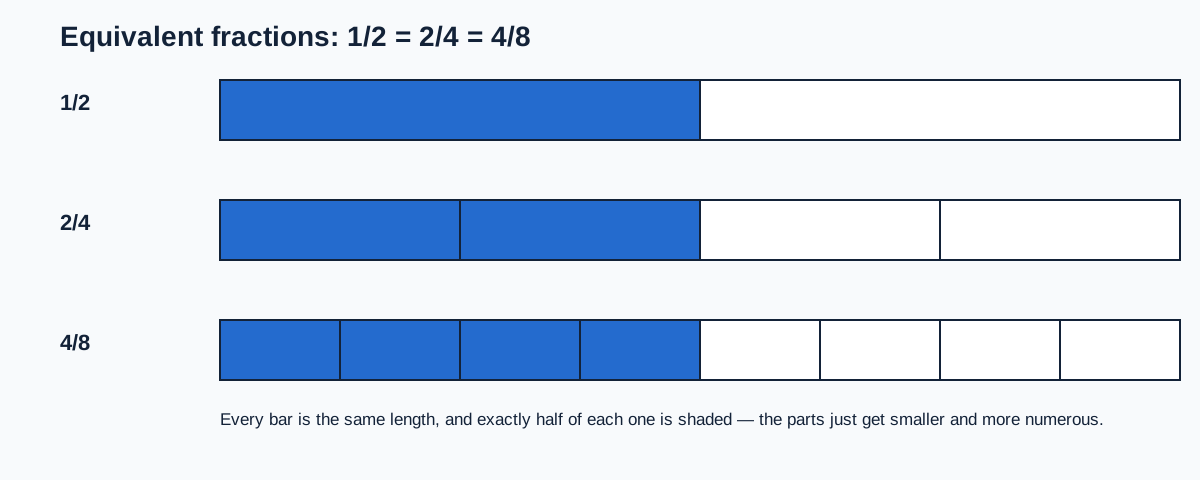
Equivalent fractions represent the same amount, written with different numerators and denominators. Multiplying (or dividing) both the numerator and the denominator of a fraction by the same nonzero number never changes its value, because you are really multiplying the whole fraction by \(\frac{n}{n}\), which is worth exactly 1. Starting from \(\frac{1}{2}\) and multiplying top and bottom by 2 gives \(\frac{2}{4}\); multiplying by 4 instead gives \(\frac{4}{8}\) — all three fractions describe the same amount, just split into differently sized pieces.
2. Simplifying using the HCF
A fraction is in its lowest terms (fully simplified) when its numerator and denominator share no common factor other than 1. The fastest way to simplify is to find the HCF of the numerator and denominator (Session 9) and divide both by it in one step, rather than dividing repeatedly by small numbers.
3. Comparing fractions with a common denominator
Fractions with different denominators cannot be compared directly, because their "pieces" are different sizes. To compare them fairly, convert both fractions to equivalent fractions that share a common denominator — the LCM of the two denominators (Session 10) — and then compare the numerators directly.
Worked example
Simplify \(\frac{18}{24}\) to its lowest terms, then compare \(\frac{3}{5}\) and \(\frac{5}{8}\) to decide which is larger.
The HCF of 18 and 24 is 6 (shared primes: \(18=2\times 3^2\), \(24=2^3\times 3\), giving HCF \(=2\times 3=6\)). Dividing both numerator and denominator by 6: \(18\div 6=3\) and \(24\div 6=4\), so \(\frac{18}{24}=\frac{3}{4}\), which cannot be simplified further since 3 and 4 share no common factor other than 1.
To compare \(\frac{3}{5}\) and \(\frac{5}{8}\), find the LCM of 5 and 8, which is 40 (they share no common factor, so the LCM is simply \(5\times 8\)). Converting each fraction to fortieths: \(\frac{3}{5}=\frac{24}{40}\) (multiplying top and bottom by 8), and \(\frac{5}{8}=\frac{25}{40}\) (multiplying top and bottom by 5). Since \(25>24\), \(\frac{5}{8}>\frac{3}{5}\).
A second worked example: ordering three fractions
Order \(\frac{5}{6}\), \(\frac{3}{4}\) and \(\frac{7}{12}\) from smallest to largest. First find a common denominator for all three: the LCM of 6, 4 and 12 is 12, since 12 is already a multiple of both 6 and 4. Converting each fraction to twelfths: \(\frac{5}{6}=\frac{10}{12}\), \(\frac{3}{4}=\frac{9}{12}\), and \(\frac{7}{12}\) is already in twelfths. Comparing the numerators \(10\), \(9\) and \(7\) directly, the order from smallest to largest is \(\frac{7}{12}<\frac{3}{4}<\frac{5}{6}\). This is exactly the same idea used to order integers on a number line in Session 2 — once every value is expressed in the same units, ordering is just a matter of comparing size directly.
Misconception checkpoint
- Multiplying or dividing only the numerator, or only the denominator, changes the value of the fraction — both must be treated together.
- A fraction is not "wrong" if it isn't simplified, but leaving it unsimplified can make later working (adding, comparing) unnecessarily difficult.
- To compare fractions, both fractions need the same denominator — comparing numerators of fractions with different denominators (like assuming \(\frac{3}{5}>\frac{5}{8}\) just because \(3<5\)) gives the wrong answer.
Self-check
Simplify 20/28 to its lowest terms
Find the HCF of 20 and 28, then divide both numbers by it.
Which is larger, 2/3 or 5/9?
Convert 2/3 to ninths using a common denominator, then compare numerators.
Independent study
Write three fractions equivalent to \(\frac{4}{5}\) by multiplying top and bottom by 2, 3 and 10. Then use a common denominator to decide whether \(\frac{7}{10}\) or \(\frac{4}{5}\) is larger.
Session summary
Multiplying or dividing a fraction's numerator and denominator by the same number produces an equivalent fraction with the same value. Dividing both by their HCF simplifies a fraction to lowest terms in one step. To compare two fractions fairly, convert them to a shared denominator — their LCM — so that only the numerators need to be compared.
Further practice
No teacher notes have been added for this session.
No additional resources have been added for this session.
Lesson Discussion
Ask a question about this lesson. A teacher or admin can answer here.
Sign in to ask a question or save this lesson.
No questions yet for this lesson.